What Is the Best Recovery Indicator for Overtraining?
TL;DR
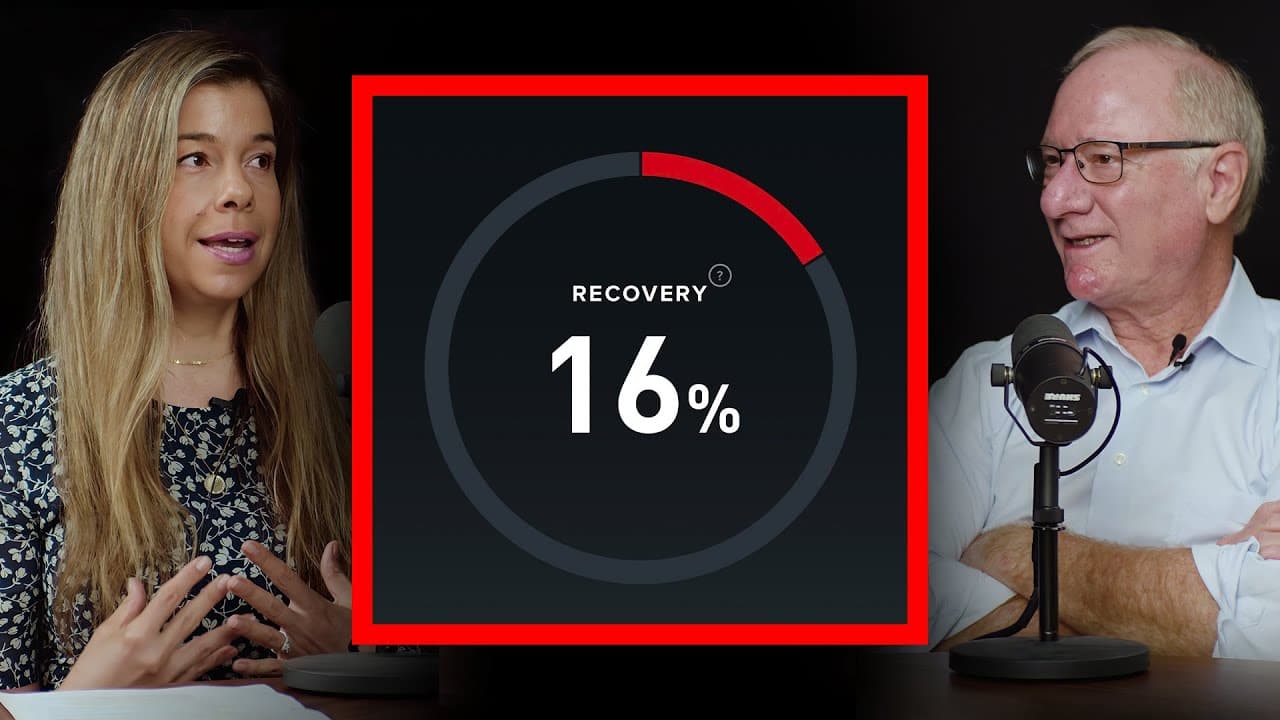
Early morning resting heart rate is the most reliable indicator of recovery and overtraining. When resting heart rate climbs, it signals you need shorter or less frequent intensity sessions and more rest. Heart rate variability is too technique-dependent and variable, even under lab conditions, to reliably track training status.
Transcript
what about I've heard you talk about recovery and Recovery days being as as important as how much load you're putting on right your heart and so how much training essentially um I'm curious what you mean by that right so so recovery is a essential part of training and I I think most athletes and coaches understand that but but it's a way that many ... Read More
Key Insights
- Recovery is an essential part of training because the body needs time for adaptations to fully express, including muscle protein production and new blood vessel growth driven by hypoxia inducible factor through VEGF after a training stimulus.
- Overtraining becomes a trap when athletes who aren't performing well decide to train harder, creating a vicious cycle of increasing overtraining rather than allowing the body adequate recovery to reap training benefits.
- Early morning resting heart rate is the best overtraining indicator, identified across more than a decade studying altitude training for USA Track and Field and the US Olympic Committee. A climbing resting heart rate signals the need to reduce intensity.
- Wrist heart rate watches are accurate at rest, but PPG plethysmogram-based watches are not accurate during exercise, so resting measurement taken in the five minutes before waking is the reliable approach.
- Good coaches always incorporate an easy session after a high-intensity session and include a day off, which can be strength training, technical work, watching film, or shooting free throws, as long as it is easy and unstressed.
- The five-zone model is anchored to the maximal steady state (zone three, threshold), the highest sustainable level where lactate sits in the 2 to 4 millimolar range and most good marathon runners race.
- Critical power (zone four) is the highest intensity sustainable without drifting toward VO2 max, and it is extraordinarily delicate. For Kipchoge's sub-two-hour marathon attempt, one or two watt differences separated sustainability from failure.
- Heart rate variability is unreliable because it depends heavily on uncontrolled respiratory rate. Even controlling every factor in the lab, day-to-day variability stays at plus or minus 25 percent, so it shouldn't be used as an indicator.
Install to Summarize YouTube Videos and Get Transcripts
Explore YouTube Video Summarizer or Get YouTube Transcript Extractor
Questions & Answers
Q: What is the best indicator of recovery and overtraining?
Early morning resting heart rate is the best indicator, according to more than a decade of altitude training studies for USA Track and Field and the US Olympic Committee. Athletes put on a heart rate monitor at rest, even going back to sleep, and track it for the five minutes before waking. As you become overtrained, resting heart rate starts to climb, signaling the need to reduce intensity session frequency, shorten sessions, or add more recovery.
Q: Why is recovery just as important as training load?
Recovery is essential because reaping the benefits of a training stimulus requires the body to do work beneath the skin: muscles produce protein, blood vessels form through the oxygen-sensing cascade from hypoxia inducible factor through VEGF, the endothelium improves, and muscle fibers are added and enlarged. If you don't allow these adaptations their full expression, you won't get the benefit of the workout you performed. Without adequate recovery, athletes stop improving despite training more.
Q: What should a recovery or off day actually look like?
A recovery day should involve something easy and unstressed. Good coaches incorporate an easy session after every high-intensity session and include a day off each week. That off day can be strength training, technical training, watching film, or shooting free throws if you're a basketball player. If you normally train in zones three, four, or five, a recovery effort would drop to zone one, below the lower limits of zone two.
Q: Why doesn't Dr. Levine think heart rate variability is useful?
Heart rate variability is too technique-dependent and variable to be a reliable indicator. Most HRV measured by consumer heart rate devices reflects high-frequency variability that is absolutely dependent on respiratory rate, which no device controls. Breathing at six breaths per minute markedly increases HRV, while faster breathing separates the rhythms. Even controlling every factor in the lab, day-to-day variability stays at plus or minus 25 percent, so the science isn't there to use it as an indicator of anything.
Q: What are the five training zones based on heart rate?
The five-zone model is anchored to the maximal steady state. Using an example maximum steady state at 155 beats, zone three (threshold) is 150 to 160, zone two is about 20 beats below at 130 to 150, and zone one (recovery) is less than 130. With a max heart rate of 180, zone four is 160 to 170 and zone five is 170 to 180. There is no magic to heart rate, and it changes day to day.
Q: What is the maximal steady state in endurance training?
The maximal steady state is the highest intensity level you can sustain for a prolonged period. It is identified where the second ventilatory threshold occurs, ventilation rises disproportionately to oxygen uptake, VE/VCO2 reaches its nadir, and lactate sits between 2 to 4 millimolar. These markers all reflect the same threshold. Most good marathon runners run at the maximal steady state, which corresponds to zone three or threshold training.
Q: How do training zones relate to race distances?
Zone three, the maximal steady state, corresponds roughly to marathon pace, and combining zone three heart rate with running economy lets a physiologist predict marathon time. Zone four is about 10K pace, sustainable for roughly 45 minutes to an hour but not after a full marathon. Zone five is VO2 max effort, used for 5K and shorter distances. You cannot run 10 meters per second for a marathon or even a 5,000 meters, though that pace is still zone five.
Q: What is critical power and why is it hard to measure?
Critical power (zone four) is the highest intensity you can sustain without failure, without a drift toward VO2 max. It is extraordinarily delicate and hard to pinpoint, requiring repeat lab testing. When Kipchoge attempted the sub-two-hour marathon, working with Andy Jones and Mike Joiner, one or two watt differences separated sustainability from failure. Andy Jones's work even uses MR magnets to examine phosphocreatine ratios and hydrogen ions. Elite East African runners spend so much time training partly to learn exactly where their zone four sits.
Summary & Key Takeaways
-
Recovery is essential to training because adaptations like muscle protein synthesis and new blood vessel formation through the oxygen-sensing cascade must fully express after a stimulus. Athletes who respond to poor performance by training harder fall into a vicious overtraining cycle instead of allowing the body to benefit.
-
Across more than a decade of altitude training studies for USA Track and Field and the US Olympic Committee, early morning resting heart rate proved the best overtraining indicator. A rising resting heart rate signals the athlete should reduce intensity frequency, shorten sessions, or take a recovery day of light zone one effort.
-
Heart rate variability is driven mainly by respiration and slower intrinsic circulatory rhythms, but consumer devices don't control breathing rate, which dominates high-frequency variability. Even under fully controlled lab conditions, day-to-day variability stays around plus or minus 25 percent, making HRV too technique-dependent to serve as a useful training or overtraining indicator.
Read in Other Languages (beta)
Share This Summary 📚
Summarize YouTube Videos and Get Video Transcripts with 1-Click
Try YouTube Summary with ChatGPT & Claude or YouTube Transcript Generator
Explore More Summaries from FoundMyFitness Clips 📚





Summarize YouTube Videos and Get Video Transcripts with 1-Click
Try YouTube Summary with ChatGPT & Claude or YouTube Transcript Generator