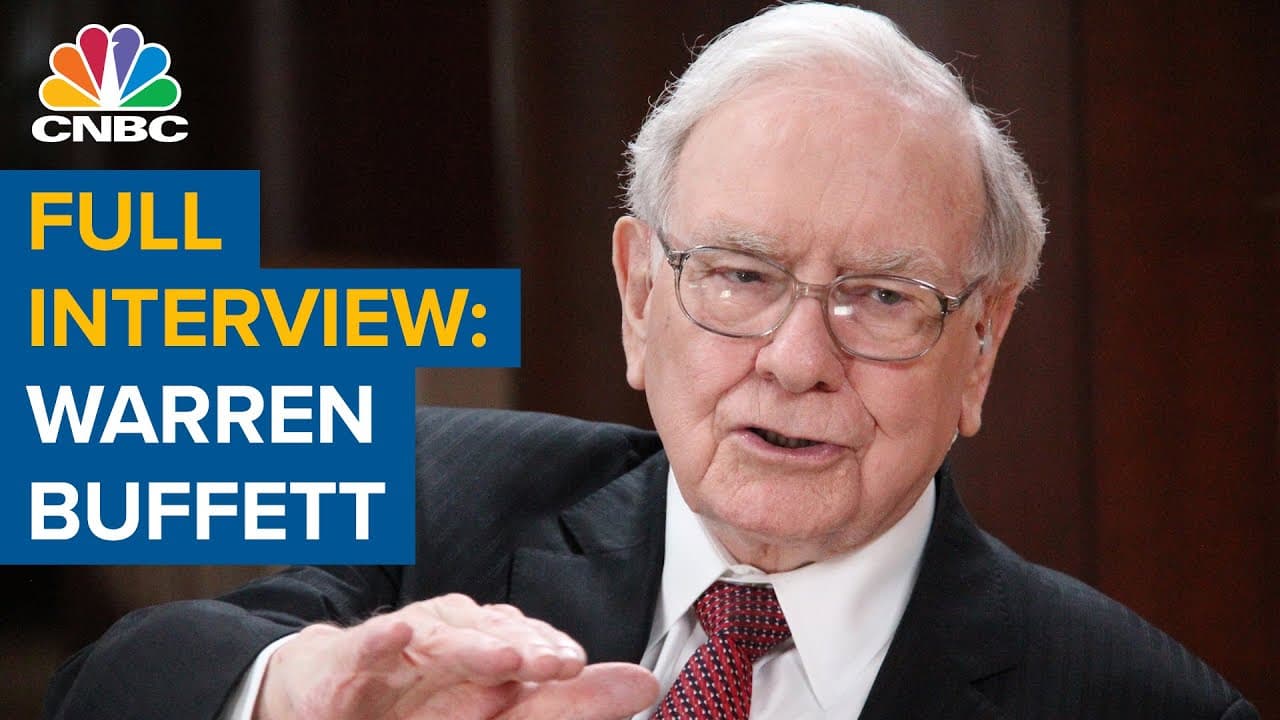
How Does Berkshire Hathaway CEO Warren Buffett Invest During a Market Decline? CNBC Full Interview
TL;DR
Warren Buffett says investors should treat stocks as businesses and ask whether their 10- or 20-year outlook has changed, rather than reacting to daily headlines. He argues that nobody can reliably predict short-term market moves, while a lower price can benefit buyers who understand a company’s future earning power. Read on for his practical test for evaluating a stock purchase during a decline.
Transcript
We are here in Omaha, Nebraska this morning with Warren Buffett, the chairman and CEO of Berkshire Hathaway. He's just released his 55th annual shareholder letter to uh to the shareholders over this weekend. And this is actually the 13th year that we are now in Omaha talking to him after that letter. This is a show that we call Ask Warren so that p... Read More
Key Insights
- Stocks are ownership interests in businesses, so investors should think in terms of buying a company rather than trading a ticker. That perspective encourages analysis of future earnings and supports holding periods of 10, 20, or 30 years instead of reactions to daily quotations.
- The key question during a market decline is whether the long-term outlook for American businesses has materially changed. A sharp move caused by current headlines may create an opportunity to buy a desirable business more cheaply if its future earning power remains intact.
- Short-term market movements are not reliably predictable, according to Buffett. Waiting because a stock might become 10% cheaper requires repeated, accurate forecasts, while investors can make a more grounded judgment about whether a business represents an intelligent purchase at its current price.
- A stock purchase should be supported by a concise written case that explains why the whole company is worth its implied market value. Buffett illustrates this by asking whether an investor could justify buying General Motors at a hypothetical valuation of $42 billion.
- Economic slowdowns are inevitable and do not automatically make strong businesses poor investments. Buffett notes that General Motors endured exceptionally weak sales in 1932, yet he describes that period as a terrific time to buy, illustrating the difference between temporary conditions and long-term value.
- Retained earnings are a major source of long-term shareholder wealth because companies can reinvest them in additional earning power or use them to repurchase shares. Buffett says Berkshire became much more valuable by retaining earnings rather than relying only on dividends received by shareholders.
- A good investment idea can become dangerous when changing prices invalidate its original conditions. Edgar Lawrence Smith’s stock argument assumed stocks and bonds had comparable yields, but rising stock prices in the 1920s changed that relationship even as investors continued following the original conclusion.
- Stocks were more attractive than 30-year bonds under the conditions Buffett described because such bonds yielded 2%, equivalent to paying 50 times fixed earnings that could not grow for 30 years. Still, he emphasizes that either stocks or bonds can be good or bad purchases depending on price.
Install to Summarize YouTube Videos and Get Transcripts
Explore YouTube Video Summarizer or Get YouTube Transcript Extractor
Questions & Answers
Q: How should investors respond when the stock market falls sharply?
Investors should ask whether the decline has changed the business’s outlook over the next 10 or 20 years. Buffett says that if a company remains desirable, the opportunity to buy it more cheaply is good luck rather than a reason to panic.
Q: Why does Warren Buffett say investors should view stocks as businesses?
Calling a stock a business directs attention toward its future earning power instead of its daily quotation. Buffett compares the decision with buying a farm, apartment house, or service station that an owner expects to hold for 10, 20, or 30 years.
Q: Can investors predict whether stocks will be cheaper next week or next month?
Buffett says he does not think anybody knows what the market will do. Waiting for a possible 10% discount requires successful short-term predictions, while investors can instead judge whether they are making an intelligent purchase at the current price.
Q: How can an investor decide whether a stock is worth buying?
Buffett suggests writing down why the entire company is worth the valuation implied by its share price. Using General Motors as an example, he multiplies a hypothetical $30 share price by 1.4 billion shares to produce a $42 billion valuation that the buyer should be able to justify.
Q: Should economic weakness stop someone from buying stocks?
Not automatically, because temporary weakness does not necessarily determine a company’s long-term earning power. Buffett notes that General Motors experienced extremely weak sales in 1932, yet he describes that period as a terrific time to buy the company.
Q: Why does Buffett advise investors to ignore daily market headlines?
Daily newspapers cannot reliably reveal whether the market will rise or fall. Buffett says investment decisions should instead rest on the business’s location, suppliers, competition, price, and expected earning power over the next 10, 20, or 30 years.
Q: What should investors examine before buying a business or stock?
They should examine the business’s future earning power and whether the purchase price offers their money’s worth. Buffett also points to practical factors such as location, supplier contracts, and competition when describing how someone would evaluate a local service station.
Q: What examples does Buffett give of long-term business ownership?
Buffett says Berkshire Hathaway had owned American Express for 20 years and Coca-Cola for 40 years. He uses those holdings to illustrate why investors should think like business owners rather than buy or sell because of current headlines.
Summary & Key Takeaways
-
Buffett argues that buying a stock should be treated like buying an entire business, farm, apartment house, or service station. Investors should evaluate future earning power, competitive position, suppliers, and price. The central question during a sudden decline is whether the business’s outlook over decades has actually changed.
-
Market timing is unreliable because neither Buffett nor anyone he has met can consistently predict short-term movements. An investor should instead write down why an entire company is worth its market value. Daily newspapers, headlines, and temporary economic slowdowns cannot replace analysis of the underlying business and its long-term earning capacity.
-
Retained earnings help stocks compound because companies can use undistributed profits to expand earning power or repurchase shares, increasing each remaining owner’s interest. However, a sound insight can produce excess when investors ignore price. Stocks may offer more value than bonds, but either asset can become attractive or unattractive depending on its price.
Read in Other Languages (beta)
Share This Summary 📚
Summarize YouTube Videos and Get Video Transcripts with 1-Click
Try YouTube Summary with ChatGPT & Claude or YouTube Transcript Generator
Explore More Summaries from CNBC Television 📚




Summarize YouTube Videos and Get Video Transcripts with 1-Click
Try YouTube Summary with ChatGPT & Claude or YouTube Transcript Generator