Why Bet on Tesla and Elon Musk Long Term?
TL;DR
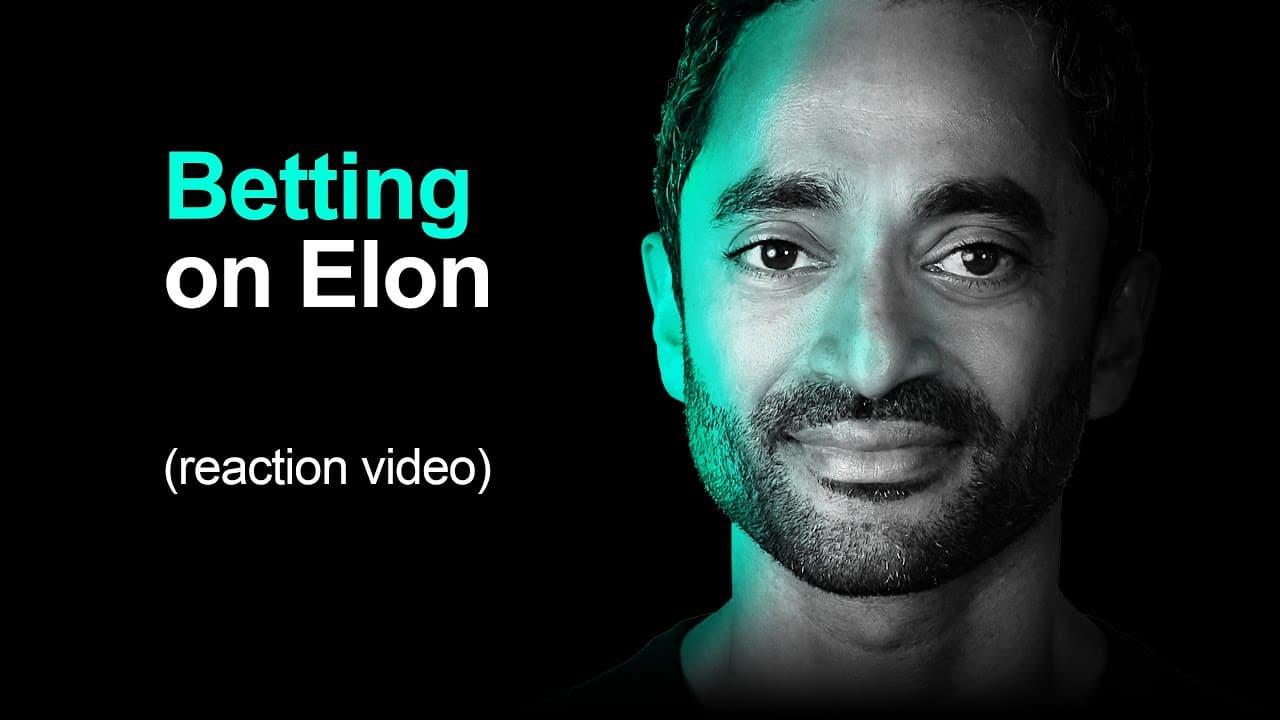
Tesla’s long-term investment case rests on Model 3 demand, product execution, and Elon Musk’s demonstrated technical ability, not quarterly volatility or controversial tweets. Chamath Palihapitiya argues that investors should separate operational substance from media noise, evaluate results across three to five years, and consider convertible bonds when seeking greater downside protection than common stock provides.
Transcript
Hey, I'm Steven and this is Solving the Money Problem. If you're new, welcome. If you're not, welcome back. So today, we're doing another reaction video. This one actually aired almost a year ago with Tesla stock in the low 200s. Can you believe it? I thought it was great to revisit this one because I think Chamath handled himself brilliantly, made... Read More
Key Insights
- Tesla’s long-term case is based on execution across three to five years, rather than precise quarter-to-quarter performance. The discussion argues that investors who concentrate on recent headlines and short-term price movements can overlook progress toward a company’s broader product and commercialization goals.
- Elon Musk’s technical ability is presented as evidence supporting confidence in his companies. Chamath Palihapitiya points to rockets performing useful work in space and landing on an ocean platform as an illustration of unusually sophisticated engineering execution.
- The Model 3 is described as Tesla’s equivalent of an iPhone moment. It represented the mass-market product that could unlock substantial product-market fit after years of company growth, risk-taking, product development, and efforts to commercialize electric transportation.
- Tesla’s product experience is portrayed as more important than controversy surrounding Musk’s style. Palihapitiya argues that sitting inside a Model 3 changes a buyer’s expectations and makes competing vehicles appear to lack features that Tesla already offers.
- Convertible bonds provided Palihapitiya with a protected way to back Musk’s execution. He explains that the securities sat above equity and other debt, meaning holders would be paid first if Tesla faced liquidity problems or had to be sold.
- Tesla’s common stock was described as vulnerable to financial manipulation. Palihapitiya attributed its volatility to hedge funds, online promotion, criticism, and extensive forum or Twitter activity rather than control by Tesla’s founder, executives, or other company insiders.
- Musk’s missed targets are framed as acceptable within a longer performance horizon. The argument is that aggressive forecasts should be assessed against what Tesla accomplishes over five years, not treated as decisive evidence based on a single missed number or deadline.
- Established automakers are not considered credible electric-vehicle competitors merely because they advertise upcoming models. The commentator argues that meaningful evidence would require firm commitment to stop producing internal-combustion vehicles after a stated date and make every subsequent vehicle electric.
Install to Summarize YouTube Videos and Get Transcripts
Explore YouTube Video Summarizer or Get YouTube Transcript Extractor
Questions & Answers
Q: Why did Chamath Palihapitiya bet on Elon Musk?
Chamath Palihapitiya based his confidence on Elon Musk’s demonstrated technical execution across companies. He highlighted the difficulty of sending a rocket into space, performing useful tasks there, returning it, and landing it on a boat in the ocean. He viewed this record, together with Tesla’s progress commercializing electrification and the Model 3, as evidence of exceptional ability rather than ordinary promotional ambition.
Q: Why was the Tesla Model 3 considered an inflection point?
The Model 3 was considered an inflection point because it was Tesla’s mass-market product after years of growth and risk-taking. Palihapitiya compared the moment to the iPhone’s importance for its company, arguing that the Model 3 could unlock substantial product-market fit. Its price point, user experience, and consumer demand supported the view that Tesla was moving into a more mature commercial phase.
Q: How should investors evaluate Tesla’s performance?
The discussion recommends evaluating Tesla over a three-to-five-year horizon rather than demanding smooth quarter-to-quarter results. Musk may issue aggressive forecasts and sometimes miss them, but the proposed test is whether Tesla fulfills its broader promises and advances its plans over several years. This approach emphasizes product demand, technological progress, commercialization, and cumulative execution instead of short-term headlines or isolated forecasting errors.
Q: Why did Chamath prefer Tesla convertible bonds to common stock?
Chamath preferred convertible bonds because he believed they offered downside protection while preserving exposure to Musk’s execution. He said the securities sat above equity and other debt, so their holders would be paid first if Tesla encountered liquidity difficulties or needed to be sold. He characterized the position as a protected option on someone he regarded as the Edison of his generation.
Q: What Tesla information did the interview treat as noise?
The interview treated controversial tweets, Musk’s personal matters, media sniping, online hype, and short-term stock movements as noise when they did not change Tesla’s underlying operations. Palihapitiya acknowledged that Musk may sometimes step out of bounds, but argued that investors should focus on vehicle demand, customer experience, technical execution, and progress toward commercialization when deciding whether to buy or sell.
Q: Why did Musk’s missed targets not invalidate the investment thesis?
Musk’s missed targets did not invalidate the thesis because Palihapitiya evaluated results across years rather than individual reporting periods. He argued that Musk sets aggressive objectives, works toward them, and may miss some numbers, yet can still deliver substantial progress over a five-year span. The relevant question is whether consumers, humanity, and the planet become better off as the broader plans are executed.
Q: What evidence supported the claim that Tesla had strong demand?
The interview cited tens of thousands of consumers buying Tesla vehicles faster than they could obtain them. Palihapitiya also described the Model 3 as an incredible car and said its interior experience permanently changed what users expected from vehicles. These observations were used to argue that product demand and customer experience mattered more to Tesla’s investment case than disputes about Musk’s communication style.
Q: When would traditional automakers become credible Tesla competitors?
The commentator argues that announcing or advertising an electric model is insufficient evidence of meaningful competition. He would look for an established automaker to commit fully by naming a date after which it would stop producing internal-combustion vehicles and by declaring that every new vehicle thereafter would be electric. Such a commitment would represent the first credible sign that traditional manufacturers intended to compete seriously.
Summary & Key Takeaways
-
Chamath Palihapitiya compares Elon Musk’s achievements to an extraordinarily difficult golf shot, citing his ability to send rockets into space and land them on an ocean platform. He views that technical sophistication across companies as evidence that Musk can execute ambitious plans, even when individual forecasts or deadlines are missed.
-
Tesla appeared to be reaching an iPhone-like inflection point because the Model 3 offered a mass-market product capable of unlocking substantial product-market fit. The argument emphasizes strong consumer demand, a distinctive user experience, and Tesla’s progress commercializing electrification rather than judging the company solely through quarter-to-quarter precision.
-
The investment thesis separates Tesla’s operational substance from controversies surrounding Musk’s communication style. Palihapitiya favored convertible bonds for their priority over equity and other debt, while the commentator bought common stock as its price declined. Both perspectives rely on long-term execution and reject media noise as the primary valuation lens.
Read in Other Languages (beta)
Share This Summary 📚
Summarize YouTube Videos and Get Video Transcripts with 1-Click
Try YouTube Summary with ChatGPT & Claude or YouTube Transcript Generator
Explore More Summaries from Solving The Money Problem 📚
Summarize YouTube Videos and Get Video Transcripts with 1-Click
Try YouTube Summary with ChatGPT & Claude or YouTube Transcript Generator