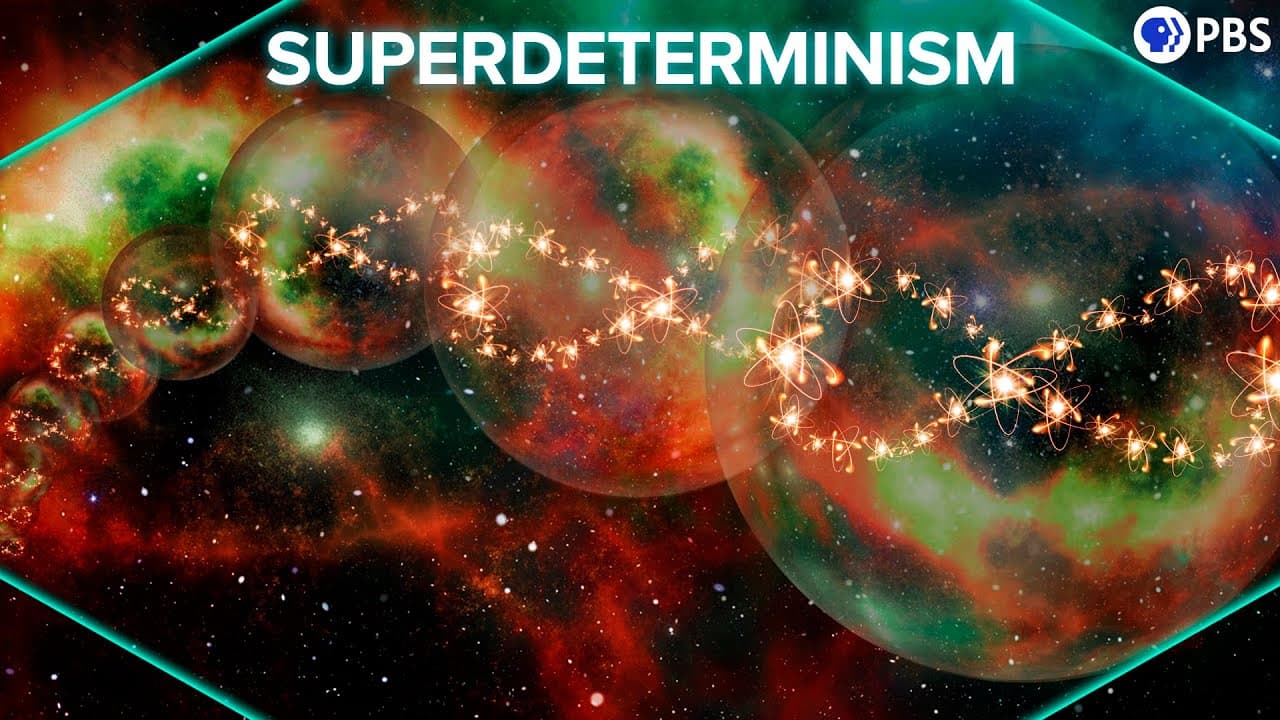
What If We Live in a Superdeterministic Universe?
TL;DR
Exploring superdeterminism's role in quantum mechanics and its implications on free will.
Transcript
Today we’re going to try to save reality
- or at least save realism. Actually just local realism. However this rescue effort has a price and one that you may not be willing to pay. According to some your free will is at stake. On its most elementary scale the universe exists in a state of fundamental indeterminacy. Photons passing through two slits... Read More
Key Insights
- Superdeterminism offers a potential resolution to the EPR paradox by suggesting that the universe's evolution is predetermined, challenging the notion of free will.
- Quantum mechanics introduces the concept of wavefunction collapse, where measurement determines a system's state, leading to debates about realism and observation.
- Albert Einstein and Erwin Schrodinger were proponents of realism, opposing the observer-dependent nature of quantum mechanics as highlighted in the EPR paradox.
- Bell's theorem and subsequent tests, like those by Alain Aspect, have shown violations of the Bell inequality, supporting quantum entanglement and challenging local realism.
- The cosmic Bell test, using distant stars and quasars, pushes the boundaries of testing local realism, suggesting that any local-realist influences are implausible.
- Superdeterminism posits that all events, including human decisions, are predetermined, raising philosophical questions about free will and the nature of reality.
- The Many Worlds interpretation and other theories attempt to reconcile quantum mechanics with realism, but often at the cost of introducing multiple realities.
- The debate over superdeterminism continues, with physicists like Sabine Hossenfelder advocating its potential as a clean solution to quantum paradoxes.
Install to Summarize YouTube Videos and Get Transcripts
Explore YouTube Video Summarizer or Get YouTube Transcript Extractor
Questions & Answers
Q: What is the EPR paradox, and how does it challenge quantum mechanics?
The EPR paradox, proposed by Einstein, Podolsky, and Rosen, challenges the observer-dependent nature of quantum mechanics. It suggests that if quantum mechanics were complete, it would allow for 'spooky action at a distance,' where entangled particles affect each other instantaneously, violating the cosmic speed limit of light. This paradox questions whether reality is fundamentally subjective or if there's an underlying realism.
Q: How does superdeterminism propose to resolve the EPR paradox?
Superdeterminism suggests that the universe's evolution is entirely predetermined, including the decisions of observers like Alice and Bob in the EPR paradox. This means that their choices are not independent but rather part of a preordained cosmic plan. By proposing that everything is causally connected, superdeterminism offers a resolution to the paradox without violating local realism.
Q: What role does Bell's theorem play in the debate over realism in quantum mechanics?
Bell's theorem provides a mathematical framework to test the predictions of quantum mechanics against local realism. It suggests that if local realism holds, certain inequalities (Bell inequalities) should be satisfied. Experiments, such as those by Alain Aspect, have shown violations of these inequalities, supporting the non-locality and entanglement predicted by quantum mechanics, thereby challenging local realism.
Q: What are cosmic Bell tests, and what do they aim to prove?
Cosmic Bell tests aim to push the boundaries of testing local realism by using distant astronomical objects, like stars and quasars, as random number generators for measurement settings. These tests seek to eliminate any potential local-realist influences by ensuring that the choices of measurement are causally independent from the measured particles, thus reinforcing the non-local predictions of quantum mechanics.
Q: How does the Many Worlds interpretation address the challenges of quantum mechanics?
The Many Worlds interpretation suggests that all possible outcomes of quantum measurements actually occur, each in its own separate universe. This interpretation retains local realism by proposing multiple, parallel realities where every possibility is realized. While it resolves some paradoxes, it introduces the controversial idea of an infinite number of coexisting universes.
Q: What philosophical implications does superdeterminism have on free will?
Superdeterminism implies that all events, including human decisions, are predetermined by the universe's initial state and laws of physics. This raises profound philosophical questions about the nature of free will, suggesting that our perceived choices are merely illusions, as they are part of a preordained cosmic sequence, challenging our understanding of autonomy and agency.
Q: Why do some physicists, like Sabine Hossenfelder, support superdeterminism?
Physicists like Sabine Hossenfelder support superdeterminism because it offers a coherent solution to the EPR paradox without abandoning realism or locality. They argue that it provides a simpler, more elegant explanation for quantum correlations by suggesting that all events are causally connected, avoiding the need for multiple realities or non-local influences.
Q: What challenges do experiments face in testing the validity of superdeterminism?
Testing superdeterminism is challenging because it requires proving true statistical independence in measurement settings, which is practically impossible. Any two points in the universe have overlapping past light cones, meaning they are causally connected. Thus, ensuring that measurement choices are truly independent of the measured particles is a significant experimental hurdle.
Summary & Key Takeaways
-
The discussion revolves around superdeterminism, a theory suggesting that the universe's evolution is predetermined, potentially resolving the EPR paradox and challenging the concept of free will. Quantum mechanics, with its wavefunction collapse, raises questions about reality's observer-dependence.
-
Einstein and Schrodinger opposed the observer-centric view of quantum mechanics, advocating for realism. Bell's theorem and experiments like Alain Aspect's have shown violations of the Bell inequality, supporting entanglement and questioning local realism.
-
Cosmic Bell tests using distant stars and quasars challenge local realism further, implying any local-realist influences are unlikely. Superdeterminism suggests all events are predetermined, raising philosophical questions about free will and reality's nature.
Read in Other Languages (beta)
Share This Summary 📚
Summarize YouTube Videos and Get Video Transcripts with 1-Click
Try YouTube Summary with ChatGPT & Claude or YouTube Transcript Generator
Explore More Summaries from PBS Space Time 📚


Summarize YouTube Videos and Get Video Transcripts with 1-Click
Try YouTube Summary with ChatGPT & Claude or YouTube Transcript Generator