How to Make a DIY Catapult with Popsicle Sticks
TL;DR
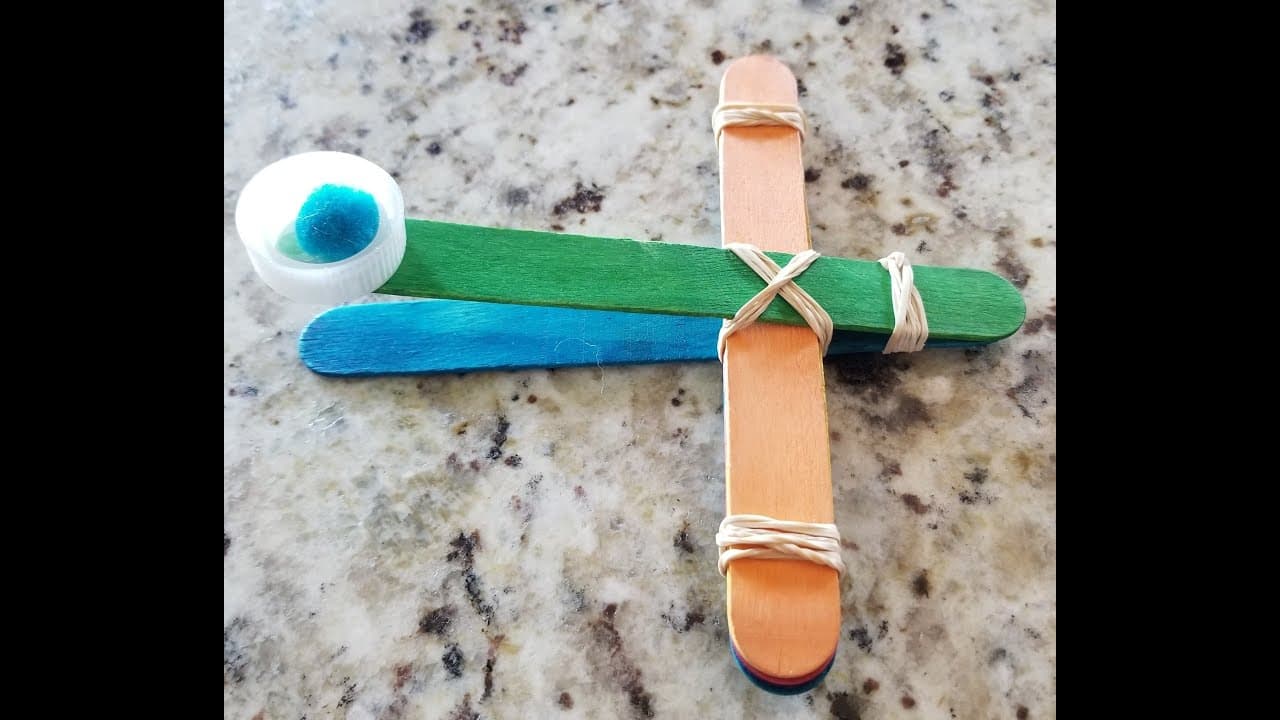
To make a DIY catapult using popsicle sticks, stack five craft sticks and secure them with rubber bands. Attach a water bottle cap to a single stick, create a V-shape with another stick, and assemble the parts to launch small projectiles like pom poms or marshmallows, demonstrating the physics of stored energy.
Transcript
hi i'm ellie from rancho bernardo library i've got a great project for us today we've got a little bit of history a little bit of physics and a whole lot of fun today we're going to talk about our catapult a catapult might look something like this and it was used since ancient times in warfare the physics part of this is that the stored energy got ... Read More
Key Insights
- 🤑 Catapults have a rich history in warfare, showcasing the early utilization of stored energy for launching projectiles.
- 🏪 Understanding the physics behind catapults involves grasping concepts related to stored energy and its rapid release to propel objects forward.
- 🤗 Building a DIY catapult can be a fun and educational project, combining elements of history, physics, and hands-on experimentation.
- 🏪 By launching various projectiles with the catapult, one can observe the practical application of stored energy release in action.
- 🤕 The design of a catapult involves strategic placement of tensioned components like rubber bands to ensure effective energy transfer to the projectile.
- 🅰️ Visiting sites like Warwick Castle in England can provide insight into trebuchets, a more complex type of catapult, and their historical significance.
- 💨 Modern technology, such as aircraft carrier launch systems, showcases how the concept of stored energy release has been adapted and utilized in innovative ways.
Install to Summarize YouTube Videos and Get Transcripts
Explore YouTube Video Summarizer or Get YouTube Transcript Extractor
Questions & Answers
Q: What is the historical significance of catapults?
Catapults have been used in warfare since ancient times to launch projectiles and were crucial in sieges and battles, demonstrating the early applications of stored energy in warfare.
Q: How does a catapult work in terms of physics?
A catapult stores energy in its tensioned components, such as rubber bands, and releases it rapidly, transferring that energy to the projectile to launch it forward, following the principles of physics.
Q: What are some modern applications of stored energy release similar to catapults?
Modern aircraft carriers utilize stored energy release mechanisms to launch airplanes off their decks, showcasing how ancient concepts like catapults have evolved and found new uses in contemporary technology.
Q: What are the key components used to build a basic DIY catapult?
Building a DIY catapult typically involves materials like popsicle sticks, rubber bands, and a small projectile, creating a simple yet effective mechanism to launch objects through stored energy release.
Summary & Key Takeaways
-
Explore the history and physics behind catapults, from ancient warfare to modern aircraft carrier technology.
-
Follow a step-by-step guide to create a DIY catapult using popsicle sticks and rubber bands.
-
Experience the thrill of launching different projectiles, such as pom poms or marshmallows, with your homemade catapult.
Read in Other Languages (beta)
Share This Summary 📚
Summarize YouTube Videos and Get Video Transcripts with 1-Click
Try YouTube Summary with ChatGPT & Claude or YouTube Transcript Generator
Explore More Summaries from San Diego Public Library 📚




Summarize YouTube Videos and Get Video Transcripts with 1-Click
Try YouTube Summary with ChatGPT & Claude or YouTube Transcript Generator