How to Train Qwen 3 LLM from Scratch
TL;DR
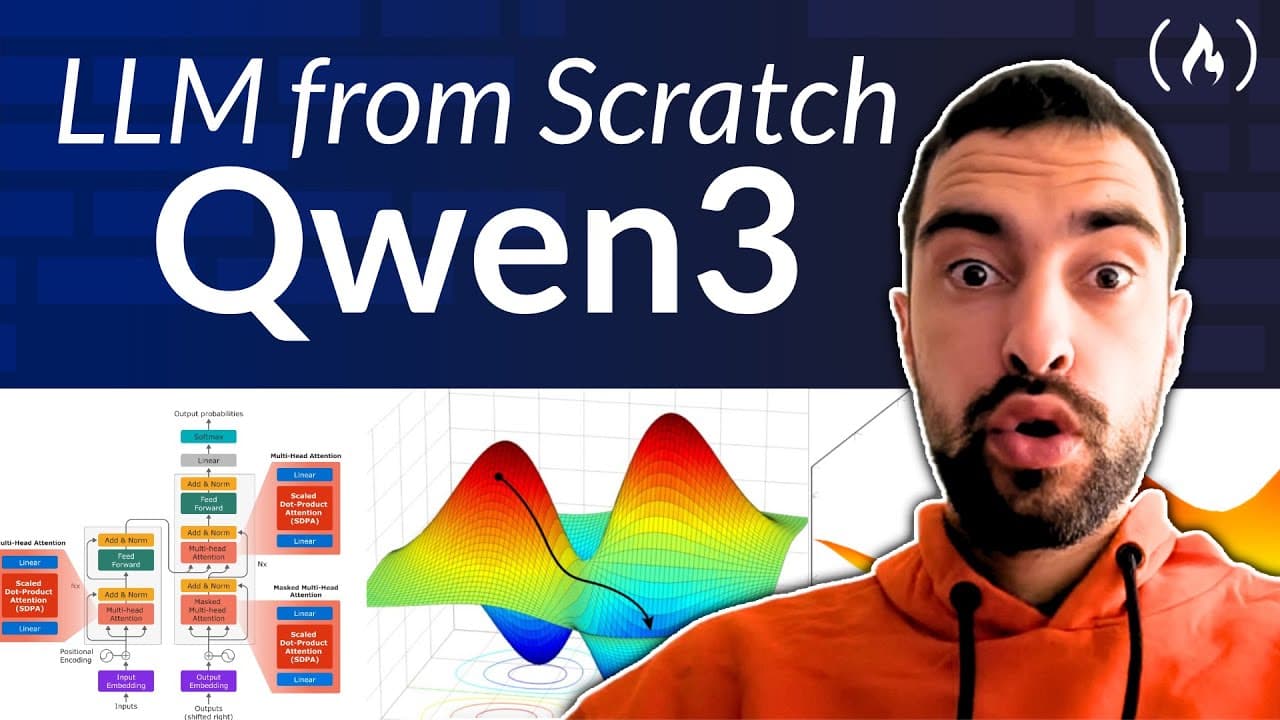
Qwen 3 is a state-of-the-art language model developed by Alibaba Cloud, featuring advanced reasoning and multilingual support. This tutorial guides you step-by-step through coding and training Qwen 3 from scratch, covering its architecture, implementation, and unique features like grouped query attention and the Muon optimizer. By the end, you'll gain a comprehensive understanding of building and training large language models.
Transcript
Quinn 3 is the cutting edge series of large language models developed by Alibaba Cloud's Quinn team. The LLM is known for its advanced reasoning, multilingual support, and efficient hybrid thinking and non-thinking modes. In this course, you'll learn to build intelligence from the ground up, training Gwyn 3 from scratch, one line at a time. You'll ... Read More
Key Insights
- Qwen 3 is developed by Alibaba Cloud and supports advanced reasoning and multilingual capabilities.
- Training Qwen 3 involves understanding its architecture and implementing it from scratch.
- The model features grouped query attention and SwiGLU activation for efficient processing.
- Muon optimizer is used for faster and more stable training, particularly for 2D matrices.
- Rope rotary positional embeddings help the model understand the position of tokens in a sequence.
- Training involves setting hyperparameters like batch size, sequence length, and learning rate.
- The model is trained using a combination of Muon and AdamW optimizers for different parameters.
- Inference involves generating text with parameters like temperature, top-K, and top-P sampling.
Install to Summarize YouTube Videos and Get Transcripts
Explore YouTube Video Summarizer or Get YouTube Transcript Extractor
Questions & Answers
Q: How to train Qwen 3 from scratch?
Training Qwen 3 from scratch involves understanding its architecture, setting up the code environment, and configuring various parameters like batch size, sequence length, and learning rate. The tutorial guides you through implementing grouped query attention, SwiGLU activation, and using the Muon optimizer for efficient training. By following the step-by-step instructions, you can build and train Qwen 3 effectively.
Q: What is the Muon optimizer used for?
The Muon optimizer is used for faster and more stable training of language models, particularly for 2D matrices. It addresses issues with large update values by orthonormalizing update matrices, which prevents arbitrary stretching of vectors. This optimization allows models to learn more efficiently, often requiring less training data compared to traditional optimizers like AdamW.
Q: What are rotary positional embeddings?
Rotary positional embeddings (RoPE) are used to help language models understand the position of tokens within a sequence. RoPE applies a rotation to the key and query vectors of each token, encoding positional information through sine and cosine transformations. This method allows the model to determine the relative position of tokens, enhancing its ability to process sequences effectively.
Q: What is grouped query attention?
Grouped query attention is a mechanism used in Qwen 3 to optimize the attention process by sharing key and value heads among multiple query heads. This reduces memory usage and computational complexity without sacrificing performance, allowing the model to handle large sequences more efficiently. The approach enhances the model's ability to process and generate coherent outputs.
Q: How does temperature affect text generation?
Temperature in text generation controls the randomness of the output. A higher temperature results in more uniform probabilities for the next token, leading to more diverse and creative outputs. Conversely, a lower temperature makes the model's predictions more deterministic, which is useful for tasks requiring precision, such as coding or mathematical text generation.
Q: What is the significance of SwiGLU activation?
SwiGLU activation is a variant of the GLU (Gated Linear Unit) that introduces a gating mechanism to control the flow of information through the network. It enhances the model's ability to learn complex patterns by selectively amplifying or suppressing certain neurons in the feed-forward network. This leads to more efficient processing and improved performance in language models.
Q: How is the training loop structured in Qwen 3?
The training loop for Qwen 3 involves initializing the model, setting up optimizers, and configuring learning rate schedules. The loop iteratively processes batches of data, calculates loss, performs backpropagation, and updates model weights. It also includes evaluation steps to monitor performance and adjust training parameters as needed, ensuring effective model learning.
Q: What is top-K and top-P sampling in inference?
Top-K sampling limits the model's choice to the K most probable tokens, while top-P sampling considers the smallest set of tokens whose cumulative probability exceeds a threshold P. Both methods are used in text generation to control randomness and coherence, allowing for more creative or deterministic outputs depending on the desired outcome. They are crucial for generating high-quality text.
Summary & Key Takeaways
-
Qwen 3 is a cutting-edge language model developed by Alibaba Cloud, known for its advanced reasoning and multilingual support. This tutorial walks you through coding and training Qwen 3 from scratch, explaining its architecture and unique features like grouped query attention and the Muon optimizer. By the end, you'll understand how large language models function and how to train them effectively.
-
The tutorial covers the entire process of building Qwen 3, from understanding its architecture to implementing training loops and optimizers. Key components include grouped query attention, SwiGLU activation, and the Muon optimizer, which enhances training speed and stability. The tutorial also explains how to use rotary positional embeddings for token positioning.
-
Training Qwen 3 involves setting various hyperparameters and using a combination of Muon and AdamW optimizers. The tutorial demonstrates how to configure these settings for efficient training and how to perform inference with parameters like temperature, top-K, and top-P sampling. By following the step-by-step guide, you gain hands-on experience in training large language models.
Read in Other Languages (beta)
Share This Summary 📚
Summarize YouTube Videos and Get Video Transcripts with 1-Click
Try YouTube Summary with ChatGPT & Claude or YouTube Transcript Generator
Explore More Summaries from freeCodeCamp.org 📚



Summarize YouTube Videos and Get Video Transcripts with 1-Click
Try YouTube Summary with ChatGPT & Claude or YouTube Transcript Generator