What Is Real-Time Path Tracing in Unreal Engine 5?
TL;DR
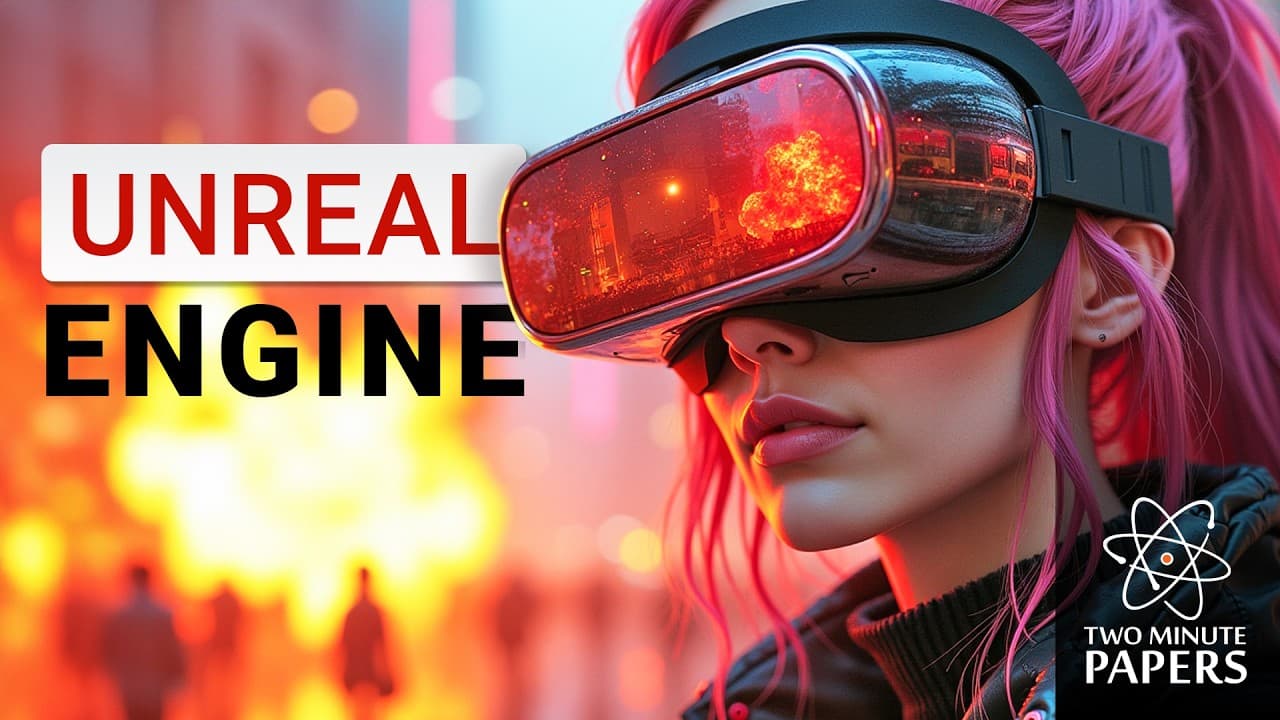
Real-time path tracing in Unreal Engine 5 enables realistic light simulation, significantly improving gaming visuals and interactivity. Unlike traditional methods that require extensive computing power and time, this new technique utilizes ReSTIR, allowing efficient light computations that can be executed in real-time. This advancement paves the way for future gaming experiences filled with richer graphics and immersive environments.
Transcript
An absolutely huge revolution is coming in gaming and virtual worlds and it is a big deal. I just read something impossible here - Unreal Engine 5 claims that it has real time path tracing. Now hold on for a minute. When they say path tracing, they mean a light simulation program where we shoot rays of light into the scene, bounce it arou... Read More
Key Insights
- 😫 Unreal Engine 5's real-time path tracing represents a significant technological advancement, setting new standards in graphics for gaming.
- 🐢 The traditional path tracing process is incredibly slow, taking from minutes to weeks for a single image, in stark contrast to real-time capabilities.
- 😀 Techniques like Voxel Cone Tracing and NVIDIA’s RTX ray tracing enhance graphical fidelity, but still face limitations regarding accuracy and performance.
- 🙂 ReSTIR is pivotal in achieving efficient light simulation, leveraging both spatial and temporal data to enhance rendering performance.
- 🙌 As ray tracing technology matures, future gaming experiences are expected to reach incredible levels of realism and detail, driven by improved hardware capabilities.
- 🌍 The democratization of these technologies through accessible tools like Unreal Engine can empower indie developers and creatives to create visually stunning virtual worlds.
- 💗 The call to action for learning opportunities emphasizes the growing community interest in mastering these advanced graphics techniques.
Install to Summarize YouTube Videos and Get Transcripts
Explore YouTube Video Summarizer or Get YouTube Transcript Extractor
Questions & Answers
Q: What is real-time path tracing and why is it important for gaming?
Real-time path tracing is a technique that simulates light interactions in virtual environments at high speeds, allowing games to produce visually stunning graphics similar to those seen in high-end CGI. This technology revolutionizes how light and shadows are rendered in games, enhancing realism and player immersion.
Q: How does Unreal Engine 5 achieve real-time path tracing?
Unreal Engine 5 uses a method called ReSTIR, which efficiently samples light rays by utilizing spatial and temporal information. This approach allows the engine to compute light interactions without simulating billions of rays, making real-time rendering feasible while still producing high-quality visuals.
Q: What are the benefits of using path tracing in video games?
Path tracing improves the accuracy of light calculations, resulting in better indirect illumination, sophisticated shadow effects, and high-quality materials. It also enhances player experience by allowing for dynamic lighting changes that respond naturally to the movement and interaction within the game world.
Q: What challenges remain with current path tracing technology in games?
Although real-time path tracing has shown significant progress, challenges include hardware limitations and the need for optimized algorithms to handle complex scenes without significant performance drops. Moreover, developers need to balance visual fidelity with playability, ensuring smooth gaming experiences.
Summary & Key Takeaways
-
Unreal Engine 5 introduces real-time path tracing, allowing for realistic light simulation in gaming environments, which significantly enhances visual quality and immersion.
-
Traditional offline path tracing is slow and resource-intensive, but new techniques like ReSTIR enable faster light computations, making advanced graphics more accessible in real-time applications.
-
The discussion highlights the potential for future gaming experiences as hardware improves, leading to richer material models and higher resolution environments.
Read in Other Languages (beta)
Share This Summary 📚
Summarize YouTube Videos and Get Video Transcripts with 1-Click
Try YouTube Summary with ChatGPT & Claude or YouTube Transcript Generator
Explore More Summaries from Two Minute Papers 📚





Summarize YouTube Videos and Get Video Transcripts with 1-Click
Try YouTube Summary with ChatGPT & Claude or YouTube Transcript Generator