What Is the Atom Optimization Algorithm in Deep Learning?
TL;DR
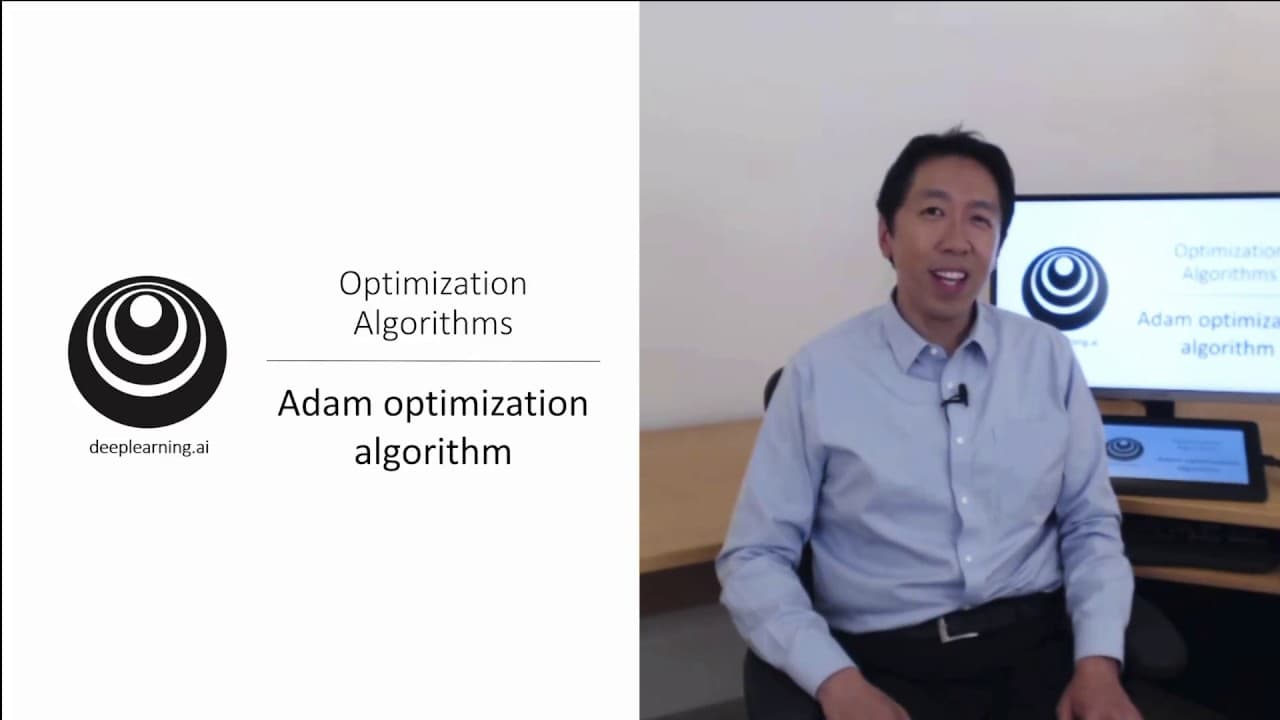
The Atom optimization algorithm effectively trains neural networks by combining momentum and RMSProp to adaptively estimate the first and second moments of gradients. It includes hyperparameters like beta 1, beta 2, and learning rate, with proven effectiveness across various architectures, making it a recommended choice for faster training.
Transcript
during the history of deep learning many researchers including some very well-known researchers sometimes proposed optimization algorithms and show their work well in a few problems but those optimization algorithms subsequently will show not to really generalize that well to the wide range of neural networks you might want to train so over time I ... Read More
Key Insights
- 🖤 The deep learning community has developed skepticism towards new optimization algorithms due to their lack of generalization.
- 👍 Atom is a widely recommended optimization algorithm that has been proven effective across various deep learning architectures.
- 🎭 Implementing Atom involves initializing velocities and squared gradients, performing momentum and rmsprop updates, and applying bias correction.
- ☠️ Hyperparameters, such as the learning rate, beta 1, beta 2, and epsilon, can be tuned to optimize Atom.
- ☄️ Atom's name comes from its ability to adaptively estimate the moments of the derivatives.
- ❓ The choice of epsilon in Atom doesn't have a significant impact on performance.
- ☠️ Beta 1 and beta 2 are commonly used default values in Atom, while alpha (learning rate) needs to be tuned.
- 💨 Atom optimization algorithm is recommended for faster training of neural networks.
Install to Summarize YouTube Videos and Get Transcripts
Explore YouTube Video Summarizer or Get YouTube Transcript Extractor
Questions & Answers
Q: How does Atom differ from other optimization algorithms in deep learning?
Atom stands out as a rare algorithm that works well across various neural network architectures, unlike many other optimization algorithms that struggle to generalize.
Q: What are the key components of the Atom optimization algorithm?
Atom combines momentum and rmsprop. It uses beta 1 to compute the momentum-like update and beta 2 to compute the rmsprop-like update. Both updates are then applied to the weights and biases.
Q: How are the hyperparameters in Atom determined?
The learning rate (alpha) is an important hyperparameter that needs to be tuned. Beta 1 is commonly set to 0.9, while beta 2 is often set to 0.99. The choice of epsilon doesn't impact performance significantly.
Q: What is the reasoning behind the name "Atom" for this optimization algorithm?
Atom stands for "adaptive moment estimation." Beta 1 computes the mean of the derivatives (first moment), while beta 2 computes the exponentially weighted average of the squares (second moment).
Summary & Key Takeaways
-
Many optimization algorithms in deep learning don't generalize well, but Atom has proven to work across a wide range of architectures.
-
Atom combines momentum and rmsprop to optimize neural networks, using hyperparameters beta 1 and beta 2.
-
To implement Atom, initialize the velocities and squared gradients, perform momentum and rmsprop updates, and then apply bias correction.
Read in Other Languages (beta)
Share This Summary 📚
Summarize YouTube Videos and Get Video Transcripts with 1-Click
Try YouTube Summary with ChatGPT & Claude or YouTube Transcript Generator
Explore More Summaries from DeepLearningAI 📚
![How Does the Logistic Regression Decision Boundary Work? — #33 Machine Learning Specialization [Course 1, Week 3, Lesson 1] thumbnail](/_next/image?url=https%3A%2F%2Fi.ytimg.com%2Fvi%2F0az8RjxLLPQ%2Fhqdefault.jpg&w=750&q=75)




Summarize YouTube Videos and Get Video Transcripts with 1-Click
Try YouTube Summary with ChatGPT & Claude or YouTube Transcript Generator