How to Build a One-Person AI Business in 2026
TL;DR
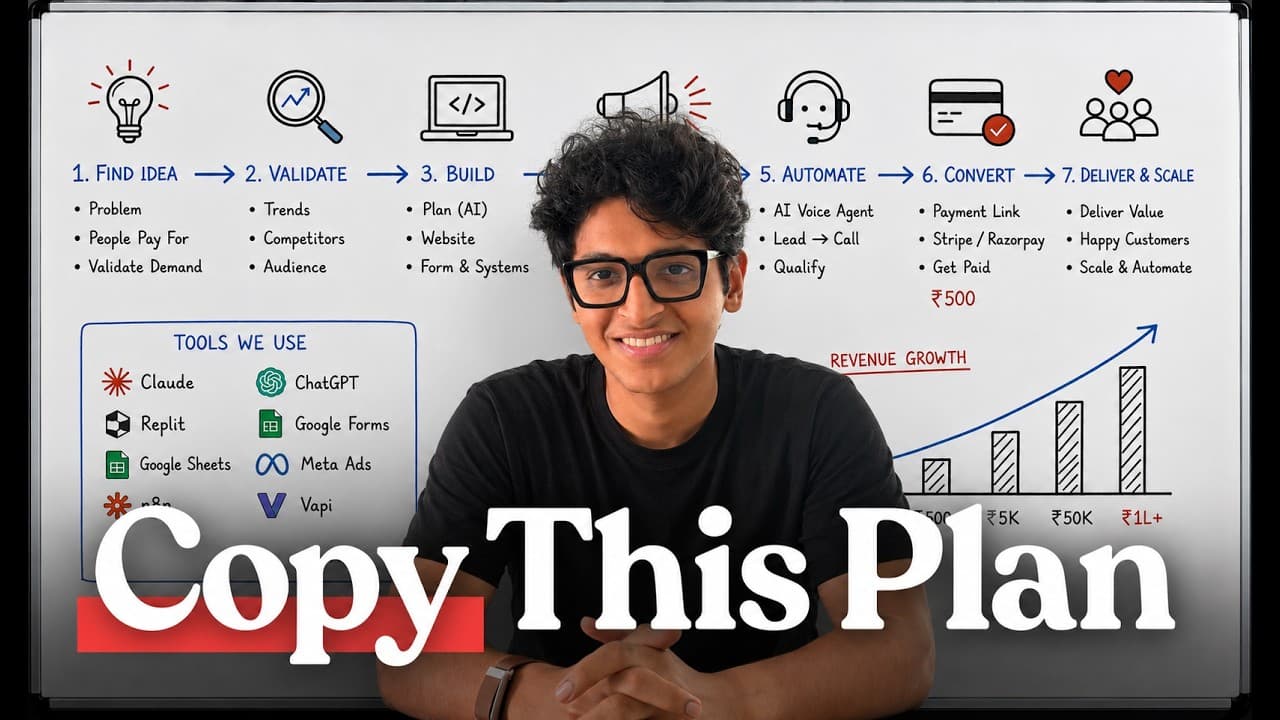
Start by identifying a proven customer need, choosing whether to sell a product or service, and defining a specific audience. Give Claude the full business context, then use specialized tools to build a landing page, collect registrations, create images and ads, qualify leads, accept payments, and automate operations, with the described setup costing Rs. 6,900 to launch.
Transcript
Have a look at Matthew Galahar. This guy created a oneperson business using AI that has made him $400 million in 2025 and is projected to make $1.8 billion in 2026. He built an entire business on the top of AI tools and he created millions of dollars of revenue. His business was selling healthcare supplements to people around the world. And the que... Read More
Key Insights
- A viable AI business begins with demand, because efficient tools cannot make an unwanted product profitable. The suggested starting point is a recurring human desire such as health, education, beauty, financial improvement, entertainment, companionship, prestige, convenience, or protection from loss.
- Business customers generally pay for measurable value, including making more money, reducing costs, or completing work faster. Potential services can be discovered by reviewing paid demand on Fiverr and Upwork for work such as content writing, video creation, lead generation, unit testing, websites, and landing pages.
- Product demand can be investigated through Exploding Topics and Google Trends. These services help reveal subjects and search terms receiving attention, allowing a founder to compare possible niches before investing time and money in a product, website, advertising campaign, or supporting automation.
- The example business insight is that people aged 20 to 30 living in Indian tier 1 cities may feel lonely and want meaningful in-person experiences. The resulting offer organizes weekend cafe conversations in groups of at least three and no more than five participants.
- Claude works as the central planning system when it receives the complete business context. The Expand and Contract skill asks detailed questions about age limits, gender balance, verification, hosts, and other operating choices before turning the initial concept into a more complete business plan.
- A simple launch stack can combine Replit with Google Forms. Replit creates the landing page from the business plan, while a Gemini-generated form collects information such as name, WhatsApp number, age, gender, location, profession, conversation interests, and reasons for joining.
- Specialized AI tools can be assigned according to their strengths. Claude develops plans and prompts, Replit builds the website, ChatGPT generates relevant images, and Meta Ads Library provides examples of existing advertisements that can inform creative development and customer acquisition.
- The stated cost to start the demonstrated AI business is Rs. 6,900. Listed expenses include Claude Pro at Rs. 2,400 per month, Higgsfield at Rs. 3,400 per month, a Rs. 400 annual domain, Rs. 500 daily Meta Ads, and Retell AI at Rs. 200 per month.
Install to Summarize YouTube Videos and Get Transcripts
Explore YouTube Video Summarizer or Get YouTube Transcript Extractor
Questions & Answers
Q: How do you choose an idea for a one-person AI business?
Choose a problem connected to something people repeatedly pay for, such as health, education, beauty, money, entertainment, companionship, prestige, convenience, or protection from loss. Next, decide whether to sell a product to individuals or a service to businesses. Check current interest through Exploding Topics and Google Trends, or examine paid service categories on Fiverr and Upwork. The idea should also remain personally interesting enough for you to pursue.
Q: How can Claude help create a business plan?
Create a dedicated Claude project and describe the proposed customer, offer, delivery model, pricing approach, and operating conditions in detail. The demonstrated Expand and Contract skill then examines the concept and asks questions about areas such as age restrictions, group composition, verification, and trained moderation. After reviewing and approving the answers, the project contains a detailed plan and shared context that can guide subsequent website, registration, and marketing prompts.
Q: What business was built in the AI business example?
The example is Meet New, an in-person weekend experience for working people in their twenties who live in tier 1 Indian cities. Participants meet at selected partner cafes in groups containing at least three and no more than five people. The business charges for each session. Its underlying insight is that young urban residents may feel lonely and want smaller, more meaningful social experiences than conventional events provide.
Q: How can you build a landing page for an AI business?
Take the complete business plan produced in Claude and provide it to Replit with a request for a landing page tailored to the offer and intended audience. In the demonstration, Replit plans and builds a site for weekend group experiences aimed at people aged 22 to 29 in tier 1 cities. The page is intended for advertising traffic and includes a call to action connected to the registration process.
Q: How can Google Forms be used to validate a business idea?
Google Forms can provide a simple registration system without purchasing more complicated software. Claude can generate the form prompt, and Gemini inside Google Forms can turn it into the actual questionnaire. The example collects a person's name, WhatsApp number, age, gender, location in Bangalore, profession, preferred discussion topics, and reason for joining. Responses can then be saved in a Google Sheet for review.
Q: How can AI-generated images support a new business website?
Provide ChatGPT with the business context and request images that match the customers, setting, and activity shown on the landing page. For Meet New, the prompt requested four to five images of three or four Indian participants enjoying conversations in a cafe. Those images were then attached in Replit and placed according to their content, avoiding the described photography expense of Rs. 2,000 to Rs. 5,000.
Q: What tools are used to operate and market the AI business?
The described workflow uses Claude for business planning and prompt creation, Replit for the website, Google Forms for registration, ChatGPT for images, and Meta Ads for customer acquisition. The description also identifies Higgsfield, n8n, Stripe, Apollo, and Retell AI as tools for creating ads, automation, payments, outreach, and lead qualification. Each tool handles a focused part of the broader operating system.
Q: How much does the demonstrated AI business cost to start?
The description states a total startup cost of Rs. 6,900. Its listed expenses include Claude Pro at Rs. 2,400 per month, Higgsfield at Rs. 3,400 per month, a domain name at Rs. 400 per year, Meta Ads at Rs. 500 per day, and Retell AI at Rs. 200 per month. Apollo works free for some time and later costs Rs. 7,000 per month.
Summary & Key Takeaways
-
The workflow begins with market selection rather than technology. Choose a persistent customer desire, decide whether to serve individuals or businesses, and investigate demand through Exploding Topics, Google Trends, Fiverr, or Upwork. The proposed concept addresses loneliness among working people in their twenties through small weekend cafe gatherings in Indian tier 1 cities.
-
Claude becomes the central planning workspace for the business. Its Expand and Contract skill examines assumptions, asks questions about matters such as age restrictions, group composition, verification, and moderation, then produces a detailed plan. Keeping this context inside one project supports more consistent prompts for later website, registration, and marketing tasks.
-
The plan is converted into an operating system using multiple focused tools. Replit builds the landing page, Google Forms captures registrations, ChatGPT creates website images, Meta Ads supports customer acquisition, Stripe collects payments, and tools including n8n, Retell AI, and Apollo support automation, qualification, and outreach. The stated startup cost is Rs. 6,900.
Read in Other Languages (beta)
Share This Summary 📚
Summarize YouTube Videos and Get Video Transcripts with 1-Click
Try YouTube Summary with ChatGPT & Claude or YouTube Transcript Generator
Explore More Summaries from Ishan Sharma 📚


Summarize YouTube Videos and Get Video Transcripts with 1-Click
Try YouTube Summary with ChatGPT & Claude or YouTube Transcript Generator