How Does Hearing and Balance Enhance Learning?
TL;DR
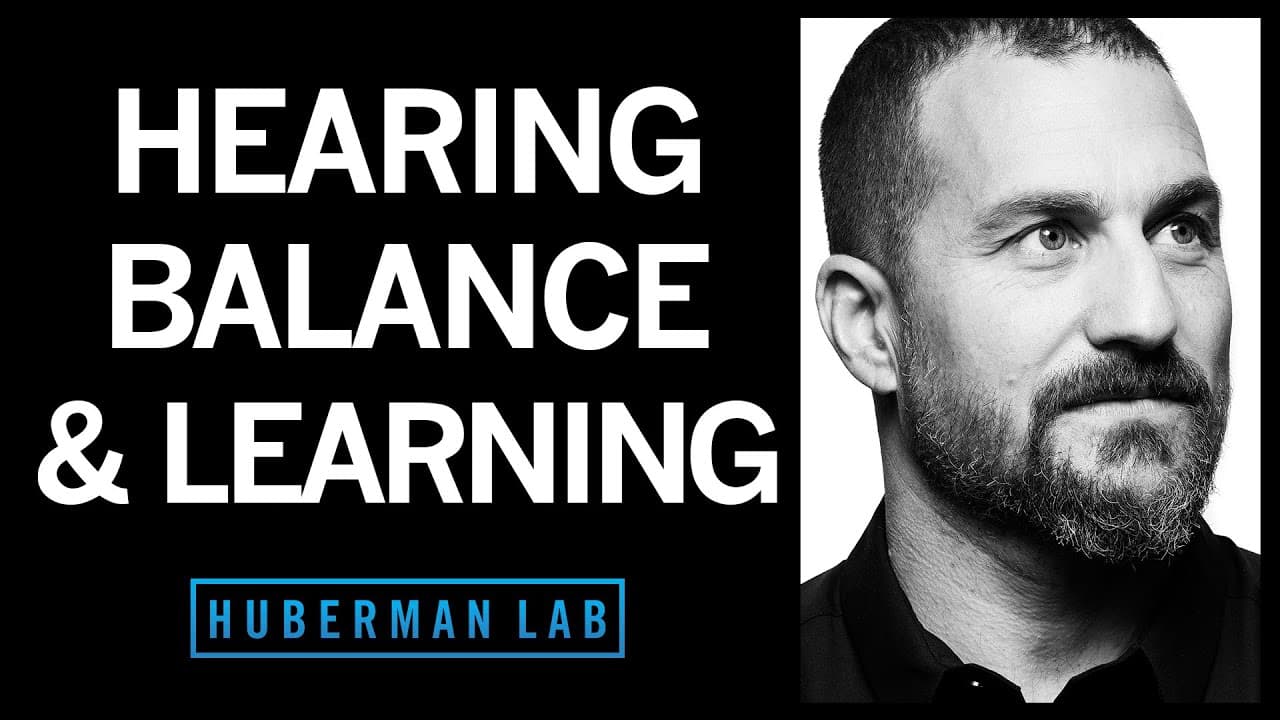
The auditory and balance systems can significantly enhance learning by leveraging specific sound protocols, such as binaural beats and white noise, to improve memory and focus. Binaural beats create beneficial brain states for learning, while white noise, at a low volume, promotes attention and motivation by increasing dopamine release. However, caution is needed with white noise exposure in young children, as it can disrupt auditory development.
Transcript
- Welcome to the Huberman Lab Podcast, where we discuss science and science-based tools for everyday life. I'm Andrew Huberman and I'm a professor of neurobiology and ophthalmology at Stanford School of Medicine. Today, we're going to talk all about hearing and balance and how you can use your ability to hear specific things and your balance system... Read More
Key Insights
- 👂 The auditory and balance systems in the body interact with other systems of the brain and body, and can be used to learn information more quickly and improve hearing and balance.
- 🎧 Binaural beats, which involve playing different frequencies of sound to each ear, can enhance brain states for learning in certain individuals, depending on the frequency of the beats.
- 🔊 White noise, when played at a low volume, can improve performance in auditory working memory tasks and enhance brain activity in dopamine-rich regions, leading to increased attention and motivation.
- 👦 White noise should be adjusted to a comfortable volume level that does not interfere with focus or attention, and it should not be excessively loud to avoid hearing loss.
- 💡 The use of white noise, binaural beats, and other auditory tools can be beneficial for learning, relaxation, anxiety reduction, and pain management.
- 🔇 However, it is important to avoid exposing infants and young children to excessive white noise, as it can disrupt the development of the auditory system and tonotopic maps in the brain.
Install to Summarize YouTube Videos and Get Transcripts
Explore YouTube Video Summarizer or Get YouTube Transcript Extractor
Questions & Answers
Q: How can binaural beats and white noise be used to enhance learning and memory?
Binaural beats and white noise have been shown to improve focus, relaxation, and creativity, as well as enhance attention and motivation. By modulating brain activity and the release of dopamine, they can create a state beneficial for learning. Binaural beats, with different frequencies in each ear, can improve cognition and problem-solving, while white noise at a low volume can enhance brain function and memory consolidation.
Q: What are the potential risks of using white noise during development?
Studies have shown that white noise exposure during development can disrupt the tonotopic maps in the brain, affecting the perception of sound. While this doesn't necessarily have long-term consequences, it highlights the need to be cautious with the use of white noise in very young children. It's best to consult with healthcare professionals for personalized guidance.
Q: How can white noise be used effectively for learning?
White noise should be at a low volume that is not intrusive or irritating, but still audible. The optimal volume may vary depending on individual sensitivity and the environment. It's important to find a level where you can fully immerse in the task at hand while benefiting from the enhanced focus and attention that white noise provides. Experimentation and personal preference will help determine the ideal volume.
Q: Can the use of headphones with white noise be harmful to hearing?
While headphones can enhance the perception of white noise, it's crucial to use them at a safe volume. Loud sounds, especially when delivered directly to the ears through headphones, can lead to hearing loss over time. It's recommended to keep the volume low and avoid prolonged exposure to loud sounds, including white noise, to protect hearing health.
Q: Are there any other methods besides white noise and binaural beats that can improve learning and memory?
Yes, there are various methods to enhance learning and memory. Some examples include incorporating regular rest periods during learning sessions, practicing mindfulness or meditation, exercising before or after studying, and using mnemonic techniques or visualization strategies. The key is to find what works best for individual preferences and incorporate these techniques into a structured learning routine.
Summary & Key Takeaways
-
The auditory system and balance system interact with the brain and body, and can be used to enhance learning, memory, hearing, and balance.
-
Binaural beats, which involve playing different frequencies of sound to each ear, can improve focus, relaxation, and creativity, while white noise at a low volume can enhance learning and cognition.
-
White noise can raise the baseline release of dopamine in the brain, promoting attention and motivation.
-
However, white noise during development can disrupt the auditory maps in the brain and affect the perception of sound.
Read in Other Languages (beta)
Share This Summary 📚
Summarize YouTube Videos and Get Video Transcripts with 1-Click
Try YouTube Summary with ChatGPT & Claude or YouTube Transcript Generator
Explore More Summaries from Andrew Huberman 📚





Summarize YouTube Videos and Get Video Transcripts with 1-Click
Try YouTube Summary with ChatGPT & Claude or YouTube Transcript Generator