What Happens to Water's Boiling Point at High Altitudes?
TL;DR
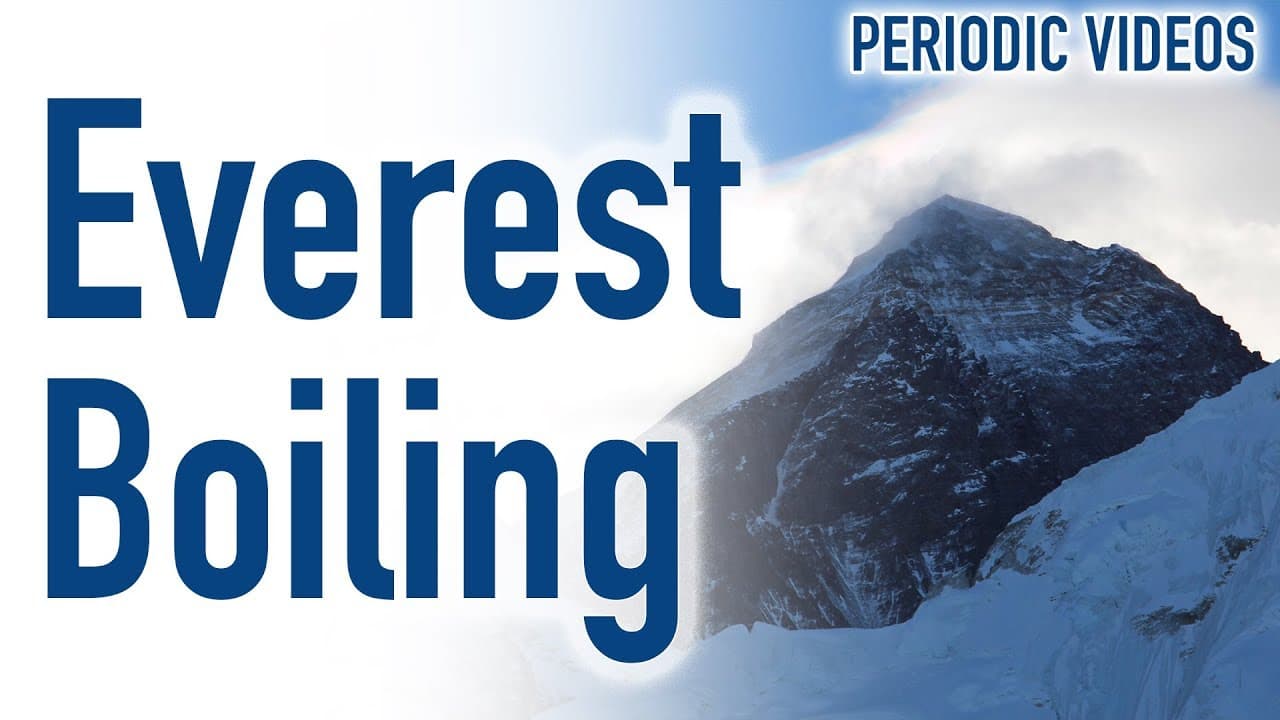
At high altitudes, the boiling point of water decreases due to lower atmospheric pressure. For example, at Everest Base Camp (~5,365 meters), water boils at around 79 degrees Celsius. Various heating methods, such as using yak dung and kerosene stoves, highlight the innovative approaches needed to boil water in these extreme conditions.
Transcript
I'm here at man over a Space Camp those guys behind me of boiling water for you at periodic videos why well it's kind of a long story and it all begins at lukla so let's go to the start Oh hello everybody I'm Buddha die so we are right now at montreux heights to 850 95 degrees 95 yes okay ninety-five outside temperature is a 993 senses okay I think... Read More
Key Insights
- 💦 Boiling water at high altitudes in Nepal requires innovative methods like using yak dung and sunlight due to limited resources.
- 😥 The impact of elevation on the boiling point of water is evident as temperatures decrease with increasing altitude.
- 🤒 Carrying equipment like kettles and thermometers to conduct experiments at high altitudes poses logistical challenges and requires physical effort.
- 😥 Understanding the differences in boiling points at various altitudes is crucial for scientific research and practical applications in mountainous regions.
- 🚵 Collaborating with local guides and porters is essential for conducting experiments in remote locations like the Nepalese mountains.
- 🔨 The expedition showcases the fusion of traditional methods like yak dung with modern scientific tools for practical applications in challenging environments.
- 😥 Exploring the boiling points of water at high altitudes contributes to a better understanding of thermodynamics and environmental factors affecting physical processes.
Install to Summarize YouTube Videos and Get Transcripts
Explore YouTube Video Summarizer or Get YouTube Transcript Extractor
Questions & Answers
Q: How do they heat water at high altitudes in Nepal?
At high altitudes in Nepal, water is heated using methods such as kerosene stoves, sunlight, and yak dung, showcasing the challenges of boiling water in such environments.
Q: What are the effects of altitude on the boiling point of water?
The boiling point of water decreases as altitude increases, leading to longer boiling times and different methodologies required for heating water in mountainous regions.
Q: What equipment is used to measure the boiling points at different altitudes?
The team carries kettles and thermometers to measure the boiling points of water at various altitudes, highlighting the technical aspects of conducting experiments in challenging environments.
Q: How do they transport equipment like kettles and thermometers to such high altitudes?
Equipment like kettles and thermometers are transported by porters, showcasing the physical challenges and logistics involved in conducting scientific experiments in remote locations.
Summary & Key Takeaways
-
The video explores boiling water at high altitudes in Nepal using different methods such as kerosene stoves and yak dung.
-
The team measures the boiling points of water at various altitudes, showcasing the impact of elevation on the process.
-
The expedition involves carrying equipment like kettles and thermometers to conduct experiments and tests.
Read in Other Languages (beta)
Share This Summary 📚
Summarize YouTube Videos and Get Video Transcripts with 1-Click
Try YouTube Summary with ChatGPT & Claude or YouTube Transcript Generator
Explore More Summaries from Periodic Videos 📚


Summarize YouTube Videos and Get Video Transcripts with 1-Click
Try YouTube Summary with ChatGPT & Claude or YouTube Transcript Generator