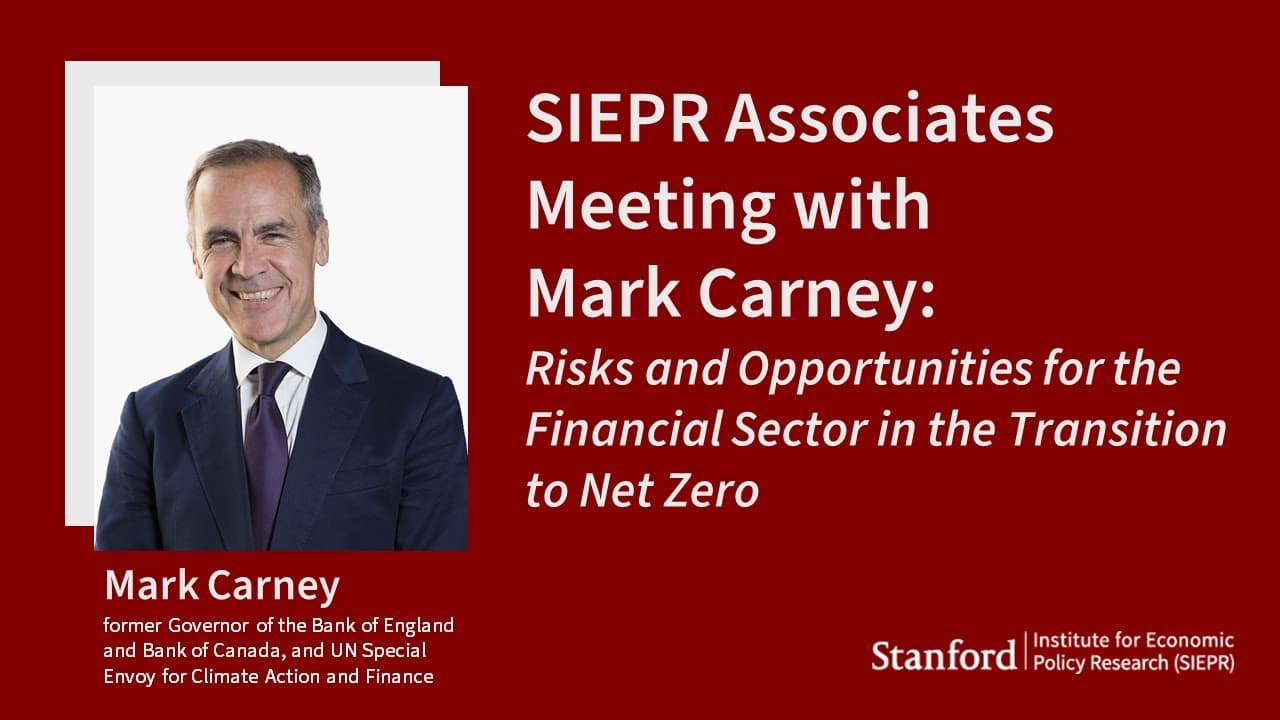
Mark Carney on Climate Change, Financial Stability, and Carbon Pricing | Associates Meeting
TL;DR
Mark Carney argues that climate change threatens financial stability through physical damage and the risks of transitioning to a net-zero economy. He notes that extreme weather events increased about threefold over recent decades while insured damage rose eightfold, with even larger uninsured losses concentrated in the developing world. Read on for his views on carbon pricing, financial-sector action, and corporate climate plans.
Transcript
hello everyone thank you so much for joining us for our last associates meeting of this academic year i'm mark duggan the triony director of the stanford institute for economic policy research and i'm enormously grateful to all of you for your support and interest in our mission of catalyzing and promoting research that will lead to improved econom... Read More
Key Insights
- 💱 Climate change poses both physical and transition risks, which affect financial stability and require urgent attention.
- 0️⃣ Carbon pricing is a key tool to incentivize businesses and governments to reduce greenhouse gas emissions and transition to a net-zero economy.
- 👨💼 Legal actions, such as the court ruling against Royal Dutch Shell, have the potential to drive transition risks and change business plans to align with climate goals.
- 🖐️ The financial sector can play a crucial role by integrating climate change considerations into its operations, such as overseeing firms and incorporating climate factors in investment decisions.
- 💐 Ensuring the flow of financial resources to developing countries is essential to tackle climate change on a global scale.
- 💱 Despite the challenges posed by climate change, there is optimism due to increasing political and financial sector awareness and action.
Install to Summarize YouTube Videos and Get Transcripts
Explore YouTube Video Summarizer or Get YouTube Transcript Extractor
Questions & Answers
Q: How does Mark Carney say climate change threatens financial stability?
Carney identifies physical risks and transition risks. Physical risks include destroyed property, disrupted supply chains, interrupted economic activity, and damaged livelihoods, while transition risks arise as economies and companies move toward net-zero emissions.
Q: What evidence does Mark Carney give that physical climate risks are increasing?
Drawing on his experience overseeing insurance and reinsurance at the Bank of England, Carney says the number of extreme weather events increased about threefold over the last few decades. He adds that insured damage rose eightfold even though many policies are short-term and regularly adjust their pricing and coverage.
Q: Why are uninsured climate losses especially concerning?
Carney says uninsured losses are much larger than insured losses and are growing much more rapidly. He notes that these losses are concentrated in the emerging and developing world.
Q: What are transition risks from climate change?
Transition risks arise from moving toward a net-zero economy. They can force businesses to revise their plans as climate goals, carbon pricing, financial decisions, and legal actions change the conditions under which they operate.
Q: How can carbon pricing encourage lower greenhouse gas emissions?
Carbon pricing gives businesses and governments a financial incentive to reduce greenhouse gas emissions. It encourages them to lower emissions and align their decisions with the transition to a net-zero economy.
Q: What does the Royal Dutch Shell court ruling mean for transition risk?
The ruling requires Royal Dutch Shell to drastically reduce its net greenhouse gas emissions by 2030. It shows how legal risk can become transition risk by requiring companies to change business plans to align with climate goals.
Q: How can the financial sector respond to climate change?
The financial sector can incorporate climate considerations into its oversight of banks and insurers, monetary policy, and investment decisions. The existing discussion also highlights corporate bond markets and screening investments according to whether companies have credible net-zero plans.
Q: What experience informs Mark Carney’s views on climate and finance?
Carney served as governor of the Bank of Canada from 2008 to 2013 and governor of the Bank of England from 2013 to 2020. At the time of the meeting, he was the UN special envoy for climate action and finance and the finance adviser to UK Prime Minister Boris Johnson for the UN climate change conference scheduled for November.
Summary & Key Takeaways
-
Mark Carney highlights the two types of risks posed by climate change: physical risks, such as property destruction and disruption of economic activity, and transition risks, which arise from moving to a net-zero economy.
-
He emphasizes the need for businesses and governments to take climate change into account and have a concrete plan to reduce emissions.
-
Carney discusses the significance of carbon pricing and the potential consequences of the recent court ruling requiring Royal Dutch Shell to drastically cut its net greenhouse gas emissions.
Read in Other Languages (beta)
Share This Summary 📚
Summarize YouTube Videos and Get Video Transcripts with 1-Click
Try YouTube Summary with ChatGPT & Claude or YouTube Transcript Generator
Explore More Summaries from Stanford Institute for Economic Policy Research (SIEPR) 📚
Summarize YouTube Videos and Get Video Transcripts with 1-Click
Try YouTube Summary with ChatGPT & Claude or YouTube Transcript Generator