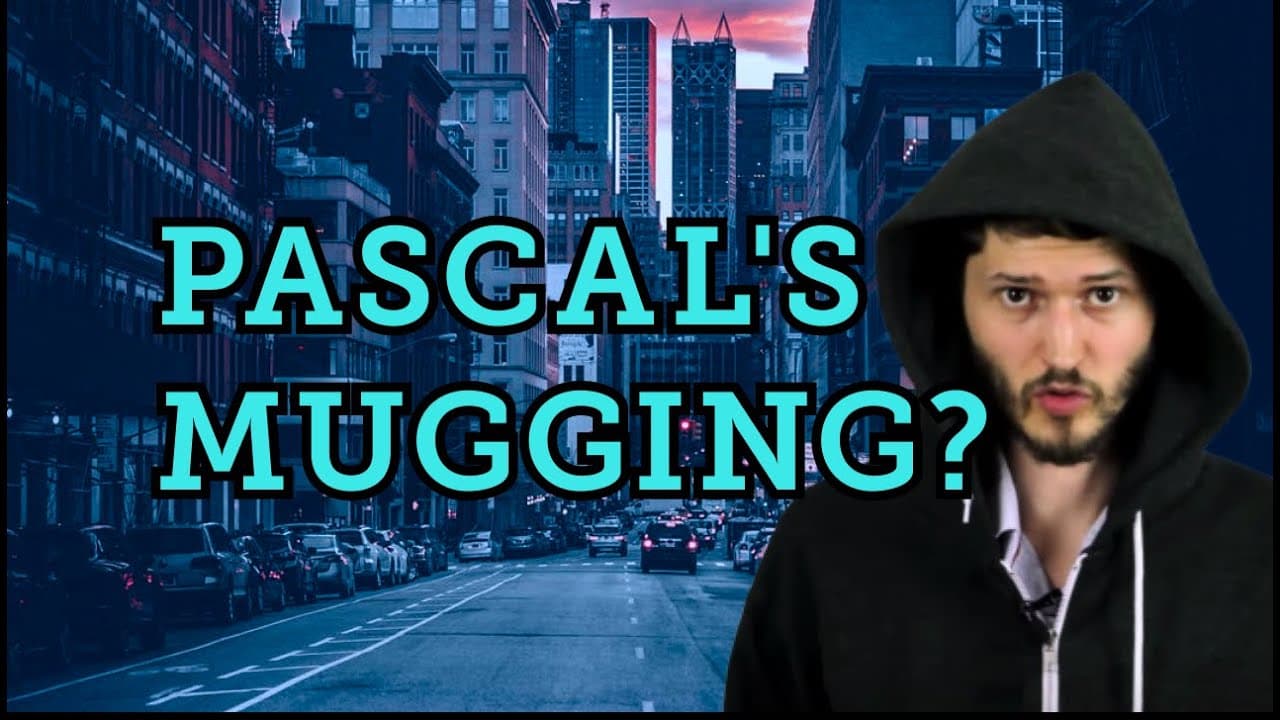
Is AI Safety Justified by Pascal's Mugging?
TL;DR
AI safety research is essential due to the potential high-stakes consequences of advanced AI, even if its likelihood remains uncertain. The debate around Pascal's Wager and Mugging highlights the need for evidence-based reasoning in making decisions about AI's future, challenging arguments that rely solely on extreme but improbable outcomes. Understanding these concepts is crucial for navigating the complexities of AI safety.
Transcript
hi today we're going to talk about Pascal's wager and Pascal's mugging this is necessarily going to touch on religious topics pretty heavily actually and I'm just gonna say at the beginning of the video that personally I don't believe that any god or gods have ever existed and I'm not going to pretend otherwise in this video so be forewarned if tha... Read More
Key Insights
- ⚾ Pascal's Wager argues that belief in God is a logical bet, based on the potential infinite rewards in heaven compared to finite costs.
- ⚾ Pascal's Mugging challenges the rationality of making decisions based on extreme but unlikely scenarios.
- ◀️ The existence of other deities or reversing the arguments undermines the coherence of Pascal's Wager.
- ✋ Evidence-based reasoning is crucial in decision-making, even in scenarios with high-consequence outcomes.
- 👨🔬 Applying Pascal's Wager to AI safety research involves considering the potential impact of artificial general intelligence on humanity's future.
- 🦺 AI safety researchers do not solely rely on Pascal's Wager-style arguments, but rather emphasize the significance of allocating resources to AI safety based on the potential risks involved.
- 💀 While unintended consequences should be considered, the risks associated with AI safety research outweigh the potential dangers of inaction.
Install to Summarize YouTube Videos and Get Transcripts
Explore YouTube Video Summarizer or Get YouTube Transcript Extractor
Questions & Answers
Q: What is Pascal's Wager and how does it relate to the existence of God?
Pascal's Wager proposes that belief in God is a rational bet, as the potential infinite rewards in heaven outweigh any costs in following religious laws or not believing in God.
Q: How does Pascal's Mugging challenge the rationality of decision-making based on extreme but unlikely scenarios?
Pascal's Mugging presents a scenario where a person is threatened by someone pretending to be God. It challenges the idea of making decisions purely based on logical reasoning, as the scenario's unlikelihood should be considered.
Q: How do inventing other deities or flipping the arguments impact Pascal's Wager?
By inventing arbitrary gods or reversing the arguments, Pascal's Wager loses its coherence, as it relies on infinite consequences rather than evidence-based reasoning.
Q: What role does evidence play in Pascal's Wager and Pascal's Mugging?
Pascal's arguments suggest that evidence is not required for decision-making. However, the analysis points out the importance of evidence-based reasoning in making informed choices.
Summary & Key Takeaways
-
Pascal's Wager suggests that it is rational to believe in God because the potential infinite rewards in heaven outweigh finite costs if God does not exist.
-
Pascal's Mugging presents a scenario where an individual is threatened by someone claiming to be God and must make a decision based on purely logical reasoning.
-
The analysis explores the flaws in Pascal's arguments, discusses the implications for AI safety research, and emphasizes the importance of evidence-based decision-making.
Read in Other Languages (beta)
Share This Summary 📚
Summarize YouTube Videos and Get Video Transcripts with 1-Click
Try YouTube Summary with ChatGPT & Claude or YouTube Transcript Generator
Explore More Summaries from Robert Miles AI Safety 📚




Summarize YouTube Videos and Get Video Transcripts with 1-Click
Try YouTube Summary with ChatGPT & Claude or YouTube Transcript Generator