How to Use Linear SVC for Machine Learning in Python
TL;DR
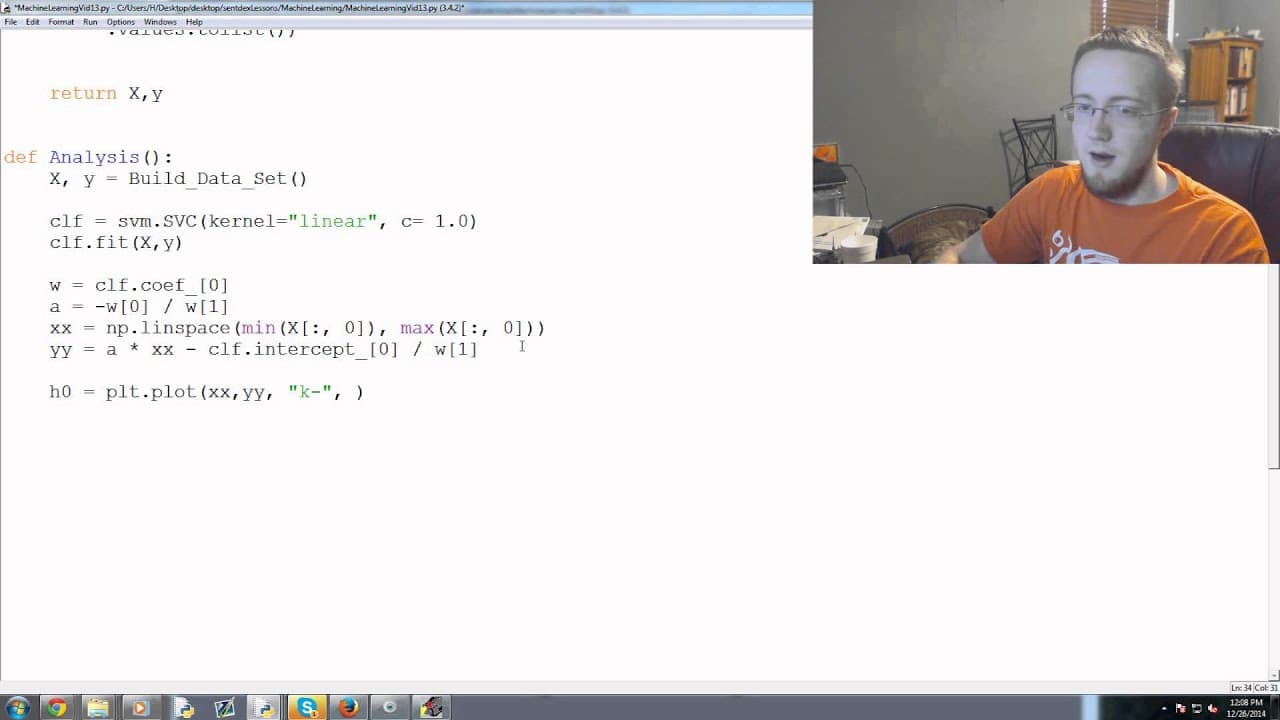
To apply linear SVC for machine learning using scikit-learn in Python, start by selecting two features, then build a dataset and run the SVC model. Visualizing the outcomes can reveal relationships between features and performance, but using more features is crucial for meaningful analysis.
Transcript
hello everybody and welcome to another the 13th tutorial video in our machine learning with scikit-learn tutorial series in this video what we're gonna be talking about is actually applying linear SVC to our our actual problem here and see what we can figure out so in this video we're also gonna only have two features we're gonna use two features r... Read More
Key Insights
- 🎰 Linear SVC is a machine learning algorithm provided by scikit-learn.
- ❓ Only two features are used in this tutorial for simplicity.
- 🎯 Visual plots can help understand the relationship between features and the target variable.
- 😫 The importance of having a larger feature set for more meaningful analysis is highlighted.
- 🎰 The tutorial emphasizes understanding the data before applying machine learning algorithms.
- ❓ Linear SVC can be used for classification problems.
- 🥳 A high trailing P/E ratio might indicate outperforming stocks.
Install to Summarize YouTube Videos and Get Transcripts
Explore YouTube Video Summarizer or Get YouTube Transcript Extractor
Questions & Answers
Q: What is the purpose of importing numpy, matplotlib, scikit-learn, pandas, and matplotlib style in this tutorial?
Numpy is used to convert data to an array, matplotlib is used to make visual plots, scikit-learn provides the linear SVC algorithm, pandas is used to create and manipulate data frames, and matplotlib style is used to enhance the appearance of the plots.
Q: How is the dataset constructed and prepared for analysis?
The dataset is loaded from a CSV file using pandas, and the desired features are selected. The features are converted to a list and then to a numpy array. The target variable is converted to numerical values using pandas' replace function.
Q: What is the purpose of the "analysis" function?
The "analysis" function is where the linear SVC algorithm is applied to the dataset. It fits the data, calculates the coefficients, and plots the data along with the decision boundary.
Q: Why is it important to have a larger feature set for more accurate analysis?
With only two features, the analysis may not provide meaningful insights. Having more features allows the algorithm to consider more factors and can potentially lead to better predictions.
Summary & Key Takeaways
-
The tutorial introduces the concept of using linear SVC in scikit-learn for machine learning.
-
Only two features are used in this tutorial for simplicity.
-
The tutorial highlights the potential limitations of using a small number of features and emphasizes the need for a larger feature set for more accurate analysis.
Read in Other Languages (beta)
Share This Summary 📚
Summarize YouTube Videos and Get Video Transcripts with 1-Click
Try YouTube Summary with ChatGPT & Claude or YouTube Transcript Generator
Explore More Summaries from sentdex 📚

Summarize YouTube Videos and Get Video Transcripts with 1-Click
Try YouTube Summary with ChatGPT & Claude or YouTube Transcript Generator