How Do Beliefs Guide Personal Transformation?
TL;DR
Positive transformation should take priority over preserving habits, relationships, and ways of thinking that prevent growth. Because objective facts alone cannot determine how a person should act, people need goals and value structures that provide direction, generate positive emotion, and withstand the constraints imposed by other people, repeated cooperation, and the practical consequences of acting in the world.
Transcript
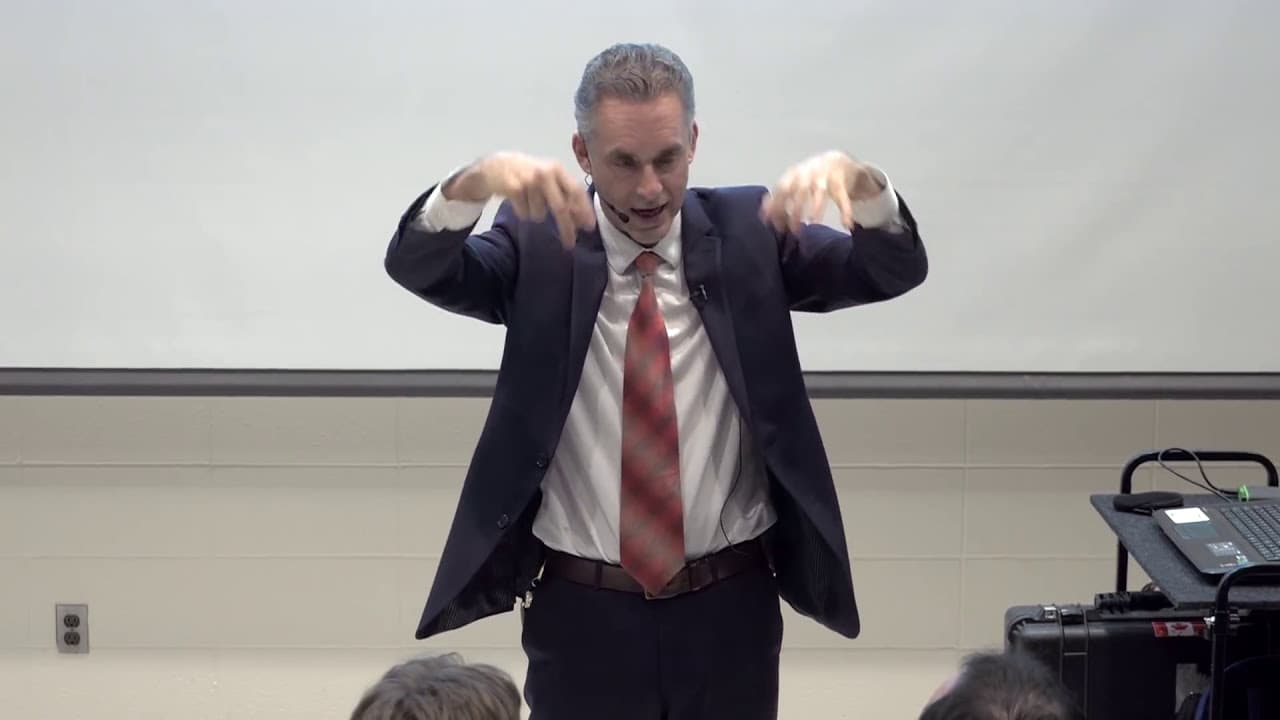
I called the course personality and its transformations and I think you could think about that as a restatement of the idea of being and becoming and that's what you are you're for whatever that means you're an entity that both is and is transforming and there's a rule that goes along with that by the way which is don't sacrifice who you could be f... Read More
Key Insights
- Human identity is both being and becoming. A person is who they are now, but also the process capable of transforming that present identity, which makes positive development more important than preserving a current position at any cost.
- Positive transformation requires releasing pathological attachments. Harmful habits, relationships, and ways of thinking may feel like parts of the self, yet growth depends on allowing those patterns to fall away rather than sacrificing future potential to maintain them.
- People often know which behaviors are harming them. Asking honestly what should be stopped can quickly reveal many recognized problems, while uncertain or seemingly unchangeable issues can be left alone until a clearer course of action becomes available.
- Clinical change begins with specifying a meaningful goal. A clinician can help explore possibilities through negotiated dialogue, but the individual must decide whether an aim is sufficiently compelling to motivate daily action and sustained effort.
- Persistence matters more than initial competence. People should expect to perform badly while practicing unfamiliar patterns, because tiny improvements accumulated through continued effort can gradually produce the transformation they are seeking.
- Scientific description intentionally removes value judgments. This makes science powerful for examining objective phenomena, but it also means that collections of facts cannot, by themselves, determine which facts matter or how a conscious person should act.
- Direction is necessary for positive emotion. Goals and value structures organize action toward a desired future, generate the positive emotion needed for movement, and provide psychological protection against pain, terror, and tragedy.
- Workable values are constrained by cooperation and consequences. An interpretive framework must function with other people over repeated interactions and must produce the outcomes it predicts when embodied through action, rather than existing only as a private preference.
- Related book: 12 Rules for Life
- Export your Kindle highlights to Glasp: How to Download Highlights and Notes from Kindle
Install to Summarize YouTube Videos and Get Transcripts
Explore YouTube Video Summarizer or Get YouTube Transcript Extractor
Questions & Answers
Q: How should a person begin positive personal transformation?
A person can begin by asking which habits, attachments, relationships, or ways of thinking they already know are making life worse. The immediate task is not to solve every uncertain problem. It is to stop one clearly recognized behavior that could be abandoned, observe what happens, and place future potential above the comfort of maintaining the present position.
Q: Why should becoming take priority over remaining who you are?
Becoming should take priority because a person is not only a fixed present identity but also the process that can transform that identity. Preserving every current habit or attachment can sacrifice future potential. When the choice is between remaining in the same position and moving in a genuinely positive direction, transformation better reflects the developing part of human identity.
Q: What does the Phoenix symbolize in personal development?
The Phoenix symbolizes the painful structure of renewal. Rebirth is attractive, but it requires an older form to deteriorate and burn away first. In personal development, the image represents allowing harmful habits, attachments, and patterns of thought to disappear so that a different mode of being can emerge from what remains.
Q: How does clinical psychology help someone change their life?
Clinical psychology can help a person examine why life is not what it could be, imagine a better possibility, and identify the changes required to approach it. The process should be a negotiated dialogue because the clinician cannot simply dictate another person's life. The individual must choose meaningful goals, practice new behaviors, and persist despite poor initial performance.
Q: Why can objective facts not determine how people should act?
Objective facts cannot independently determine action because scientific description removes value propositions from its account of the world. There are also infinitely many facts, and the facts themselves do not identify which ones should guide a decision. A person therefore needs an additional value structure or narrative framework that selects relevant information and directs conduct toward a desired future.
Q: Why do people need goals and a value structure?
People need goals because direction produces primary positive emotion and supports movement through life. Positive emotion also helps protect a person against pain and terror. A value structure divides the present world from a possible better world, identifies an endpoint, and organizes action so that the person can move toward that endpoint rather than remain directionless.
Q: What limits the values a person can reasonably adopt?
A value structure cannot function solely as a private preference because people must share space and interact over time. It must permit games and patterns of cooperation that others are willing to continue. If a framework repeatedly causes conflict, abandonment, or catastrophic disintegration, social reality constrains it and demonstrates that it is not workable for sustained common life.
Q: How does a pragmatist test whether a belief is true enough?
A pragmatist lays out an interpretation with a predicted endpoint, embodies that interpretation through action, and observes whether it produces the intended result. If the outcome does not occur, the framework fails by the standards of its own game. A belief is true enough when it works in practice, supports cooperation, and generates the result it claims to pursue.
Summary & Key Takeaways
-
A person is both a present reality and a transforming potential. Positive development requires letting harmful habits, attachments, and ways of thinking fall away. People often already know several behaviors they could stop, so practical transformation can begin by abandoning one recognized problem and observing how life changes.
-
Clinical psychology helps people identify who they could become, choose meaningful goals, and practice the processes needed to move toward them. Initial failure is acceptable because competence develops gradually. A negotiated dialogue can clarify possibilities, but individuals must ultimately choose aims that genuinely motivate them to get out of bed.
-
Science powerfully describes objective phenomena, but its value-free method cannot independently determine how people should live. Narrative and belief organize facts into actionable frameworks. A workable value structure must support direction, cooperation over time, and outcomes that survive social resistance and the practical constraints imposed by the world.
Read in Other Languages (beta)
Share This Summary 📚
Summarize YouTube Videos and Get Video Transcripts with 1-Click
Try YouTube Summary with ChatGPT & Claude or YouTube Transcript Generator
Explore More Summaries from Jordan B Peterson 📚




Summarize YouTube Videos and Get Video Transcripts with 1-Click
Try YouTube Summary with ChatGPT & Claude or YouTube Transcript Generator