What Did the Trump-Putin Alaska Summit Achieve?
TL;DR
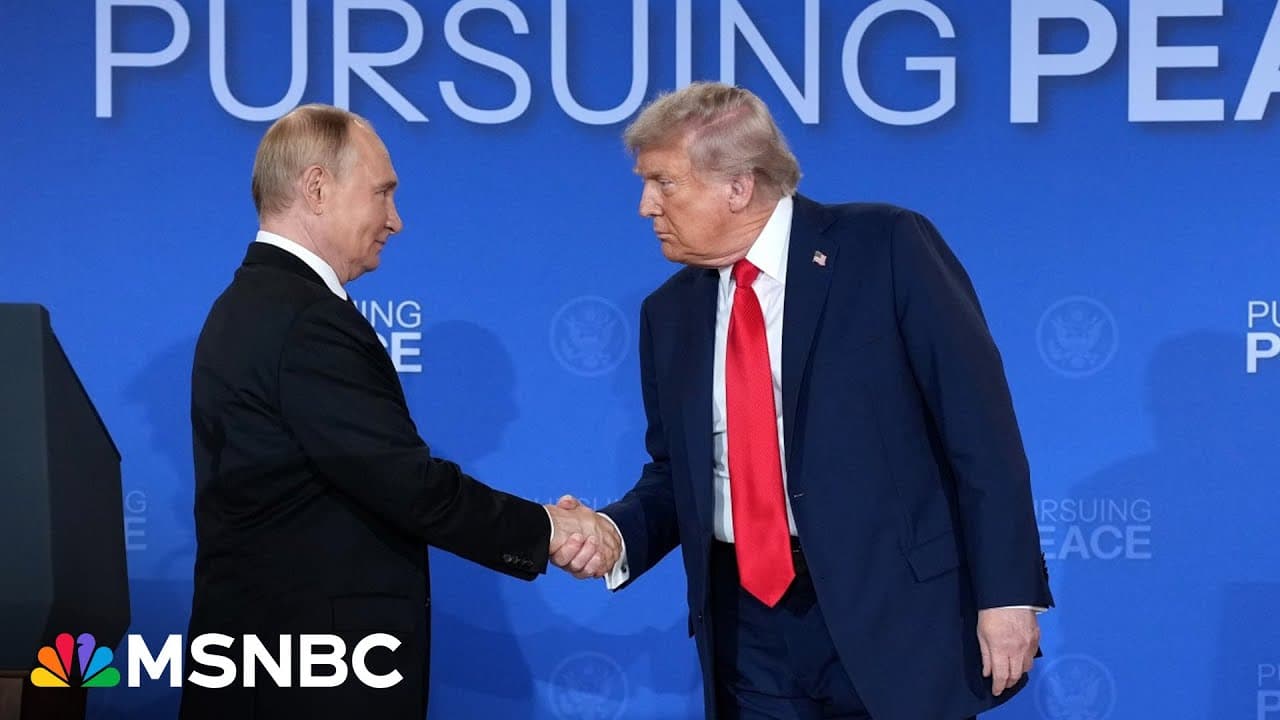
The Alaska summit produced no announced ceasefire, trilateral meeting, or other agreement between Donald Trump and Vladimir Putin. Trump described the talks as productive and claimed progress, but the panel concluded that Putin gained the clearer benefit through a warm reception, prominent military-base imagery, and renewed visibility on American soil.
Transcript
GOOD EVENING. >> ONCE AGAIN. >> I'M STEPHANIE. >> RUHLE AND IT. >> IS DAY. >> 208 OF THE SECOND TRUMP ADMINISTRATION. AND PRESIDENT TRUMP. >> IS NOW. >> ON BOARD AIR. >> FORCE ONE AND. >> HEADED BACK. >> TO WASHINGTON. >> AFTER. >> HIS SUMMIT WITH. VLADIMIR PUTIN. >> IN ALASKA. SO LET'S TALK ABOUT WHAT. >> WE KNOW. >> EACH SIDE GOT OUT. >> OF TH... Read More
Key Insights
- The summit ended without an announced ceasefire, trilateral meeting, or final agreement. Trump said many points had been settled and that progress had occurred, but he also acknowledged that major issues remained unresolved and offered no concrete public account of what had changed.
- Putin received extensive symbolic benefits from the Alaska meeting. He stepped onto American soil, walked a red carpet, appeared at a United States military base, exchanged a warm greeting with Trump, and rode privately with the president in the presidential vehicle.
- The public appearance provided unusually little information about the negotiations. Trump spoke for less than four minutes, neither leader answered questions, and both men remained vague about their private discussion, leaving observers unable to identify any tangible result beyond claimed progress.
- The summit's friendly imagery contrasted sharply with Putin's international isolation. Peter Baker noted that Putin had been sanctioned by the United States and faced an International Criminal Court arrest warrant, yet was welcomed publicly in a manner resembling the reception of an ally.
- The meeting lacked clear and consistent expectations. Trump had expressed interest in a ceasefire and consequences if Putin refused one, but he also lowered expectations by describing the encounter as a listening session, producing uncertainty about the standard for success.
- The panel viewed Trump's personal rapport with Putin as insufficient for securing policy outcomes. David Rohde said Trump administration aides believed direct meetings could unlock major agreements, but the Alaska summit offered another example in which that expectation did not produce a visible deal.
- American leadership was presented as the larger strategic concern. Kevin Baron argued that Trump should have assembled NATO leaders and applied coordinated transatlantic pressure on Russia, instead of relying primarily on a personal meeting that emphasized theater without demonstrating broader alliance leadership.
- The contrast between Putin's reception and Zelensky's treatment shaped the panel's criticism. Trump subsequently said Zelensky should make a deal because Russia was a very big power and Ukraine was not, reinforcing concerns that public pressure was being directed toward Ukraine.
Install to Summarize YouTube Videos and Get Transcripts
Explore YouTube Video Summarizer or Get YouTube Transcript Extractor
Questions & Answers
Q: What did the Trump-Putin Alaska summit achieve?
The summit produced no announced ceasefire, trilateral meeting, or final agreement. Trump said the three-hour discussion was productive, claimed that many points had been agreed upon, and reported progress on unresolved matters. However, he did not identify specific commitments or answer questions. The panel therefore concluded that there was very little tangible evidence of a substantive result.
Q: Why did the panel say Putin benefited from the summit?
The panel said Putin gained valuable public imagery and renewed visibility in the international community. He received a red-carpet welcome on American soil, appeared at a United States military base, exchanged a warm greeting with Trump, and rode with him in the presidential vehicle. These benefits were publicly visible, while Trump left without the ceasefire he had discussed before the meeting.
Q: Did Trump and Putin agree to a ceasefire in Ukraine?
No ceasefire was announced after the Alaska meeting. Trump acknowledged that there was no deal, although he said progress had been made and that many points had been settled. Peter Baker emphasized that observers had expected at least a temporary halt to hostilities, but the public statements offered no such commitment, meaning the hostilities were expected to continue.
Q: Why was the post-summit appearance criticized?
The appearance was criticized because it disclosed almost nothing about the private negotiations. Trump spoke for less than four minutes, and neither leader answered questions. Putin spoke first and at length, while Trump did not provide a detailed account of agreed points, unresolved disputes, or American principles. The panel believed this format gave Putin a platform without demonstrating a corresponding American gain.
Q: How did Trump's stated goals compare with the outcome?
Trump had signaled that he wanted a ceasefire and had mentioned consequences for Putin if one was not reached. He had also hoped for a trilateral meeting, according to the discussion. Neither outcome was announced. At other moments, Trump called the summit a listening session and warned against expecting too much, so the panel found his goals inconsistent and the result difficult to measure.
Q: What did Trump say about the success of the meeting?
Trump called the meeting very productive and said the two sides had agreed on many points while making headway on several larger ones. He also said there was no deal until an actual deal existed. In a later Fox News interview cited during the discussion, he rated the meeting ten out of ten, despite announcing no ceasefire or other concrete agreement.
Q: How did the panel compare Putin's reception with Zelensky's?
The discussion contrasted Putin's red-carpet reception with the treatment Volodymyr Zelensky had received during an earlier White House visit. After the summit, Trump said Zelensky should make a deal and emphasized that Russia was a very big power while Ukraine was not. The panel viewed this contrast as evidence that Putin received warmth while public pressure was placed on Zelensky.
Q: What alternative strategy did the panel propose for pressuring Russia?
Kevin Baron argued that Trump should have gathered NATO heads of state, demonstrated transatlantic unity, and applied the alliance's combined pressure to Russia and Putin. He considered that broader strategy more important than ceremonial details alone. In his assessment, the summit displayed theater and military imagery but did not show the coordinated American leadership needed to force a meaningful agreement.
Summary & Key Takeaways
-
Donald Trump left the three-hour Alaska summit without announcing a ceasefire or providing substantive details about progress. His public remarks lasted less than four minutes, included no questions, and acknowledged unresolved issues. Although Trump called the meeting productive and later rated it ten out of ten, the panel saw little evidence of results.
-
Vladimir Putin received a red-carpet welcome, a warm greeting from Trump, a ride in the presidential vehicle, and striking images at a United States military base. Panelists argued that these optics helped a sanctioned Russian leader regain international visibility while the continuing hostilities in Ukraine showed that American military symbolism had not changed his course.
-
The discussion contrasted Trump's friendly treatment of Putin with his earlier reception of Volodymyr Zelensky and questioned the administration's preparation, objectives, and diplomatic strategy. Commentators argued that stronger coordination with NATO leaders and clearer public principles could have demonstrated American leadership, increased pressure on Russia, and kept measurable outcomes at the center of negotiations.
Read in Other Languages (beta)
Share This Summary 📚
Summarize YouTube Videos and Get Video Transcripts with 1-Click
Try YouTube Summary with ChatGPT & Claude or YouTube Transcript Generator
Explore More Summaries from MS NOW 📚

Summarize YouTube Videos and Get Video Transcripts with 1-Click
Try YouTube Summary with ChatGPT & Claude or YouTube Transcript Generator