How to accelerate scientific discovery with AI labs
TL;DR
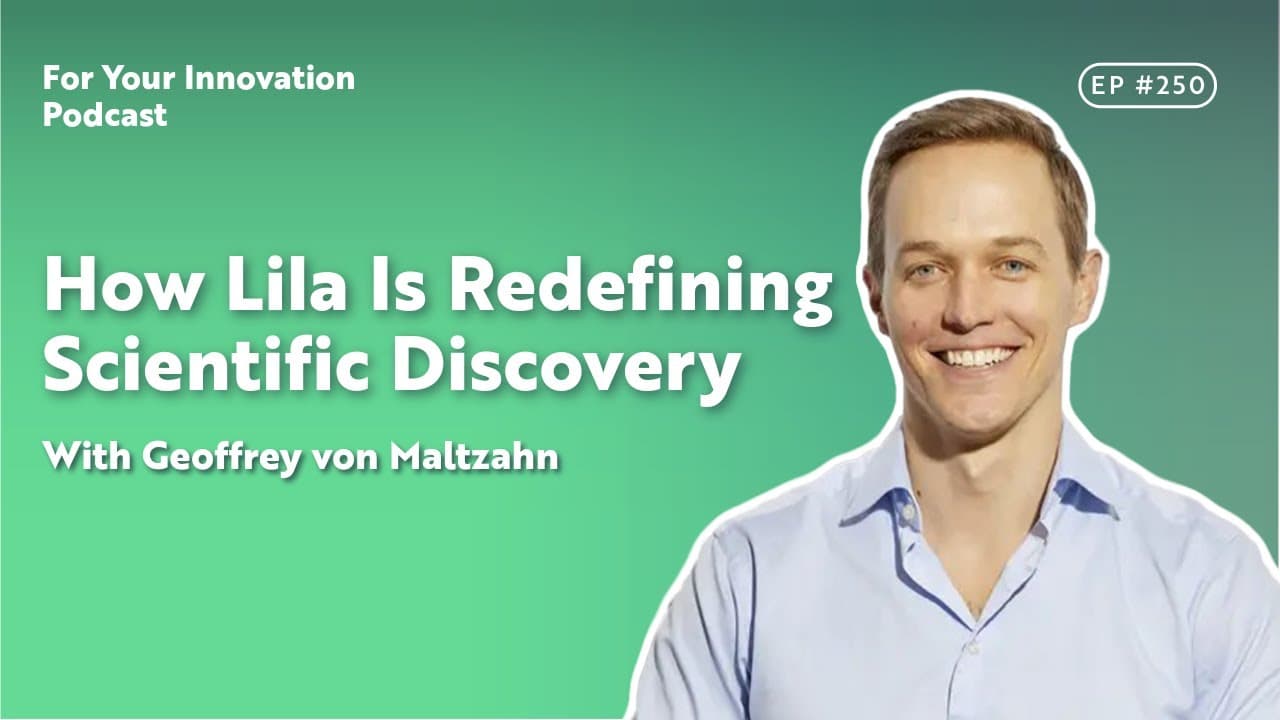
Autonomous science powered by AI and automated labs could dramatically speed up scientific discovery. By combining AI driven hypothesis generation with automated experimentation and a proprietary data engine, Laya aims to push the frontier of multiple domains while maintaining a focus on ground truth through lab validation. Proprietary data and scalable AI play central roles in sustaining advantage.
Transcript
Welcome to FYI, the 4-year innovation podcast. This show offers an intellectual discussion on technologically enabled disruption because investing in innovation starts with understanding it. To learn more, visit ark-invest.com. Ark Invest is a registered investment adviser focused on investing in disruptive innovation. This podcast is forformationa... Read More
Key Insights
- Autonomous science is the core idea, combining AI with automated labs to conduct experiments and explore search spaces across domains.
- Proprietary data provides a durable competitive edge, as public models can be matched by competitors who access secret data and methods.
- Laya’s approach treats the scientific method as a process that can be encoded and automated to increase speed, scale, and intelligence of experiments.
- AI driven reasoning engines are essential to extract needed data and guide subsequent experiments beyond simple pattern recognition.
- Ground rules and a well defined framework are necessary to let AI models navigate multi domain science while respecting lab realities.
- The conversation emphasizes the distinction between public AI progress and the need for lab grounded validation to confirm hypotheses.
- AI models will not instantly solve all science; iterative experimentation and validation remain central to progress.
- The podcast presents science as a frontier where autonomous systems can push discovery rates higher, but with careful management of data quality and interpretation.
Install to Summarize YouTube Videos and Get Transcripts
Explore YouTube Video Summarizer or Get YouTube Transcript Extractor
Questions & Answers
Q: How can AI labs accelerate discovery across multiple scientific domains?
AI labs accelerate discovery by combining intelligent hypothesis generation with automated experimentation and a proprietary data engine that guides what to test next. This approach enables rapid exploration of large search spaces, cross domain learning, and refinement of models through lab validated results. It aims to push scientific progress faster while maintaining ground truth through experiments.
Q: What is meant by autonomous science in the Lila vision?
Autonomous science refers to AI systems that can perform steps of the scientific method with minimal human intervention. This includes formulating hypotheses, designing experiments, running them in automated labs, analyzing results, and iterating on new hypotheses. The goal is to scale intelligent experimentation across materials science, chemistry and life sciences.
Q: Why is proprietary data considered essential for competitive advantage?
Proprietary data is essential because public data alone can be replicated by competitors. By combining unique datasets with specialized models and lab workflows, a company can sustain a higher level of insight and faster experimentation. This data advantage supports enduring performance as the frontier of science advances.
Q: How does Laya view the role of public versus proprietary AI models?
Laya views public AI models as offering meaningful progress but potentially limited in competitive edge. Proprietary data and controlled experimentation allow for faster, more accurate hypothesis testing and discovery. The combination aims to create a leading intelligence in science beyond what public data alone can deliver.
Q: What is the scientific method in the context of AI driven laboratories?
In this context, the scientific method is reimagined as a cycle powered by AI and automation: generate a hypothesis, design and run experiments in autonomous labs, analyze outcomes, and update or discard hypotheses. This loop accelerates learning by executing many experiments with high fidelity and at scale.
Q: What limits do current AI models face in science, according to the podcast?
Current AI models trained on publicly available data may approach certain breakthroughs but will fall short of making science fully deterministic. Ground truth from lab experiments remains essential to distinguish feasible hypotheses from speculative ones, ensuring progress is validated through physical testing.
Q: How does Laya plan to manage data quality and interpretation?
Laya plans to manage data quality by grounding AI reasoning in lab validated results and using a proprietary data engine to curate and leverage high quality datasets. This approach helps ensure interpretations are robust and decisions about which experiments to run next are well founded.
Q: What future benefits does the show suggest could come from AI driven scientific discovery?
The podcast suggests that accelerating the rate of scientific discovery could bring faster innovations, such as breakthroughs in material science and biology. By increasing the scale and speed of experiments, AI driven discovery could reduce development timelines and help address humankind’s major challenges, provided safeguards and validation remain integral.
Summary & Key Takeaways
-
Laya seeks to reinvent the scientific method by enabling AI driven autonomous experiments that operate across materials science, chemistry, and biology, using a proprietary data engine to guide lab work and hypothesis testing
-
The team distinguishes AI models trained on public data from proprietary data advantages, arguing that true competitive edge comes from the ability to run the most insightful next experiment at scale and speed
-
The episode frames scientific progress as a controllable system that can be accelerated by autonomous labs and reasoning engines, while acknowledging current limits and the need for lab verification to distinguish fact from fiction.
Read in Other Languages (beta)
Share This Summary 📚
Summarize YouTube Videos and Get Video Transcripts with 1-Click
Try YouTube Summary with ChatGPT & Claude or YouTube Transcript Generator
Explore More Summaries from ARK Invest 📚


Summarize YouTube Videos and Get Video Transcripts with 1-Click
Try YouTube Summary with ChatGPT & Claude or YouTube Transcript Generator