How to Build AI Loops That Work Autonomously
TL;DR
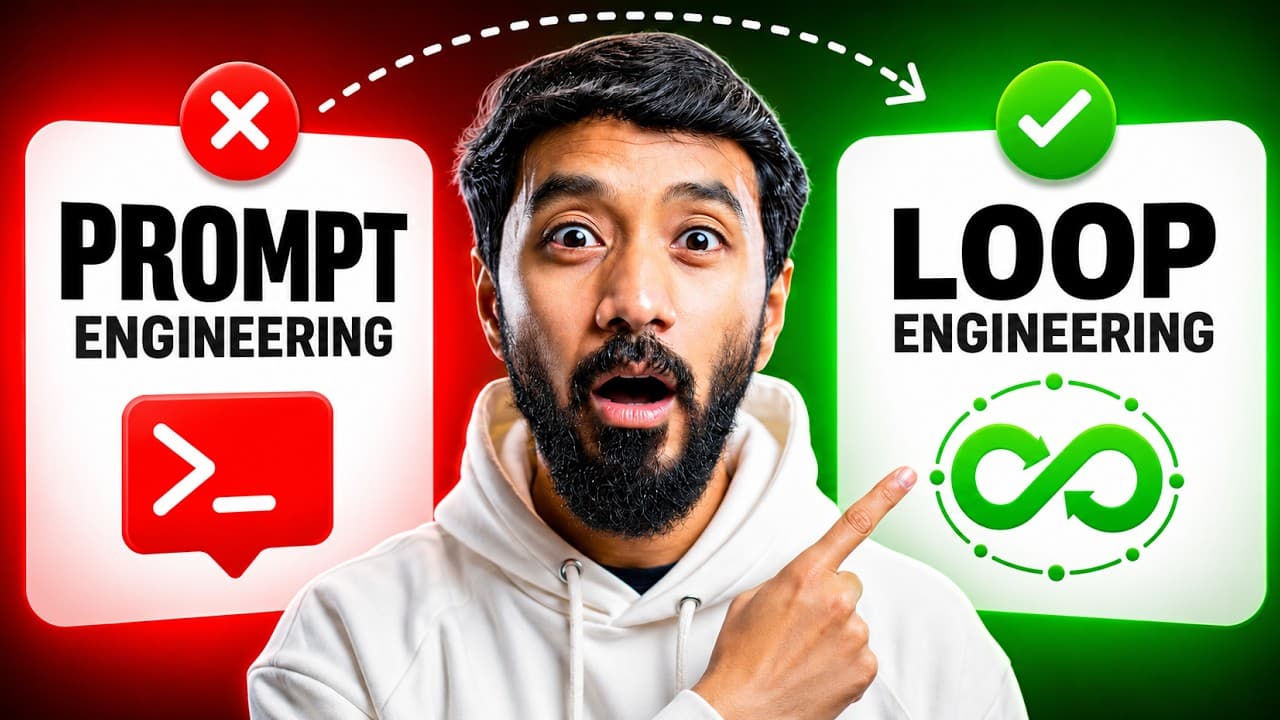
Loop engineering turns repeated manual prompting into an AI workflow that monitors conditions, remembers prior results, evaluates changes, and continues until its goal or stopping condition is reached. A reliable loop defines what to watch, how often to check, what action to take, what to remember, and when human approval is required.
Transcript
For the last 2 years, you've been doing a job you didn't even know you had. Every single time you used AI, you were doing [music] it. Let me show you what I mean. Picture it. You open ChatGPT, you type a prompt, and you wait. The answer comes back, so you read it, you check if it's any good, you fix the parts that aren't, and you type again. And th... Read More
Key Insights
- Loop engineering is the practice of defining an iterative AI workflow that can act, observe results, evaluate progress, adjust its approach, and repeat. The user establishes the goal, context, tools, memory, limits, verification steps, and conditions for stopping or requesting assistance.
- A useful loop is defined by five questions: what it should watch, how often it should check, which change it seeks, what it should do when that change occurs, and when it must stop and ask the user for guidance.
- Traditional automation is usually a fixed trigger followed by one predefined action, while an AI loop repeatedly inspects a situation until it is resolved. The loop can compare new information with prior observations, retry work, filter results, and decide whether human attention is warranted.
- Memory is essential because it allows a loop to distinguish new findings from previously handled information. A product watcher avoids duplicate availability alerts, while a job watcher remembers roles it has already presented instead of interrupting the user with identical results every day.
- Human approval is the central safety boundary for consequential actions. The product loop may detect the correct item but must never purchase it, while career and sales loops may draft messages or applications but must wait before submitting or sending anything.
- Parallel agents can reduce the time required to inspect multiple sources. The career example assigns separate agents to company job pages, while the opportunity scout uses independent scanners for Reddit, X, funding news, and technology press before combining and ranking their findings.
- A trustworthy loop reports limitations instead of implying that every check succeeded. The business opportunity example identifies sources it could not access and explains that it relied on the remaining sources, giving the user information needed to judge the completeness of the results.
- Self-improving loops can build an artifact and repeatedly evaluate and revise their own output. The website example extends the loop beyond external monitoring by using feedback and verification to continue improving something it created without requiring a fresh instruction after every iteration.
Install to Summarize YouTube Videos and Get Transcripts
Explore YouTube Video Summarizer or Get YouTube Transcript Extractor
Questions & Answers
Q: What is loop engineering in AI?
Loop engineering is the practice of designing an iterative workflow around an AI agent. Instead of manually supplying every follow-up prompt, the user defines the goal, context, available tools, memory, verification process, operating limits, and stopping conditions. The agent can then act, observe what happened, evaluate the result, adjust its next step, and continue until the work is complete or human input is genuinely required.
Q: How is loop engineering different from prompt engineering?
Prompt engineering focuses on improving an individual instruction and the answer it produces. Loop engineering defines how an AI should continue working across multiple steps. It specifies what the system monitors, how frequently it checks, what changes matter, what information it remembers, which actions it may take, and when it must stop. This moves the user from manually operating every exchange to supervising a bounded, persistent process.
Q: How are AI loops different from traditional automation?
Traditional automation commonly performs one fixed action after a predefined trigger, such as sending an email when a form is submitted. An AI loop repeatedly checks whether circumstances have changed, whether an item was already handled, whether the goal has been completed, and whether another attempt is appropriate. It continues monitoring until the situation is resolved or a condition requires human attention.
Q: What questions should you answer when designing an AI loop?
A practical loop begins with five questions. Define what the AI should watch, how often it should perform a check, which specific change it is looking for, what it should do when that change appears, and when it should stop and consult the user. These answers establish the loop's schedule, success criteria, permitted response, and human escalation boundary before autonomous work begins.
Q: How can an AI loop monitor an out-of-stock product?
The product loop can inspect a page every hour and check whether the item remains unavailable, whether its price is within budget, and whether the requested size is offered. It stays silent unless every condition is satisfied, records its latest observation to prevent duplicate alerts, and continues running in the cloud. It only notifies the user and never completes the purchase, leaving the financial decision to a person.
Q: How can an AI loop help with a job search?
A job-search loop can check selected company career pages three times a day, keep only roles in specified fields and locations, and ignore engineering positions or listings already shown. When it finds a match, it can provide the company, role, location, fit explanation, and link, then draft a short application note. It must present that draft for review instead of submitting an application on the user's behalf.
Q: How can an AI loop find potential business opportunities?
A business opportunity loop can periodically scan Reddit, X, funding announcements, hiring pages, and technology coverage for signals that an organization may need the user's service. It can grade the strength of each signal, identify a possible contact, rank the opportunities, and draft personalized outreach. The loop should never send those messages without approval, and it should disclose when particular sources were inaccessible.
Q: What makes an autonomous AI loop safe and trustworthy?
A safe loop has explicit limits, a clear stopping condition, memory of prior actions, and mandatory human approval before consequential steps. It should monitor and prepare work without independently spending money, submitting applications, or sending outreach. Trust also depends on verification and transparency: the loop should report inaccessible sources, identify judgment calls, avoid repeated alerts, and ask the user when uncertainty falls outside its defined rules.
Summary & Key Takeaways
-
Loop engineering replaces repeated human follow-up prompts with a persistent workflow. The user defines a goal, schedule, memory, tools, evaluation rules, and stopping conditions. The AI can then monitor a changing situation, decide what matters, take permitted steps, and request human input when judgment or risk exceeds its boundaries.
-
A product watcher demonstrates the basic structure. It checks availability, price, and size every hour, remains silent unless all conditions match, remembers previous observations, and avoids duplicate alerts. Its boundary prohibits purchasing, ensuring the loop handles repetitive monitoring while the user retains control over the consequential financial decision.
-
More advanced loops monitor career pages, business signals, and a website project. They can run several agents in parallel, filter and rank results, disclose inaccessible sources, draft responses without sending them, and repeatedly review their own output. These examples show how memory, verification, transparency, and human approval make persistent AI workflows useful.
Read in Other Languages (beta)
Share This Summary 📚
Summarize YouTube Videos and Get Video Transcripts with 1-Click
Try YouTube Summary with ChatGPT & Claude or YouTube Transcript Generator
Explore More Summaries from Vaibhav Sisinty 📚






Summarize YouTube Videos and Get Video Transcripts with 1-Click
Try YouTube Summary with ChatGPT & Claude or YouTube Transcript Generator