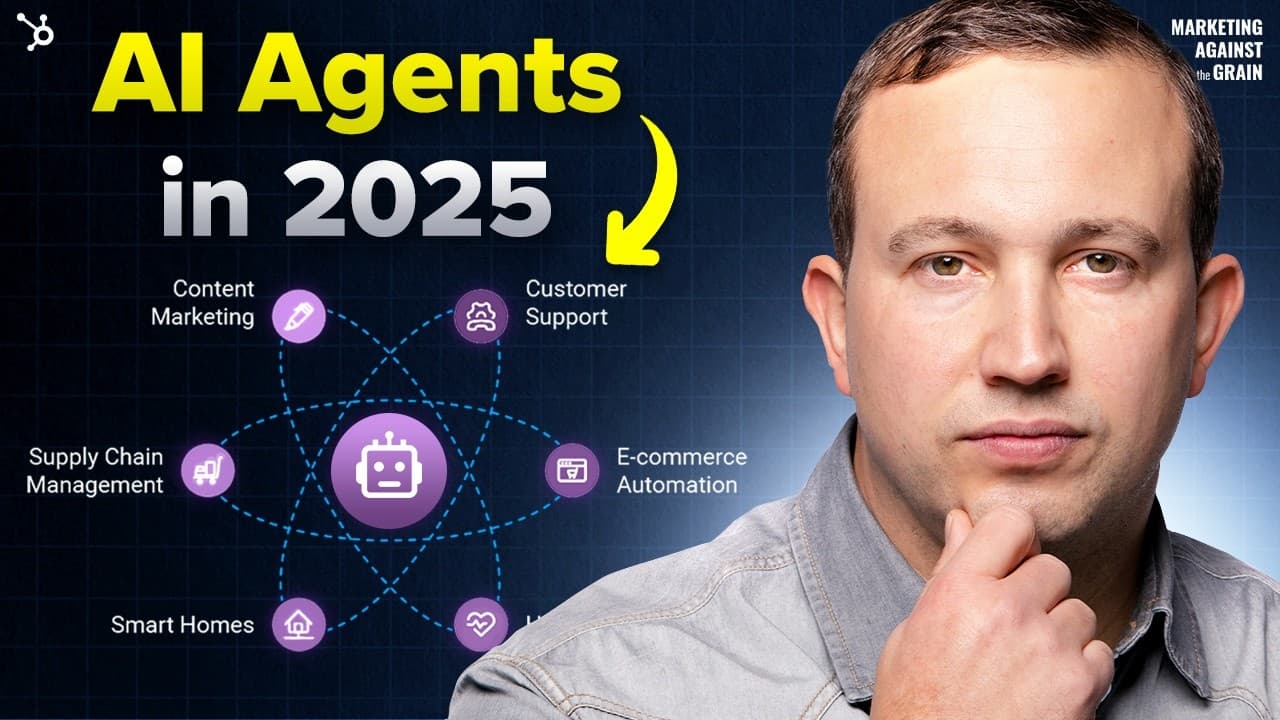
What AI Agents Really Work in 2025? Joe Mora of crewAI on Marketing Against the Grain
TL;DR
AI agents work best today as supervised systems that use memory and tools to complete bounded tasks, not as fully autonomous replacements for people. OpenAI Operator, offered through the $200-a-month ChatGPT Pro edition described in the discussion, illustrates both their potential and their current slowness. The conversation explains how agents differ from chatbots, where businesses are finding value, and why human oversight remains essential.
Transcript
This year has been called the year of AI agents. Now there's a ton of buzz about agents on YouTube, on X and actually a lot of it is wrong. A lot of these agents are not very good yet. We want to give you the actual real down low of what is happening with agents, and we're doing that with one of the best brains in the business. Joe Mora, the CEO an... Read More
Key Insights
- Agency changes the interaction: A chatbot responds to successive prompts, but an agent is given an objective and tries to determine the path independently. The important distinction is not simply better text generation. It is whether the system can continue working toward a result after the user leaves, making decisions as new steps arise.
- Reasoning enables autonomous navigation: LLMs can compare two possible emails, select one, and explain the choice. Agent systems exploit this ability to navigate a broader problem rather than only predict and present content. The reasoning process gives the agent a way to choose its next action, although present capabilities still require supervision in many practical settings.
- Memory sustains agent behavior: An isolated LLM produces output without necessarily retaining the information needed across a longer task. Memory provides a mechanism for holding relevant context as the agent works. Short-term and long-term memory can be treated separately, but the core purpose is consistent: preventing the agent from approaching every stage as an entirely disconnected interaction.
- Tools convert words into actions: Tool access lets an agent reach beyond generated text and interact with operational systems. The transcript specifically names ERP and CRM platforms as examples. This connection is what enables an agent to perform work on a user’s behalf, rather than returning instructions that a person must manually carry out in another application.
- Autonomy remains task-dependent: Calling a system autonomous does not mean it can reliably finish every assignment without assistance. Current agents are better suited to bounded activities where an imperfect or delayed result is acceptable. When the work requires high precision, difficult judgment, repeated authentication, or complex interaction, human involvement remains necessary to confirm progress and correct failures.
- Operator reveals a cost barrier: Access to OpenAI Operator is described as part of the $200-a-month ChatGPT Pro edition. One speaker contrasts that price with the $20-a-month plan they previously used. The jump illustrates that experimenting with a prominent browser agent can require a meaningful subscription upgrade before users can evaluate whether its performance fits their work.
- Browser control broadens possible tasks: Operator uses a browser created by OpenAI and navigates it from a user request. The speakers identify hotel, flight, and dinner reservations alongside general research as possible assignments. These examples show how a browser agent can gather information or progress through online workflows without the user manually visiting and searching each relevant page.
- Background work fits current strengths: Operator is most appealing when the assignment can run in the background and does not require repeated user interaction. A request to find a hotel with a pool is presented as a suitable example. The user can delegate the search and review the gathered information later, even if the agent takes longer than expected.
- Speed challenges the value proposition: The agent is described as slow, clunky, and potentially about 10 times slower than a person performing the same search. That creates a mismatch between autonomy and productivity. An agent may technically complete a task independently, yet still offer limited practical advantage when a human or an Upwork freelancer can deliver the result sooner.
- Low-precision work supports adoption: Early business use concentrates on assignments where every detail does not need to be perfect on the first attempt. Research, presentation drafts, and simple automated processes provide room for review and correction. Starting there allows organizations to test productivity benefits before trusting agents with more complex or accuracy-sensitive responsibilities.
- Central deployment preserves control: Enterprises often introduce agents through IT or dedicated AI departments instead of allowing fragmented adoption across every team. Centralization supports oversight of integrations, privacy, and security while agents connect to company systems. It also gives the organization a structured way to expand usage as teams gain confidence in the technology’s capabilities and limitations.
- Agent portfolios may signal skill: The speakers suggest that future professional value could depend partly on the quality of the agents a person has built to support their role. Someone might eventually showcase those agents on a professional profile such as LinkedIn. The underlying idea is that creating and managing useful agents could become evidence of practical workplace capability.
Install to Summarize YouTube Videos and Get Transcripts
Explore YouTube Video Summarizer or Get YouTube Transcript Extractor
Questions & Answers
Q: What is an AI agent?
An AI agent is a system with agency that receives a task and attempts to navigate toward the result autonomously. Unlike a basic chatbot, it is not limited to answering one prompt with generated content. It uses an LLM’s ability to reason among options and decide what to do next. Memory and tools help it retain information and act through other systems.
Q: How is an AI agent different from a chatbot?
A chatbot primarily responds when a user sends a prompt, such as a request to write or revise an email. An agent is assigned an objective and continues trying to solve it after the user steps away. It determines intermediate actions through reasoning instead of waiting for every instruction. This distinction matters because the agent is expected to pursue completion, not merely continue a conversation.
Q: Why do AI agents need memory and tools?
Memory lets an agent hold information while working through a task instead of treating each step as disconnected. That memory may be divided into short-term and long-term forms. Tools let the agent interact with systems such as an ERP or CRM and perform actions for the user. The two components support autonomy by combining retained context with the ability to affect external systems.
Q: What can OpenAI Operator do?
Operator is described as a browser-control agent that navigates OpenAI’s browser according to a request. It can research hotels, flights, and dinner reservations or handle broader research tasks. It works best as a background assistant when the task does not require repeated logins or extensive interaction. For example, it can look for a hotel with a pool and return the relevant information.
Q: How much does OpenAI Operator cost in the discussion?
The speakers say Operator was launched as part of the $200-a-month ChatGPT Pro edition. One speaker upgraded from a $20-a-month subscription to gain access. This creates a cost barrier before users can test the browser agent directly. The price difference also raises the question of whether its current speed and usefulness justify the upgrade for a particular workflow.
Q: Why are current AI agents not fully autonomous replacements for people?
Current agents can be slow, imprecise, and dependent on human intervention. Operator is described as clunky and about 10 times slower than a human on the illustrated search task. Complex workflows may also require logins, repeated interaction, or judgments the system cannot handle reliably. Human oversight therefore remains essential for checking accuracy, resolving obstacles, and completing high-precision work.
Q: How are businesses using AI agents today?
Businesses are starting with low-precision activities such as research, drafting presentations, and automating simple processes. Other reported applications include contract analysis, marketing data enrichment and personalization, and targeted sales insights. These uses can produce productivity improvements or cost savings while still allowing people to review the output. Companies can then expand toward more complex applications as confidence and performance improve.
Q: How are enterprises deploying AI agents safely?
Enterprise deployments are often centralized through IT or dedicated AI departments. This structure gives the organization greater control as agents connect with internal systems and business functions. Central oversight also supports attention to data privacy, security, and consistent integration. Human intervention remains part of the operating model because present agents cannot reliably handle every complex or high-precision situation alone.
Summary & Key Takeaways
-
Defining an AI agent: Joe Mora, CEO and founder of crewAI, explains that an agent must have agency. While an LLM can predict the next token and generate or revise content, an agent receives a task and attempts to navigate the problem autonomously. Instead of sustaining a chat, it reasons toward an objective after the user steps away. This capacity to choose among options and determine how to proceed separates an agent from a basic content-generation interaction.
-
Adding memory and tools: An isolated LLM primarily produces text, so agentic behavior requires additional components. Memory lets the system retain information rather than repeatedly starting without context, with both short-term and long-term memory available as deeper technical distinctions. Tools allow the agent to interact with external systems such as an ERP or CRM. Together, memory and tools let an agent preserve relevant information and take actions on the user’s behalf rather than merely suggesting what should happen.
-
Testing OpenAI Operator: The discussion uses Operator as a visible example of a browser-control agent. OpenAI launched it as part of the $200-a-month ChatGPT Pro edition, prompting an upgrade from the $20-a-month plan. Operator can navigate a browser in response to requests involving hotels, flights, dinner reservations, or research. It performs most naturally when assigned a background task that does not demand repeated logins or extensive interaction from the user.
-
Confronting present limitations: Operator may find a hotel with a pool and return useful information, but the speakers emphasize that it is slow and clunky. They estimate that it can be about 10 times slower than a human completing the same work. A freelancer hired through Upwork might finish the search sooner. The example frames current agents as a preview of future capability, while demonstrating that autonomous execution is not yet consistently faster or more practical than human work.
-
Finding practical business value: Companies are beginning with low-precision tasks, including research, presentation drafting, and simple process automation, before expanding into more complex work. Reported applications include contract analysis, marketing data enrichment and personalization, and targeted sales insights. Deployment is often centralized under IT or AI teams so organizations can maintain control over integration, privacy, and security. Despite productivity improvements and cost savings, human intervention remains important when tasks demand accuracy or involve complicated systems.
Read in Other Languages (beta)
Share This Summary 📚
Summarize YouTube Videos and Get Video Transcripts with 1-Click
Try YouTube Summary with ChatGPT & Claude or YouTube Transcript Generator
Explore More Summaries from Marketing Against the Grain 📚



Summarize YouTube Videos and Get Video Transcripts with 1-Click
Try YouTube Summary with ChatGPT & Claude or YouTube Transcript Generator