Will The Sun’s Magnetic Field Flip This Year?
TL;DR
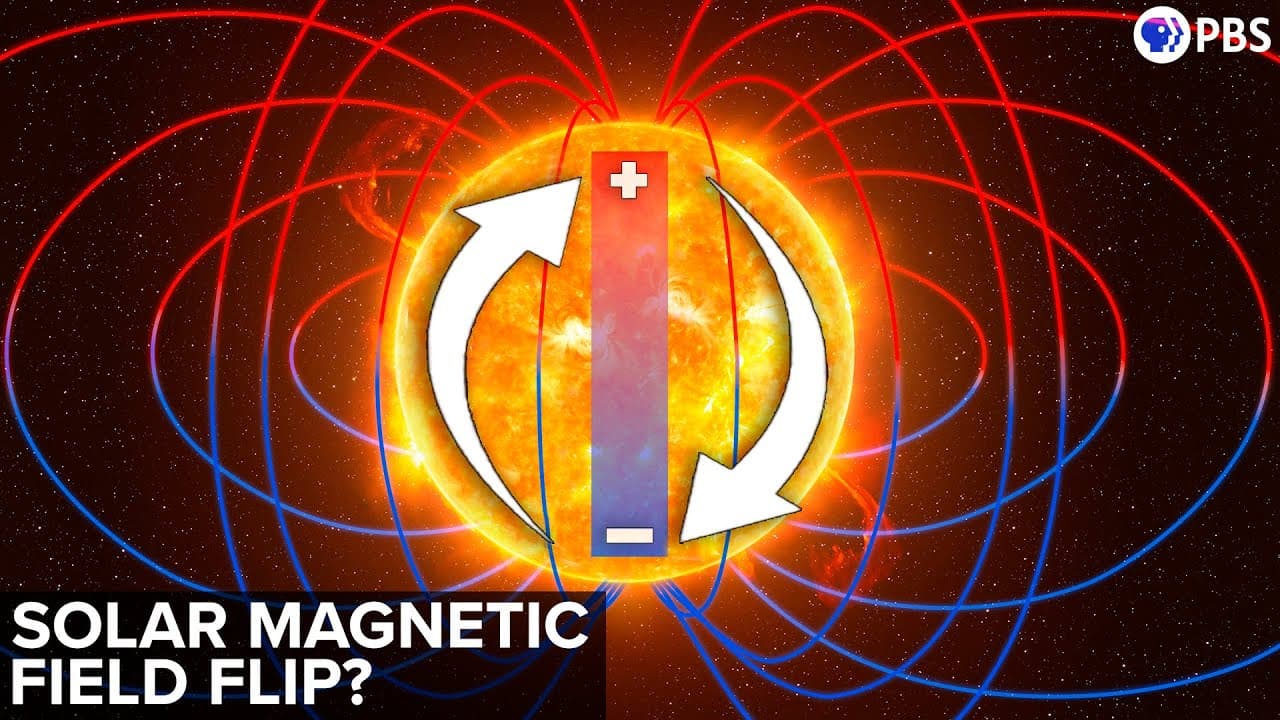
The Sun's magnetic field is flipping, causing unexpected solar activity.
Transcript
Thank you to Incogni for supporting PBS. Hey Everyone. Just letting you know there’s new limited edition Merch at the Merch store. More info at the end of the episode. May 8th, 2024. On the blazing surface of the Sun, a collection of sunspots have been growing for days, ignored by most of us but watched with fascination and some confusion b... Read More
Key Insights
- The Sun's magnetic field is currently in a cycle that is more intense than predicted, indicating a potential flip in the near future.
- Solar activity, including sunspots and coronal mass ejections, is influenced by the Sun's magnetic field and its complex interactions.
- The Sun's magnetic field is generated by the dynamo effect, similar to Earth's, but is more complex due to the Sun's fluid-like convective zone.
- Differential rotation in the Sun's convective zone leads to the twisting and coiling of magnetic field lines, resulting in sunspots and solar eruptions.
- The Sun's magnetic field undergoes an 11-year cycle, during which it flips direction, resetting the cycle.
- The current solar cycle, the 25th since monitoring began, is unexpectedly strong, defying predictions of a weaker cycle.
- Predicting solar cycle strength is challenging due to the complex dynamics of plasma and magnetic fields in the Sun.
- Historical data, including geological records, provide insights into solar cycles, showing stability in cycle duration but variability in intensity.
Install to Summarize YouTube Videos and Get Transcripts
Explore YouTube Video Summarizer or Get YouTube Transcript Extractor
Questions & Answers
Q: What causes the Sun's magnetic field to flip direction?
The Sun's magnetic field flips direction due to the winding and twisting of magnetic field lines in the convective zone. As the toroidal field intensifies, the coriolis force induces kinks that eventually reconnect into larger loops with opposite polarity. This process leads to a reversal of the global dipole field, resetting the solar cycle.
Q: How does the Sun's differential rotation affect its magnetic field?
The Sun's differential rotation, where the equator rotates faster than the poles, causes the magnetic field lines to twist and coil. This twisting transforms the poloidal field into a toroidal field, contributing to the formation of sunspots and solar eruptions. The differential rotation is a key factor in the Sun's magnetic cycle dynamics.
Q: Why is predicting solar cycle strength challenging?
Predicting solar cycle strength is challenging due to the complex nature of the Sun's magnetic field and plasma interactions. Factors such as the reconstruction of the poloidal field from chaotic fields and the variability in cycle duration add to the difficulty. Current predictive models rely on crude metrics, highlighting the need for more sophisticated simulations.
Q: What role does magnetic buoyancy play in solar activity?
Magnetic buoyancy causes tubes of magnetic flux to rise to the Sun's surface. As the toroidal field winds up, stronger magnetic buoyancy leads to more field lines pushing to the surface, contributing to the formation of sunspots. This process is crucial in the dynamics of solar activity, influencing the frequency and intensity of solar eruptions.
Q: How do sunspots form on the Sun's surface?
Sunspots form when strong magnetic fields protrude from the Sun's surface, shutting down convection in those regions. This results in cooler, darker areas compared to the surrounding solar surface. Sunspots typically appear in pairs with opposite polarity, reflecting the kinks in the toroidal magnetic field lines caused by differential rotation and coriolis forces.
Q: What historical data is used to study solar cycles?
Historical data, such as geological records and isotopic measurements like Beryllium-10 in ice cores, are used to study solar cycles. These records provide insights into the duration and intensity of past solar cycles, revealing patterns and stability over millions of years. Such data helps scientists understand long-term solar activity trends and predict future cycles.
Q: What is the dynamo effect and how does it relate to the Sun?
The dynamo effect is the process by which a celestial body's magnetic field is generated through the movement of conductive fluids. In the Sun, interactions between the radiative and convective zones create swirling currents that amplify magnetic fields, sustaining a global dipole field. This effect is fundamental to the Sun's magnetic cycle and solar activity.
Q: What are the implications of the current solar cycle's unexpected intensity?
The unexpected intensity of the current solar cycle suggests a deviation from predicted trends, challenging existing models and prompting a reevaluation of solar dynamics. This cycle's strength could lead to increased solar activity, including more frequent and intense solar eruptions, affecting space weather and potentially impacting Earth-based technologies and communication systems.
Summary & Key Takeaways
-
The Sun's magnetic field is undergoing a cycle that is proving more intense than scientists initially predicted, with a potential polarity reversal imminent. This unexpected activity highlights the complexity and unpredictability of solar dynamics.
-
Solar activity, such as sunspots and coronal mass ejections, is driven by the Sun's magnetic field, which is generated by the dynamo effect. This process involves complex interactions in the Sun's interior, particularly in the fluid-like convective zone.
-
Predicting the strength and duration of solar cycles is challenging due to the intricate dynamics of the Sun's magnetic field. Historical data, including geological records, provide valuable insights, but the current cycle has defied expectations, indicating a need for improved predictive models.
Read in Other Languages (beta)
Share This Summary 📚
Summarize YouTube Videos and Get Video Transcripts with 1-Click
Try YouTube Summary with ChatGPT & Claude or YouTube Transcript Generator
Explore More Summaries from PBS Space Time 📚
Summarize YouTube Videos and Get Video Transcripts with 1-Click
Try YouTube Summary with ChatGPT & Claude or YouTube Transcript Generator