What Happens When Mercury Contacts Aluminum?
TL;DR
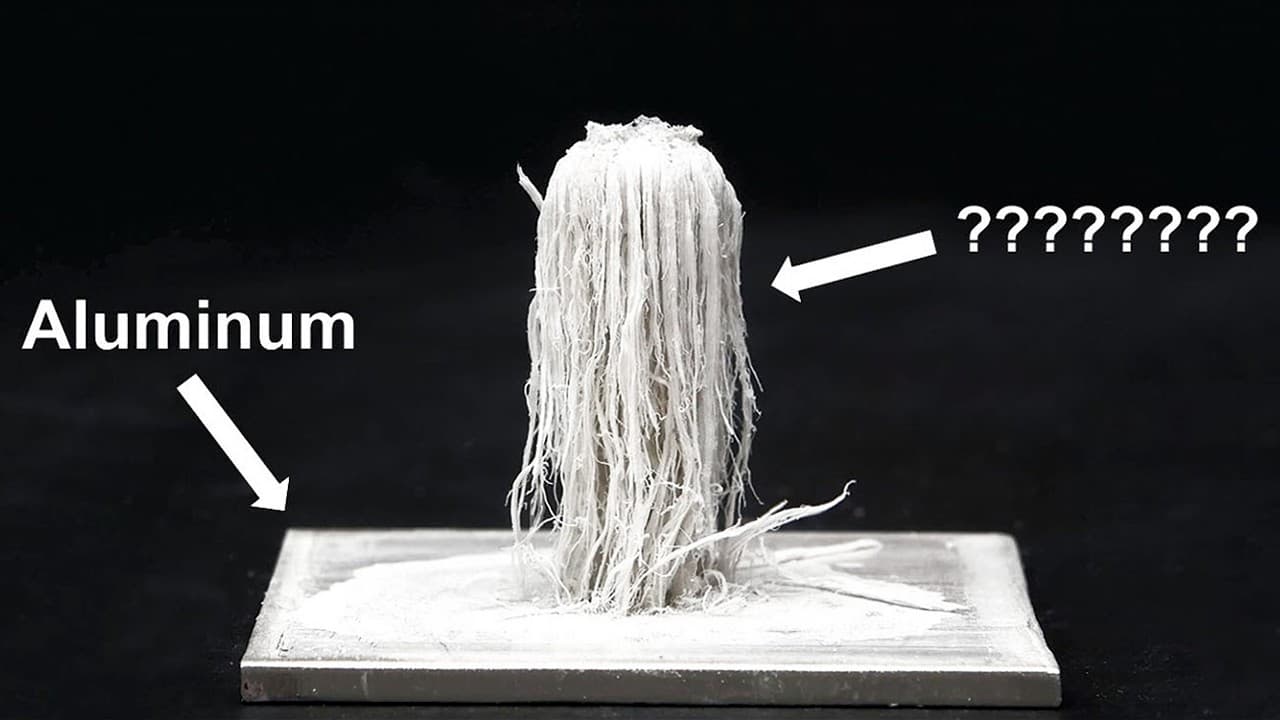
When mercury contacts aluminum, a destructive amalgamation occurs that requires the removal of aluminum's protective oxide layer. This is done by treating the aluminum with dilute hydrochloric acid, exposing fresh metal for mercury to react with and form fragile aluminum oxide fibers. The amalgamation process compromises the structural integrity of the aluminum over time.
Transcript
Mercury forms alloys with most metals in a process known as amalgamation. Last week, I messed around and tested it out with some gold leaf, and it was pretty cool. This time though, I'm going to see what happens when I add it to aluminum. It's supposed to be quite destructive, which is why you're not allowed bringing mercury on a plane. So I went ... Read More
Key Insights
- 🤘 Mercury forms alloys through amalgamation with most metals.
- ❓ Removal of the oxide layer on aluminum is necessary for mercury-aluminum reactions.
- 🥺 Mercury dissolved in the aluminum can lead to the formation of aluminum oxide fibers.
- 🥼 The amalgamation process coats the surface with an oxide layer, preventing further growth of fibers.
- ❓ The amalgamation reaction between mercury and aluminum is commonly used in reduction reactions in chemistry.
- ⌛ The destructive effects of mercury on aluminum require a significant amount of time or continuous removal of oxide layers.
- 🧂 Soluble mercury salts are often used in place of metallic mercury for reactions with aluminum.
Install to Summarize YouTube Videos and Get Transcripts
Explore YouTube Video Summarizer or Get YouTube Transcript Extractor
Questions & Answers
Q: What happens in the aluminium and mercury reaction?
Mercury combines with the aluminum to form an aluminum amalgam. Some of that amalgam dissolves into the mercury and travels to the surface, where it meets oxygen in the air and reacts to form white aluminum oxide. This grows as fibers out from the sides, and over about four hours it left the plate weak and fragile.
Q: Why is mercury not allowed on planes?
Mercury is destructive to metals like aluminum, which is what many aircraft are built from. Through amalgamation the mercury can creep along and even penetrate deeper into the aluminum, compromising its structural strength, so it is banned from flights.
Q: Why doesn't mercury react with aluminum at first?
Under normal conditions aluminum is surrounded by a protective oxide layer, and metallic mercury cannot penetrate through this barrier, so nothing happens. In the video, trying to scratch the oxide away manually, using a drill, and even leaving it for about an hour all failed to start the reaction.
Q: Why add hydrochloric acid before the mercury?
Dilute hydrochloric acid quickly reacts with the oxide layer and dissolves it away, exposing fresh aluminum metal underneath. The acid is left for about a minute and then removed. Because the oxide starts reforming immediately, the mercury has to be added quickly so it can reach the bare metal.
Q: What is aluminium amalgam and how do the fibers form?
Aluminum amalgam is the combination of aluminum and mercury. As it forms, some dissolves into the mercury drop and rises to the top, where contact with air turns it into white aluminum oxide. That spot quickly gets covered and protected, so fibers instead keep growing out from the sides as dissolved mercury creeps along and amalgamates more aluminum.
Q: How much aluminum oxide formed and how strong was the plate afterward?
Although the oxide looked like a lot, weighing it showed only about 200 milligrams. When poked, the amalgamated aluminum was not structurally strong and was surprisingly fragile, which is why the plate could be cut in half to inspect the damage.
Q: Does the amalgamation keep going forever, or does it stop?
When the main mercury drop was removed, the reaction slowed and then stopped. The likely reason is that the remaining mercury has all amalgamated with aluminum and become hidden under the oxide layer, so without an excess drop there is no free mercury to creep out and make more amalgam.
Q: What changes if you add water instead of running the reaction dry?
Adding water prevents the oxide fibers from forming and instead produces bubbling all over the surface. Here the amalgam reacts with the water rather than air, forming aluminum hydroxide and hydrogen gas. The bubbles appearing everywhere showed that amalgam was still present, just trapped under the gray oxide.
Summary & Key Takeaways
-
Mercury forms alloys with metals through amalgamation, and this video focuses on the reaction between mercury and aluminum.
-
Initially, the oxide layer on the aluminum prevented the mercury from reacting, so the oxide was chemically dissolved using hydrochloric acid.
-
The amalgamation process resulted in the formation of aluminum oxide fibers and the dissolution of mercury into the aluminum.
Read in Other Languages (beta)
Share This Summary 📚
Summarize YouTube Videos and Get Video Transcripts with 1-Click
Try YouTube Summary with ChatGPT & Claude or YouTube Transcript Generator
Explore More Summaries from NileRed 📚
Summarize YouTube Videos and Get Video Transcripts with 1-Click
Try YouTube Summary with ChatGPT & Claude or YouTube Transcript Generator