How Does Acid and Heat Change Lead Sponge?
TL;DR
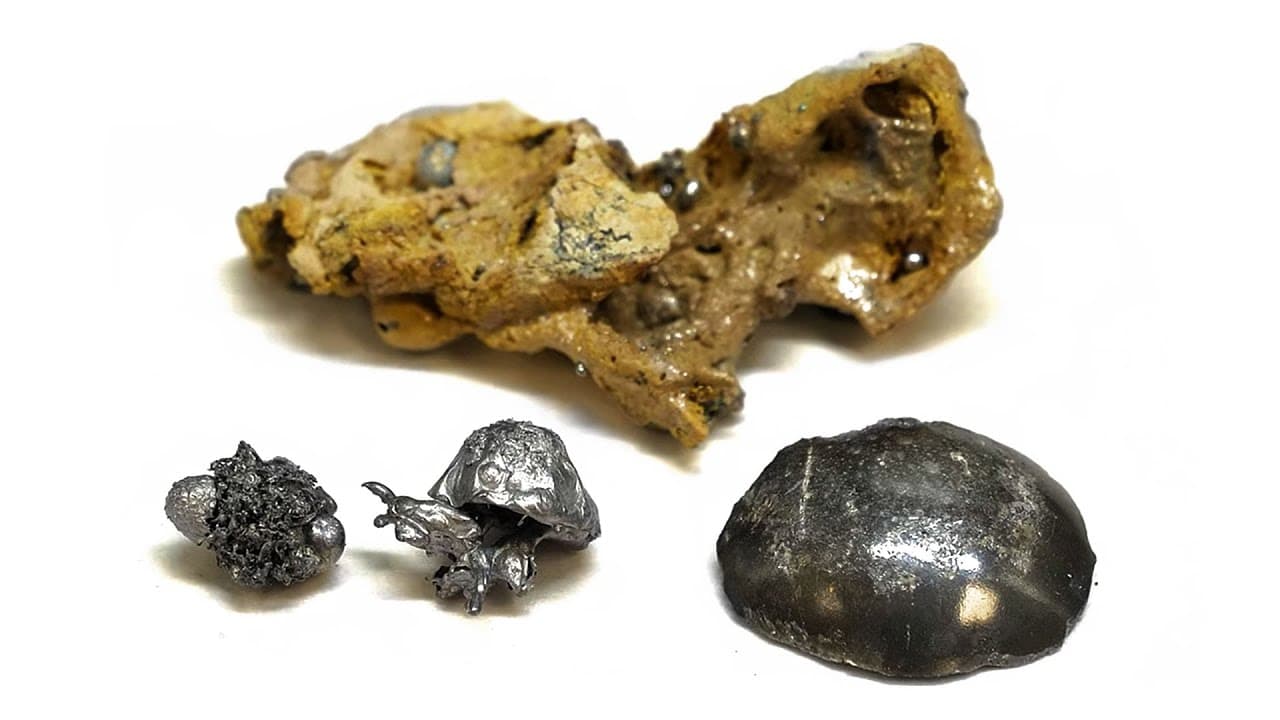
Hydrochloric acid made the lead sponge weaker and much easier to melt by removing zinc metal and possibly dissolving higher-melting lead and zinc compounds. The untreated sponge sank because its connected pores released their air, resisted a propane torch, and appeared to contain mostly compounds rather than pure metal, while the acid-treated material melted quickly but still contained nonconductive impurities.
Transcript
A couple months ago, I was just messing around by adding zinc powder to a solution of lead, and I accidentally ended up making lead sponge. As far as I could tell, when the zinc powder was added, small strands of lead metal grew from the surface of each zinc particle. The strands from one particle would overlap the strands of other particles, and i... Read More
Key Insights
- Lead sponge is a porous, brittle material formed when zinc powder is added to a lead solution, apparently causing small lead strands to grow from zinc particles and overlap with neighboring strands in a friction-bound network.
- The dried sponge does not float because its porous structure appears to contain connected passages rather than sealed air pockets. When placed in water, trapped air escaped, allowing the lead and zinc material to sink instead of receiving enough buoyancy to remain afloat.
- Hydrochloric acid reacts with zinc in the sponge and produces hydrogen gas, which accounts for the visible bubbling. The treatment also produced a white precipitate, attributed to leftover lead acetate first forming lead chloride and then soluble chloride complexes.
- Acid treatment weakens the sponge because removing zinc eliminates important anchoring points for the proposed lead-strand network. After soaking overnight and repeated distilled-water washing, the treated material broke apart easily and was noticeably more fragile and brittle than the original sample.
- The grayish-white surface of the acid-treated sponge is attributed to lead carbonate formation. The proposed explanation is that freshly exposed lead slowly reacts with carbon dioxide in air, changing the initially blackened material during several days of drying.
- The untreated sponge resists melting under a propane torch despite lead and zinc having stated melting points of about 328 C and 420 C. Its resistance suggested that much of the sample consisted of lead and zinc compounds rather than low-melting elemental metals.
- The acid-treated sponge melts far more readily than the untreated sample, liquefying almost immediately under the propane torch. The proposed explanation is that acid removes zinc metal and higher-melting compounds, leaving a greater proportion of low-melting lead metal behind.
- The melted acid-treated material is not pure metal because its conductivity is inconsistent across different contact points. Its partially transparent melted regions and uneven electrical response indicate that metallic lead remains mixed with salt compounds or other nonconductive impurities.
Install to Summarize YouTube Videos and Get Transcripts
Explore YouTube Video Summarizer or Get YouTube Transcript Extractor
Questions & Answers
Q: How is lead sponge formed from zinc powder?
Lead sponge formed accidentally when zinc powder was added to a solution of lead. The proposed structure consists of small strands of lead metal growing from the surfaces of individual zinc particles. Strands from neighboring particles overlap, producing a solid but weak network that appears to be held together largely by friction rather than by a dense, continuous metallic structure.
Q: Why does porous lead sponge sink in water?
The lead sponge sinks because its pores appear to form a connected network instead of isolated, sealed air pockets. When the sample enters water, the air can escape from the structure rather than remaining trapped to provide buoyancy. The observed sample therefore sank even though it was extremely porous and initially contained a substantial amount of air.
Q: What happens when lead sponge is treated with hydrochloric acid?
Hydrochloric acid causes immediate white precipitation and bubbling, then makes the sponge substantially weaker. The bubbling comes from hydrogen gas produced as the acid reacts with zinc. The white material was attributed to leftover lead acetate forming insoluble lead chloride, which then combines with additional chloride ions to form soluble complexes. After overnight treatment, the sponge became blacker and fragile.
Q: Why does hydrochloric acid weaken the lead sponge?
Hydrochloric acid weakens the sponge by dissolving zinc that may serve as the anchoring points for its lead strands. If lead strands originally grew from individual zinc particles, removing those particles eliminates a major source of structural stabilization. Consistent with that explanation, the washed, acid-treated sponge fell apart easily and required more careful handling than the untreated material.
Q: Why does acid-treated lead sponge turn grayish white?
The acid-treated sponge became grayish white after it was washed and left to dry for several days. The proposed explanation is that freshly exposed lead metal slowly reacts with carbon dioxide in air and forms white lead carbonate on its surface. This interpretation was considered expected, although the experiment did not independently identify the surface material.
Q: Why does untreated lead sponge resist melting?
Untreated lead sponge resisted a propane torch and only melted slowly when a hotter MAPP gas torch was used. Because the transcript gives melting points of about 328 C for lead and 420 C for zinc, a mostly metallic sample should have melted more easily. The resistance therefore indicated that the sponge contained substantial amounts of higher-melting lead and zinc compounds.
Q: Why does acid-treated lead sponge melt more easily?
The proposed explanation is that hydrochloric acid removes zinc metal along with lead and zinc compounds, leaving a larger proportion of lead metal, which has the lowest stated melting point among the expected components. Removing higher-melting material would sharply reduce the temperature needed for liquefaction. The removal was not considered complete, so salts or other compounds likely remained after melting.
Q: Is the melted acid-treated sponge pure lead metal?
The melted product is not pure metal, even though it looks substantially more metallic than the heated untreated sponge. Its electrical conductivity was inconsistent, and readings could only be obtained at certain points. A continuous piece of metal should conduct regardless of where the contacts touch. Partially transparent regions also suggested a mixture of metal and salt compounds rather than pure lead.
Summary & Key Takeaways
-
The original lead sponge formed when zinc powder was added to a lead solution. Lead strands appeared to grow from zinc particles and overlap, creating a porous structure held together by friction. The wet material resembled soft clay, while drying made uncompressed samples hard, rocklike, brittle, and filled with connected air spaces.
-
The dried sponge sank in water because its porous network did not retain isolated air pockets. Hydrochloric acid produced white precipitate and hydrogen bubbling, then weakened the structure by removing zinc. After washing and air drying, the material became grayish white, likely because lead on its surface formed white lead carbonate.
-
Heating revealed major differences between untreated and acid-treated samples. The untreated sponge resisted propane heating and required hotter MAPP gas to melt partially, suggesting abundant lead and zinc compounds. The acid-treated sample liquefied immediately under propane, looked more metallic after cooling, but showed inconsistent conductivity and therefore was not pure metal.
Read in Other Languages (beta)
Share This Summary 📚
Summarize YouTube Videos and Get Video Transcripts with 1-Click
Try YouTube Summary with ChatGPT & Claude or YouTube Transcript Generator
Explore More Summaries from NileRed 📚
Summarize YouTube Videos and Get Video Transcripts with 1-Click
Try YouTube Summary with ChatGPT & Claude or YouTube Transcript Generator