Why Does Space Dust Challenge Our Understanding of the Universe?
TL;DR
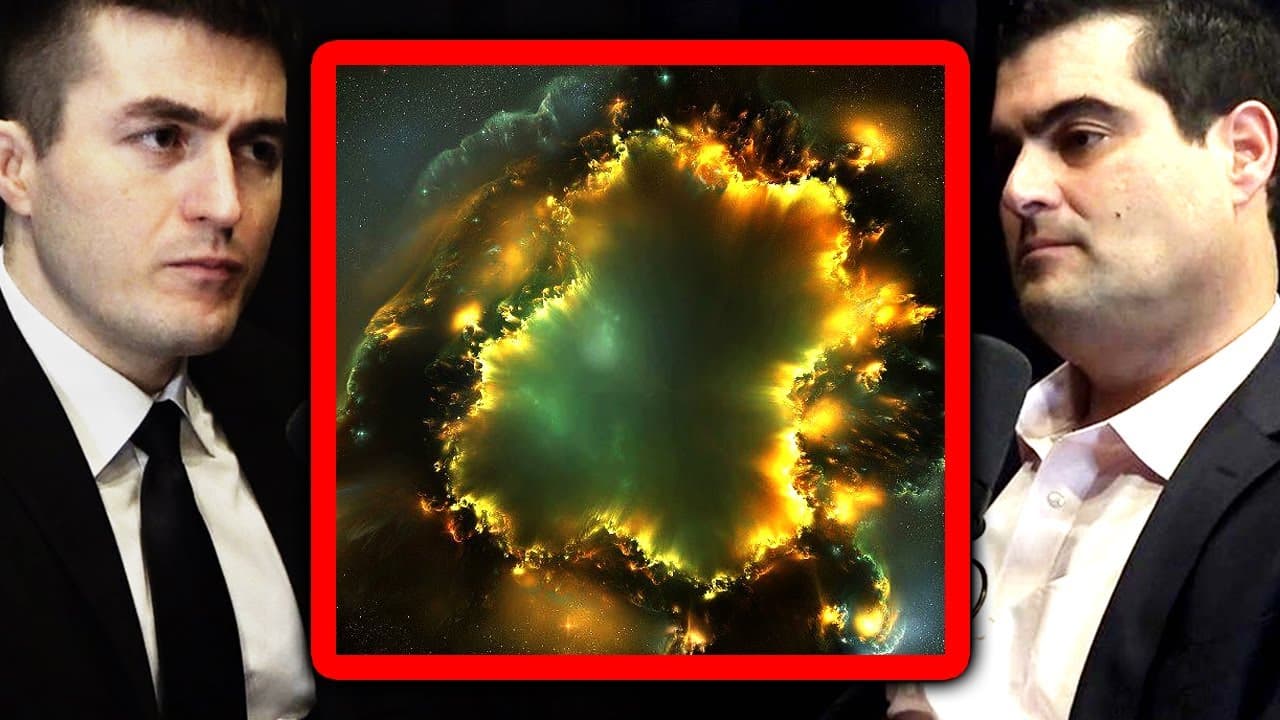
Space dust obstructs astrophysicists and cosmologists in their quest to study the universe's origin, evolution, and composition. This disruptive material complicates the detection of key signals like gravitational waves and the Cosmic Microwave Background, leading to significant implications for our understanding of cosmic phenomena.
Transcript
you didn't win the nobel prize the team of bicep that led the bicep 2 didn't win the nobel prize because of some space dust that's right uh kick uh which one is the moon which one is that one's the dust the space dust yeah what are we looking at so why why is space dust the the villain of this whole story well it's funny you know i wrote these book... Read More
Key Insights
- ❓ Astrophysics focuses on studying physical phenomena in the heavens, while cosmology explores the universe as a whole.
- 🤩 Gravitational waves and the Cosmic Microwave Background are key signals scientists use to understand the cosmos.
- 👾 Space dust, consisting of particles and grains, poses challenges for observing and measuring the universe accurately.
- 👋 The detection of aftershocks of inflation, such as gravitational waves, supports the theory of inflation and the existence of a multiverse.
- 🏑 Transparency in science, including the possibility of retractions, is crucial for maintaining credibility and fostering diversity in the field.
- 🎙️ More videos with Brian Keating:
Install to Summarize YouTube Videos and Get Transcripts
Explore YouTube Video Summarizer or Get YouTube Transcript Extractor
Questions & Answers
Q: What is the difference between astrophysics and cosmology?
Astrophysics studies physical phenomena in the heavens, such as stars, galaxies, and planets. Cosmology, on the other hand, focuses on the origin, evolution, and composition of the universe as a whole.
Q: How do astrophysicists use gravitational waves to study the universe?
Astrophysicists use photons from the Cosmic Microwave Background (CMB) as a film onto which gravitational waves can reverberate and create a characteristic polarization pattern. By detecting these patterns, they can glean insights into the universe's properties.
Q: Why is space dust a challenge for observing the cosmos?
Space dust, consisting of microscopic particles and grains, can interfere with telescope observations by absorbing or polarizing light. It can mimic cosmic signals and obscure the detection of faint gravitational wave patterns.
Q: What is the significance of detecting the aftershocks of inflation?
Detecting the aftershocks of inflation, such as gravitational waves, confirms the theory of inflation and provides evidence for the existence of a multiverse. This has profound implications for our understanding of the universe's origins.
Summary & Key Takeaways
-
Space dust poses a challenge for astrophysicists and cosmologists in studying the origin, evolution, and composition of the universe.
-
While astrophysics focuses on physical phenomena in the heavens, cosmology is concerned with the universe as a whole.
-
Gravitational waves and the Cosmic Microwave Background are among the signals scientists look for to understand the cosmos.
Read in Other Languages (beta)
Share This Summary 📚
Summarize YouTube Videos and Get Video Transcripts with 1-Click
Try YouTube Summary with ChatGPT & Claude or YouTube Transcript Generator
Explore More Summaries from Lex Clips 📚



Summarize YouTube Videos and Get Video Transcripts with 1-Click
Try YouTube Summary with ChatGPT & Claude or YouTube Transcript Generator