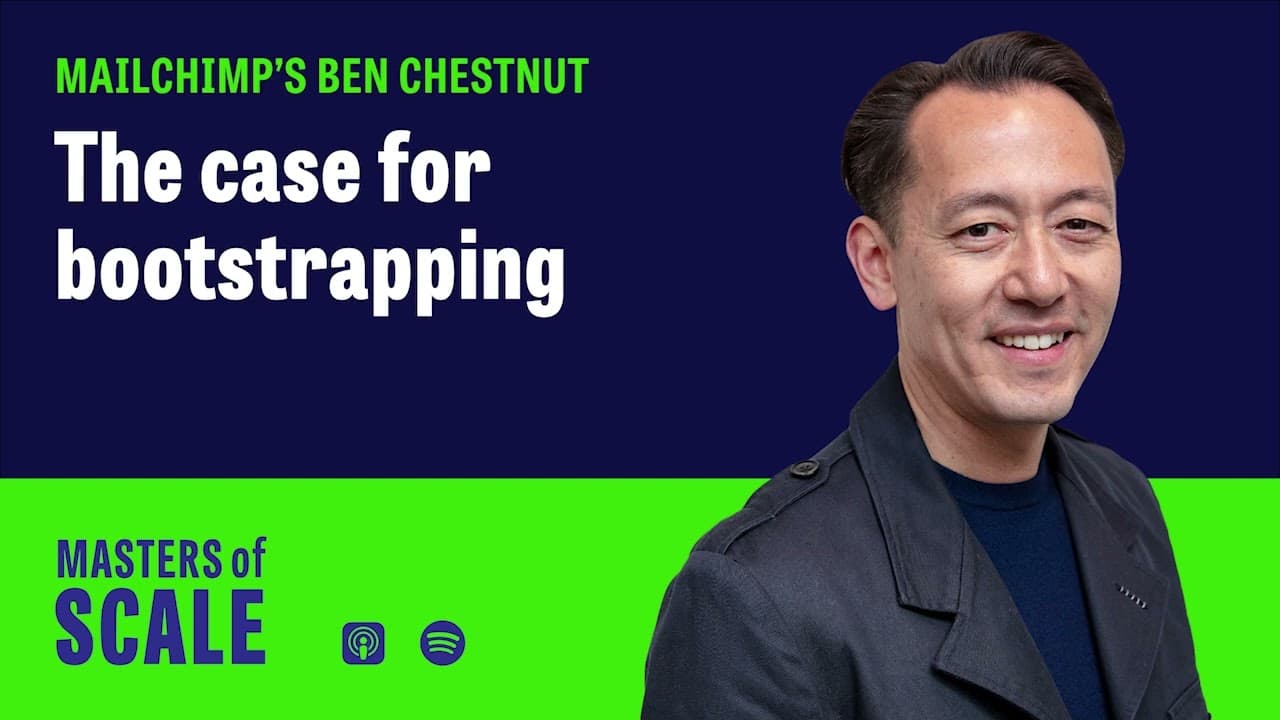
How Did Mailchimp Scale Without Outside Funding?
TL;DR
Mailchimp scaled to $600 million without outside funding by emphasizing a DIY approach and leveraging customer feedback. The freemium model allowed users to try the product for free, creating a viral loop that boosted growth. Effective use of new technologies and strategic decisions helped Mailchimp overcome early stagnation and drive continuous improvement.
Transcript
(suspensive music) - To be an artist has always required that you find a way to solve for the financial equation of the cost of producing your art. In the old days it was a sponsorship system, in Medieval times, which was one of the greatest explosions of art culture on the planet, it was all about finding a rich patron to support you. That dynamic... Read More
Key Insights
- Bootstrapping requires creating your own luck and leveraging new technologies to minimize costs while scaling effectively.
- Mailchimp's early stagnation was overcome by listening to customer feedback, which led to rapid feature development and user retention.
- Freemium models can significantly boost user acquisition by allowing potential customers to try before they buy, creating a viral loop.
- The importance of finding investors who understand and align with your vision cannot be overstated; mismatched investors can hinder growth.
- Crowdfunding can be a viable alternative for early-stage entrepreneurs, especially when traditional funding avenues are inaccessible.
- Ben Chestnut of Mailchimp emphasizes the power of simplicity and customer feedback in driving product development and scaling.
- Mailchimp's success was partly due to its timing, as it capitalized on the rise of SaaS and managed hosting services.
- Investors can offer more than just money; they provide strategic advice and networks that can accelerate growth significantly.
Install to Summarize YouTube Videos and Get Transcripts
Explore YouTube Video Summarizer or Get YouTube Transcript Extractor
Questions & Answers
Q: How did Mailchimp bootstrap its way to becoming a $600M company?
Mailchimp grew without outside funding by using its own revenue, listening closely to customers, and rapidly building requested features. It also benefited from managed hosting services and AWS, adopted freemium to attract users, and used platforms such as Twitter to support growth.
Q: Why did Ben Chestnut decide against taking VC funding for Mailchimp?
Ben Chestnut was influenced by the early-2000s tech bubble and by investors who encouraged Mailchimp to pursue enterprise customers. He wanted to retain control and keep the company focused on empowering small businesses.
Q: How did Mailchimp overcome stagnation and user loss?
Mailchimp created a toll-free number so customers could submit feature requests directly. The team turned that feedback into a prioritized feature list and developed the requested improvements rapidly, helping retain users and restart growth.
Q: What role did freemium play in Mailchimp's growth?
Freemium let potential customers try a limited version of Mailchimp without paying. This increased user acquisition and created a viral loop as more people tried the service and spread the word.
Q: How did new technology help Mailchimp scale without external funding?
Mailchimp benefited from the rise of SaaS, managed hosting services, and AWS. These technologies reduced storage costs and the need for heavy infrastructure investment, making self-funded scaling more feasible.
Q: What does the episode say bootstrapping requires?
Reid Hoffman argues that a company can bootstrap to scale only by catching multiple waves of good fortune. The episode also emphasizes scrappiness, moderate growth, contained risk, and using new technologies to keep costs manageable.
Q: How did LeVar Burton fund the Reading Rainbow app after investors declined?
After months of unsuccessful meetings with Silicon Valley investors, LeVar Burton launched a Kickstarter campaign with a $1 million goal. The campaign raised $6.4 million, mostly from small donations, and included $1 million from Seth MacFarlane.
Q: What funding alternatives to traditional VC are discussed?
The episode presents bootstrapping and crowdfunding as alternatives to traditional VC funding. Bootstrapping uses the company’s own revenue, while crowdfunding can provide both capital and evidence of market demand from supporters.
Summary & Key Takeaways
-
Mailchimp's Ben Chestnut built a $600M company without outside funding, emphasizing a DIY ethos and leveraging new technologies. The company initially struggled with stagnation but overcame it by listening to customer feedback and rapidly developing new features.
-
The freemium model played a crucial role in Mailchimp's growth, allowing users to try the product for free and creating a viral loop. This approach, alongside strategic use of new platforms like Twitter, helped Mailchimp scale rapidly.
-
Finding investors who understand and align with your vision is crucial, as mismatched investors can hinder growth. Crowdfunding offers a viable alternative for early-stage entrepreneurs, providing both funding and market validation.
Read in Other Languages (beta)
Share This Summary 📚
Summarize YouTube Videos and Get Video Transcripts with 1-Click
Try YouTube Summary with ChatGPT & Claude or YouTube Transcript Generator