Why Constant Learners All Embrace the 5 Hour Rule
TL;DR
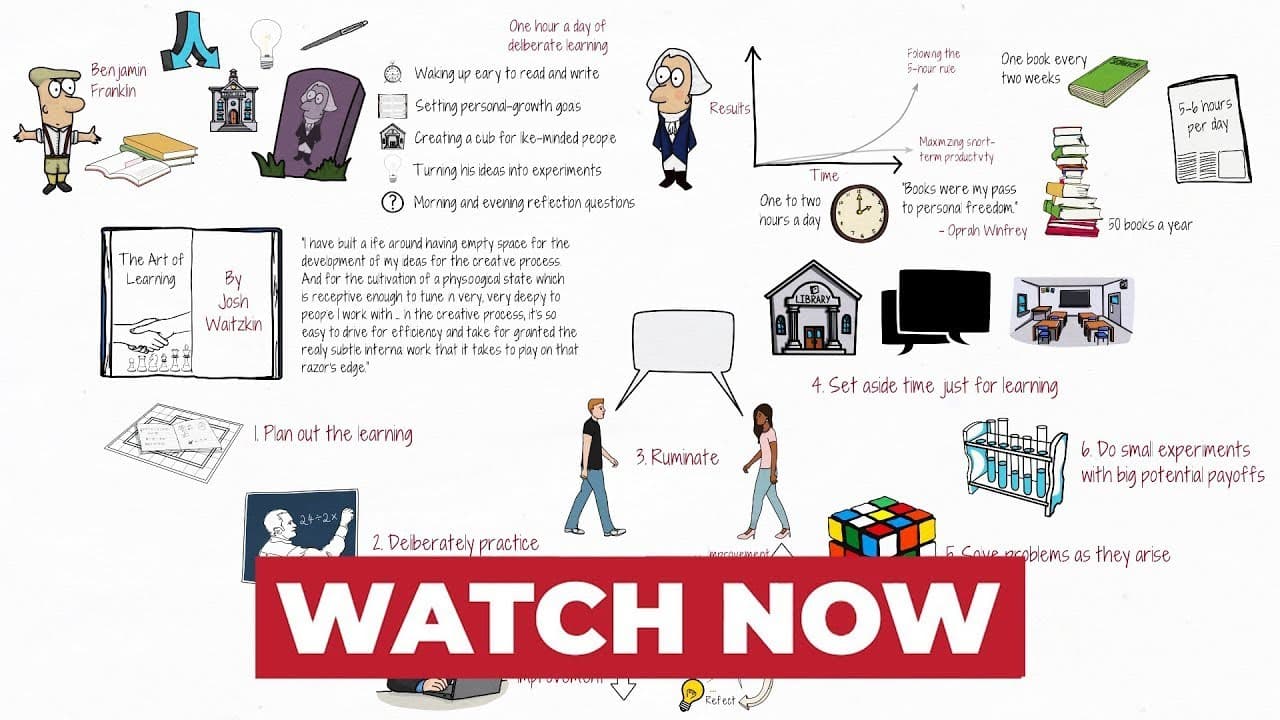
Constant learners embrace the five-hour rule because dedicating one hour every weekday to deliberate learning supports continuous, long-term improvement. Benjamin Franklin used that time to read, write, track personal-growth goals, experiment, and reflect, while figures such as Warren Buffett and Bill Gates also prioritize extensive reading. The rule turns everyday work into opportunities to practice, gather feedback, and solve problems. Read on for six practical ways to apply it.
Transcript
At the age of 10, Benjamin Franklin left formal schooling to become an apprentice to his father. As a teenager, he showed no particular talent or aptitude aside from his love of books. When he died a little over half a century later, he was America’s most respected statesman, its most famous inventor, a prolific author, and a successful entrepreneu... Read More
Key Insights
- 🍉 Investing an hour daily in deliberate learning, like Benjamin Franklin, contributes to long-term success.
- ❓ Successful individuals like Warren Buffett prioritize daily learning, emphasizing its importance for growth.
- ⌛ Implementing the five-hour rule involves planning, practice, reflection, learning time allocation, problem-solving, and experimentation.
- 👻 Embracing a learning lifestyle allows for continuous improvement and growth over time.
- 😒 Focusing on learning un-automates behaviors, enabling ongoing improvement rather than plateauing.
- 🎁 Every event presents an opportunity for learning and improvement when learning is prioritized.
- 🥳 Utilizing slack in the day for learning, creativity, and reflection enhances overall productivity and quality.
Install to Summarize YouTube Videos and Get Transcripts
Explore YouTube Video Summarizer or Get YouTube Transcript Extractor
Questions & Answers
Q: What is the five-hour rule for constant learning?
The five-hour rule means investing roughly one hour a day on every weekday in deliberate learning. It prioritizes sustained improvement through activities such as reading, practice, reflection, problem-solving, and experimentation.
Q: Why did Benjamin Franklin follow the five-hour rule?
Franklin consistently devoted about an hour each day to deliberate learning throughout his adult life. Although this meant accomplishing less on a given day, the transcript describes it as arguably the best long-term investment of his time.
Q: What learning activities did Benjamin Franklin practice?
Franklin woke early to read and write, set and tracked personal-growth goals, and used morning and evening reflection questions. He also formed a club for aspiring artisans and tradesmen and turned his ideas into experiments.
Q: How can someone apply the five-hour rule?
Create slack in the day to plan what to learn, practice specific skills, reflect, and reserve time for learning activities. Use the remaining space to solve emerging problems and conduct small experiments with potentially large payoffs.
Q: What counts as deliberate practice under the five-hour rule?
Deliberate practice means choosing a specific skill to improve instead of performing a task automatically. It includes seeking honest feedback, practicing that skill during real work, and reflecting afterward on what was learned.
Q: Why is reflection important for continuous learning?
Reflection provides perspective on lessons and helps people absorb new ideas. The transcript recommends walking or talking with conversation partners as ways to process insights and develop slow hunches that may lead to creative breakthroughs.
Q: How do successful people make time for learning?
Warren Buffett spends five to six hours per day reading five newspapers and 500 pages of corporate reports, while Bill Gates reads 50 books per year. Mark Zuckerberg reads at least one book every two weeks, and Arthur Blank reads two hours a day.
Q: How does a learning-focused approach improve everyday work?
A learning-focused professional chooses a skill before a repeated task, practices it during the task, and reflects afterward. For additional feedback, the person can invite a colleague to observe and respond, turning each event into an opportunity to improve rather than plateau.
Summary & Key Takeaways
-
Benjamin Franklin's success stemmed from investing an hour daily in deliberate learning, reflected in his accomplishments.
-
Emulating Franklin's approach, successful individuals like Warren Buffett, Bill Gates, and Mark Zuckerberg prioritize daily learning.
-
Implementing the five-hour rule involves planning, deliberate practice, reflection, learning time allocation, problem-solving, and experimentation.
Read in Other Languages (beta)
Share This Summary 📚
Summarize YouTube Videos and Get Video Transcripts with 1-Click
Try YouTube Summary with ChatGPT & Claude or YouTube Transcript Generator
Explore More Summaries from The Art of Improvement 📚




Summarize YouTube Videos and Get Video Transcripts with 1-Click
Try YouTube Summary with ChatGPT & Claude or YouTube Transcript Generator