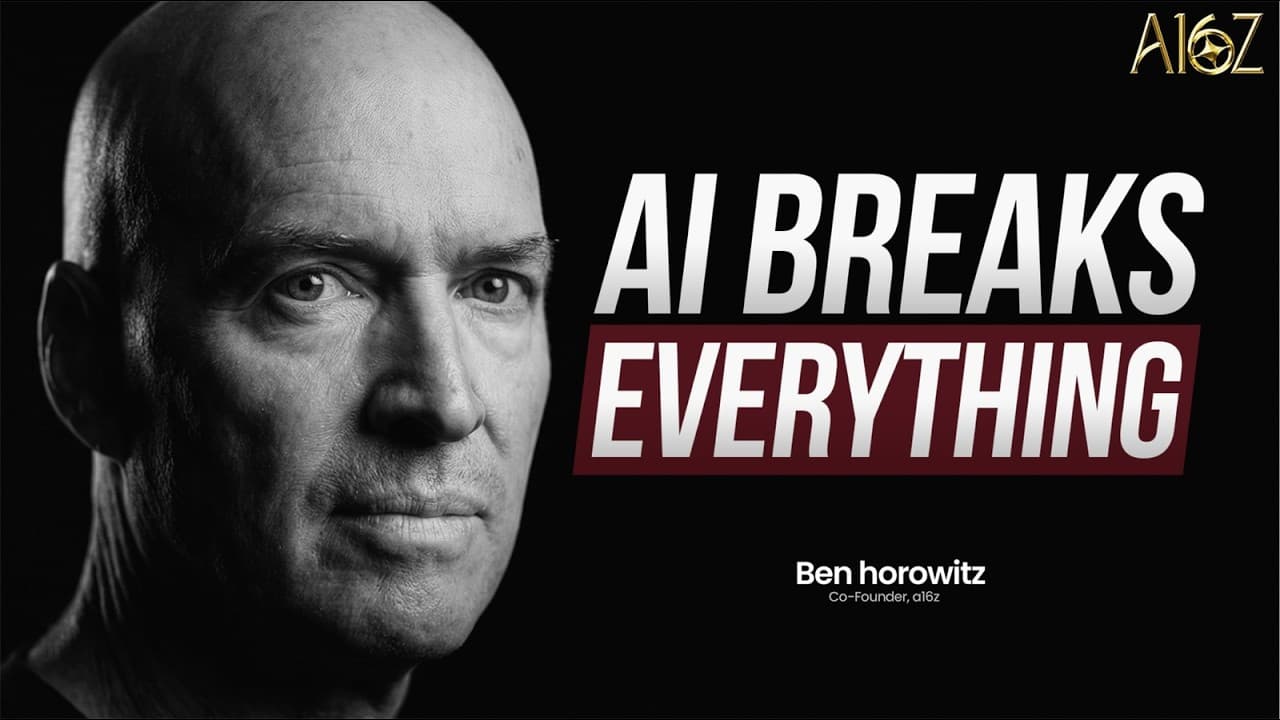
How Does AI Change Big Tech and the Future of Startups? Ben Horowitz | a16z
TL;DR
AI is forcing startups and established tech companies to rethink where their value comes from. Ben Horowitz argues that companies with enough money, good data, and GPUs can now overcome software problems, while migration, data, and user-interface lock-ins are disappearing. Product advantages that once lasted five or 10 years may last only five weeks, so read on for his guidance on adapting.
Transcript
America's got to rebuild its entire infrastructure like right now. We don't have enough rare earth minerals. We don't have enough electricity. We don't have enough manufacturing capacity. Nvidia will make enough chips, but then we won't have enough memory. Almost everything is the bottleneck. >> The China graph is like this and the US graph is like... Read More
Key Insights
- AI allows companies to solve problems by investing resources, unlike traditional constraints where adding more engineers couldn't catch up with competitors.
- Traditional software lock-ins, such as data and user interface dependencies, are becoming obsolete due to AI's flexibility.
- Startups face pressure to innovate rapidly, as the lifecycle of a successful product has significantly shortened.
- The financial market's perception of value has shifted, causing companies to reevaluate their strategies to avoid becoming obsolete.
- AI's impact on communication raises concerns about authenticity, necessitating cryptographic verification to ensure human interaction.
- Cryptography and blockchain technology are essential in verifying identity and preventing AI-generated fraud.
- AI and crypto convergence is crucial for creating secure digital interactions and enabling AI to participate as economic actors.
- The future of venture capital and entrepreneurship is uncertain, with potential for both expansive growth and consolidation into fewer, larger entities.
Install to Summarize YouTube Videos and Get Transcripts
Explore YouTube Video Summarizer or Get YouTube Transcript Extractor
Questions & Answers
Q: How does Ben Horowitz think AI will affect startups and big tech companies?
Horowitz says AI changes two basic assumptions behind technology companies: money can now be used to overcome software problems, and traditional software lock-ins are largely disappearing. Both startups and established companies must therefore identify a more distinct source of customer value.
Q: Why can companies now throw money at software problems?
Horowitz says a company with enough money and good data can buy enough GPUs to solve almost any software problem. He contrasts this with the earlier belief that hiring a thousand engineers could not help a company erase a two-year product deficit.
Q: Which traditional software lock-ins does AI weaken?
AI weakens migration-pain, data, and user-interface lock-ins. Code is easy to replicate, data is easy to move, and AI systems are flexible about how they use interfaces.
Q: How should a pre-AI company respond to the transition?
Its CEO should first recognize that the basic rules of building technology companies have changed. The company must then honestly assess what it truly has, determine where its value comes from, and deliver something more distinct than traditional lock-ins.
Q: How does AI affect the lifespan of a successful product advantage?
A good product might once have provided five or 10 years of momentum, but the discussion suggests that advantage may now last only five weeks. This compresses the time companies have to adapt before competitors or new technology undermine their position.
Q: Why are software companies under pricing pressure?
Migration difficulty, stored data, and familiar interfaces no longer provide the same protection. Horowitz says pricing must instead reflect another, more distinct form of value that the company delivers.
Q: Why might staying private help a company during an AI transition?
The discussion suggests that an existential crisis is easier to navigate as a private company than as a public company. However, waiting also carries risk because rapid disruption could leave the company worth zero.
Q: What infrastructure bottlenecks could limit AI growth in America?
The discussion identifies rare earth minerals, electricity, manufacturing capacity, and memory as shortages or potential bottlenecks. It says Nvidia may produce enough chips while insufficient memory still constrains progress, making infrastructure rebuilding urgent.
Summary & Key Takeaways
-
AI is transforming the business landscape by allowing companies to overcome traditional constraints through resource investment. This shift challenges the relevance of traditional software lock-ins, pushing companies to adapt quickly. The financial market's changing perception of value adds pressure on companies to innovate rapidly or risk obsolescence.
-
AI's influence extends to communication, where authenticity concerns necessitate cryptographic verification to distinguish between human and AI-generated interactions. This convergence with crypto technology is vital for secure digital interactions and enabling AI to function as economic actors, highlighting the importance of blockchain in the future economy.
-
The future of venture capital is uncertain, with potential for both expansive growth due to increased entrepreneurial opportunities and consolidation into fewer, larger entities. Companies must navigate this dynamic landscape, balancing innovation with strategic adaptation to maintain competitiveness in an AI-driven world.
Read in Other Languages (beta)
Share This Summary 📚
Summarize YouTube Videos and Get Video Transcripts with 1-Click
Try YouTube Summary with ChatGPT & Claude or YouTube Transcript Generator
Explore More Summaries from a16z 📚




Summarize YouTube Videos and Get Video Transcripts with 1-Click
Try YouTube Summary with ChatGPT & Claude or YouTube Transcript Generator