What Questions Should I Ask When Choosing a Speech-to-Text API?
TL;DR
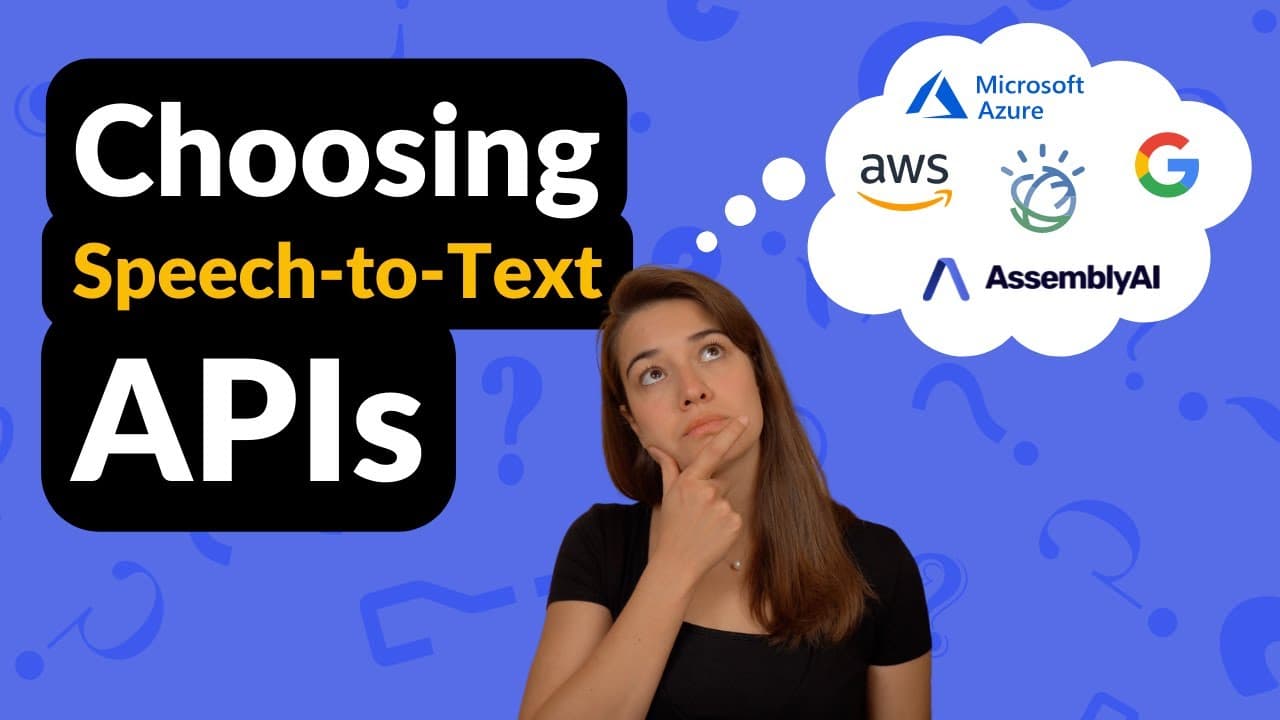
When choosing a speech-to-text API, ask about its accuracy, additional features, clear pricing, comprehensive documentation, and data security practices. Evaluate the API's Word Error Rate benchmarks and use tools like Diff Checker for manual comparison. Prioritizing support and innovation will help ensure your long-term success with the API.
Transcript
integrating an api to your project is a big commitment so here are seven questions to answer to help you select the best speech to text api number one how accurate is this api accuracy of automatic speech recognition systems or asrs for short is calculated using a metric called word error rate or w e r word error rate is the number of errors that a... Read More
Key Insights
- 😯 Accuracy, measured by WER, is essential for evaluating speech-to-text API performance.
- 🔇 Additional features like speaker diarization and sentiment analysis can enhance your project's functionality.
- ❓ Clear pricing, comprehensive documentation, and prompt support are crucial for seamless integration.
- 💁 Data security should be a top priority when choosing an API to safeguard sensitive information.
- 💦 Prioritize working with companies that focus on innovation to ensure your project remains up-to-date.
- 🔠 Utilize tools like Diff Checker to compare transcription results and select the best API for your specific use case.
Install to Summarize YouTube Videos and Get Transcripts
Explore YouTube Video Summarizer or Get YouTube Transcript Extractor
Questions & Answers
Q: What seven questions should I ask when choosing a speech-to-text API?
Ask about the API’s accuracy, additional features, pricing clarity, documentation quality, customer support, data security, and commitment to innovation. Together, these questions cover transcription performance, integration needs, ongoing maintenance, costs, privacy, and the API’s ability to evolve.
Q: How should I evaluate the accuracy of a speech-to-text API?
Review benchmark results based on Word Error Rate, or WER, which divides the number of transcription errors by the total number of words. For a use-case-specific assessment, request a custom benchmark based on your own dataset when that option is available.
Q: Why shouldn’t I rely only on Word Error Rate?
WER counts mistakes without considering their context or significance. In the example, changing “Paul” to “ball” produces an 11.11 WER, while changing “I am” to “I’m” produces a 22.22 WER, even though the second transcription is described as more accurate.
Q: How can Diff Checker help compare speech-to-text APIs?
Diff Checker displays two transcriptions together so you can inspect their differences manually. Combining this comparison with WER benchmarks provides a stronger way to identify which API performs best for your specific use case.
Q: What additional speech-to-text API features should I consider?
Depending on the project, useful features can include topic detection, chapterization, speaker diarization, and sentiment analysis. These capabilities provide more value than plain transcription and support a wider variety of future use cases.
Q: What should I check about pricing, documentation, and support?
Confirm that the website clearly states base pricing, extra-feature costs, high-volume discounts, and any potentially hidden charges. Documentation should be accessible, structured, and understandable, while developer or customer support should be available promptly when personalized help is needed.
Q: How can I assess a speech-to-text API’s data security?
Ask whether the API retains audio, video, or transcription files, uses them to improve its model, or monetizes the data. If copies are retained, determine whether you can request permanent deletion at any time and how quickly that request will be completed.
Q: How can I tell whether a speech-to-text company prioritizes innovation?
Review the company’s updates and changelog to see whether its API evolves with new approaches and improvements. The transcript also suggests that keeping pace with speech-to-text innovation will often require an on-staff research team.
Summary & Key Takeaways
-
Accuracy is crucial: Ensure to check the API's Word Error Rate (WER) benchmark results to gauge performance.
-
Additional features matter: Look for APIs offering features like topic detection, sentiment analysis, etc., to add value to your project.
-
Consider pricing, documentation, support, data security, and innovation to make an informed decision.
Read in Other Languages (beta)
Share This Summary 📚
Summarize YouTube Videos and Get Video Transcripts with 1-Click
Try YouTube Summary with ChatGPT & Claude or YouTube Transcript Generator
Explore More Summaries from AssemblyAI 📚
Summarize YouTube Videos and Get Video Transcripts with 1-Click
Try YouTube Summary with ChatGPT & Claude or YouTube Transcript Generator