How to Control N20 Geared DC Motors Using Arduino
TL;DR
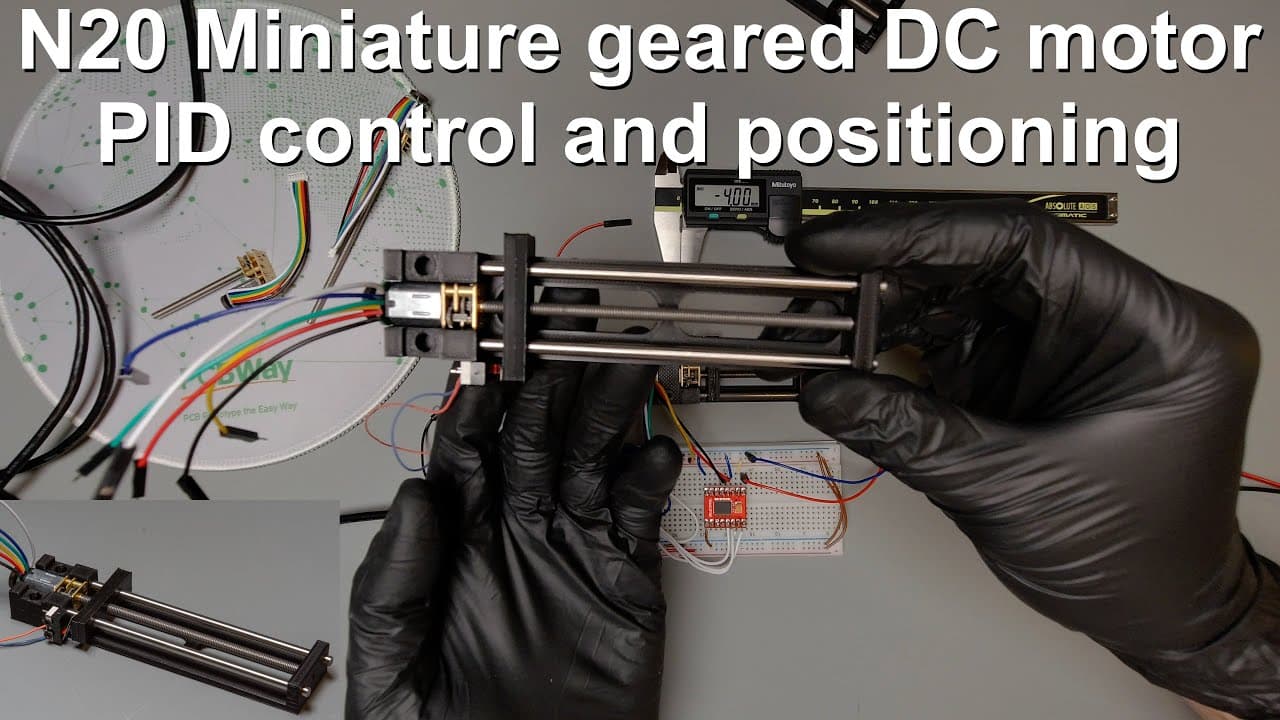
To control N20 geared DC motors with Arduino, connect the motor to a TB6612 driver and use PID control for precise movement. The setup will involve understanding motor specifications such as voltage and gear ratios, and utilizing encoders for feedback. This allows for accurate positioning in motion control applications, making it a cost-effective alternative to stepper motors.
Transcript
this video is sponsored by pcba welcome everyone in this video I'm going to show you some motion control related stuff again in some of my older videos I showed you how to control a DC motor using PID and I'm going to do something similar here but using different kinds of motors and I found these motors on eBay or AliExpress quite often but I haven... Read More
Key Insights
- 🧑🦼 Various types of DC motors, especially the N20 geared version, are suitable for motion control applications, offering flexibility and efficiency.
- 🥳 Understanding motor specifications, such as torque and gear ratios, is crucial for effectively integrating them into projects using Arduino.
- 🧑🦼 The TB6612 motor driver allows for effective control of DC motors, supporting PWM and bidirectional operation with Arduino.
- 🧑🦼 Real-time feedback from encoders enables precise calibration of motor position and tracking, enhancing overall system performance.
- 🫵 Viewers are encouraged to experiment with the shared code and resources, promoting innovation and improvement in their own projects.
- 👨💻 Backlash compensation remains an important aspect for accurate positioning, requiring careful consideration in the design and coding phases.
- 🛟 The video's practical demonstrations serve as a valuable learning tool for individuals interested in robotics and automation.
Install to Summarize YouTube Videos and Get Transcripts
Explore YouTube Video Summarizer or Get YouTube Transcript Extractor
Questions & Answers
Q: What types of motors are discussed in the video?
The video primarily focuses on N20 geared DC motors, which are readily available on platforms like eBay and AliExpress. These motors come in various sizes and specifications, including different voltages (e.g., 12V, 6V) and RPM values. The versatility in size and shape provides numerous potential applications in robotics and motor control systems.
Q: How does the Arduino interact with the motor driver in this setup?
The Arduino connects to the TB6612 motor driver, which allows it to control the direction and speed of the DC motor through PWM signals. The driver is configured to handle two channels, enabling bidirectional control of the motor. The Arduino sends signals to the driver based on the PID control algorithm, adjusting the motor's speed and position as needed.
Q: What are the advantages of using DC motors over stepper motors?
DC motors generally offer advantages such as simplicity in control, higher speeds, and a more cost-effective solution for certain applications. They can be controlled to achieve smooth motion, while stepper motors might face limitations like losing steps under heavy load. The flexibility of integrating feedback systems (like encoders) with DC motors enhances their precision control capabilities.
Q: How is the concept of backlash addressed in this project?
Backlash appears as a discrepancy when switching motor directions because mechanical systems can experience free play. The video highlights that this system does not implement backlash compensation, which can lead to positioning errors during repeated direction changes. Viewers are encouraged to optimize the code to better manage backlash for more accurate motion control.
Q: What is the significance of using encoders in this motor control system?
Encoders provide feedback on the motor's actual position by translating movement into pulses. This data allows the Arduino to calculate the precise movement needed to reach a target position, enabling the implementation of PID control for smooth and accurate motion. The use of encoders is crucial for correcting positional errors and achieving desired accuracy.
Q: What resources are made available for viewers in the video?
The presenter shares multiple resources, including wiring diagrams, code snippets, and detailed instructions on the project's website. These resources are designed to support viewers in replicating or improving upon the projects discussed in the video, ensuring they can implement their own motion control systems effectively.
Q: What challenges are mentioned regarding wiring the motors?
One challenge highlighted is the fragility of the wires connecting to the encoders and other components. Bending these wires can lead to breakage, complicating repairs or re-soldering due to the magnets obstructing access. This emphasizes the need for careful handling during assembly to avoid damaging sensitive electrical connections.
Summary & Key Takeaways
-
The video explores different types of DC motors, particularly geared versions found online, and their applications in motion control. It details motor specifications like voltage, torque, and gear ratios essential for users.
-
A hands-on demonstration includes wiring the motors to an Arduino, using a TB6612 driver, with an emphasis on coding a system that allows precise motor control through PID tuning and encoder feedback.
-
Viewers are encouraged to utilize provided resources, including code snippets and wiring diagrams, and can create similar motion control projects, indicating the benefits of using DC motors over stepper motors in specific applications.
Read in Other Languages (beta)
Share This Summary 📚
Summarize YouTube Videos and Get Video Transcripts with 1-Click
Try YouTube Summary with ChatGPT & Claude or YouTube Transcript Generator
Explore More Summaries from Curious Scientist 📚
Summarize YouTube Videos and Get Video Transcripts with 1-Click
Try YouTube Summary with ChatGPT & Claude or YouTube Transcript Generator