Why Did a Glacier Trigger a Massive Nepal Flood?
TL;DR
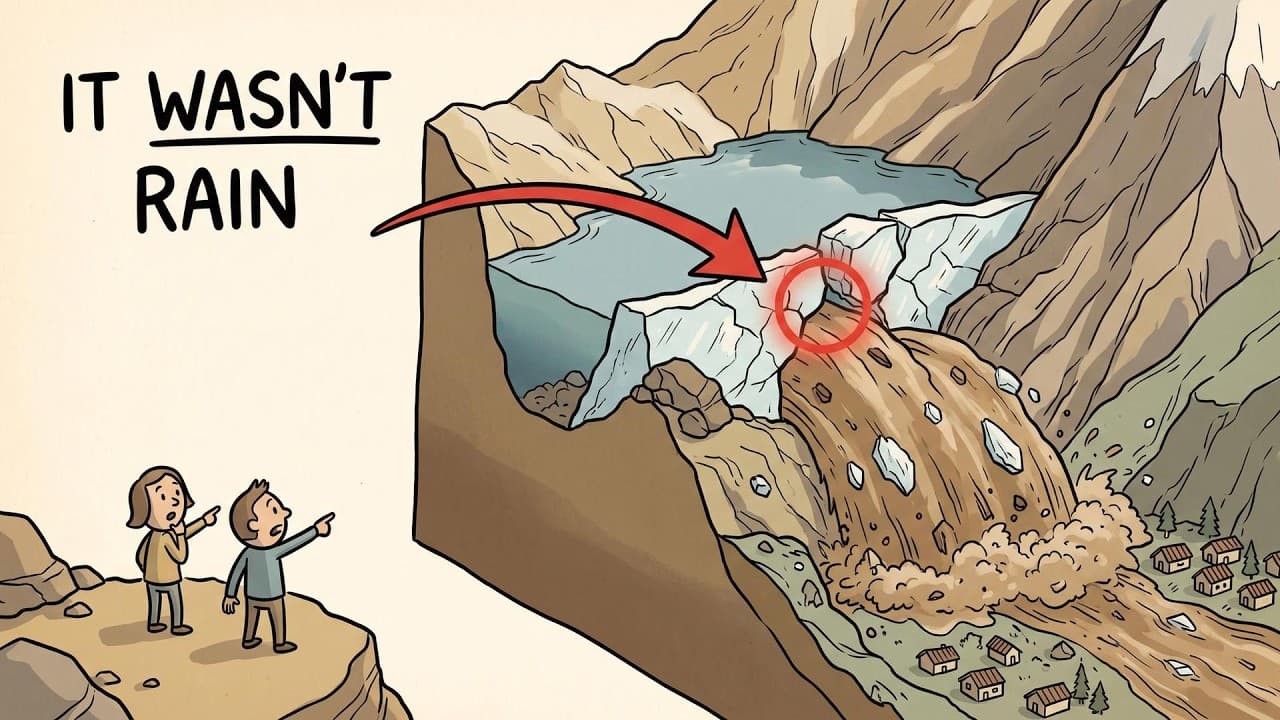
A massive wall of debris surged through Nepal's mountainous region on August 26, 2026, without prior rain or warning. A section of glacier detached, causing a rock ice avalanche that transformed into a fast-moving debris flow. This event, misidentified initially as an earthquake, highlights the increasing frequency of glacier-related disasters due to climate change.
Transcript
Some of the most terrifying flood footage ever uploaded to the internet has just emerged from the mountains along the border between Nepal and Tibet. In the videos, an enormous brown wall advances through a narrow valley. Buildings vanish into it. Vehicles are carried away like leaves. Entire settlements are overwhelmed within seconds. The front of... Read More
Key Insights
- A section of glacier and mountainside detached, causing a rock ice avalanche.
- The avalanche fell more than a kilometer, striking the valley floor with immense force.
- Entrainment caused the avalanche to absorb river water and sediment, forming a debris flow.
- The debris flow traveled tens of kilometers downstream, destroying infrastructure and lives.
- The event registered as a magnitude 4.4 earthquake due to the impact's force.
- The surge resembled a tsunami but was a debris flow, not a wave through water.
- Current warning systems failed as they are designed for storm-driven floods, not glacier collapses.
- Climate change is increasing the frequency of such glacier-related disasters in the Himalayas.
Install to Summarize YouTube Videos and Get Transcripts
Explore YouTube Video Summarizer or Get YouTube Transcript Extractor
Questions & Answers
Q: How did the glacier collapse trigger a flood in Nepal?
The glacier collapse triggered a flood by causing a rock ice avalanche that fell over a kilometer down the mountainside. This avalanche absorbed river water and sediment through a process called entrainment, transforming into a fast-moving debris flow. This flow traveled downstream, destroying infrastructure and causing significant loss of life, resembling a flood but driven by debris rather than water overflow.
Q: What is entrainment in the context of the Nepal flood?
Entrainment in the context of the Nepal flood refers to the process where the collapsing glacier material absorbed river water, sediment, and debris. This transformed the rock ice avalanche into a debris flow, a fast-moving slurry with the consistency of wet concrete. This process allowed the avalanche to grow larger and travel further downstream, causing widespread destruction.
Q: Why was the Nepal flood initially recorded as an earthquake?
The Nepal flood was initially recorded as an earthquake because the impact of the glacier collapse generated ground vibrations similar to a shallow earthquake. Instruments detected these seismic waves, leading to an initial misclassification as a magnitude 4.4 earthquake. The vibrations were due to the immense force of the avalanche hitting the valley floor, not tectonic activity.
Q: What made the debris flow look like a tsunami?
The debris flow looked like a tsunami because of its near-vertical front and immense force. The heaviest materials, like boulders, concentrated at the leading edge, creating a dense, powerful front. This bulldozer-like front, driven by the wetter slurry behind, gave the appearance of a tsunami, though it was a mass of debris moving downstream, not a wave traveling through water.
Q: Why did current warning systems fail to predict the Nepal disaster?
Current warning systems failed to predict the Nepal disaster because they are primarily designed for storm-driven floods, focusing on rainfall measurement and river gauge monitoring. These systems do not account for spontaneous glacier collapses, especially in remote valleys. The debris flow reached downstream gauges before they could issue warnings, highlighting a gap in disaster preparedness for glacier-related events.
Q: How is climate change linked to the frequency of glacier collapses?
Climate change is linked to the frequency of glacier collapses due to rising temperatures causing rapid glacier melting and permafrost thawing. This destabilizes mountain slopes and reduces friction holding glaciers in place, making them more prone to collapse. The thinning of glaciers and melting of natural 'glue' increases the likelihood of such catastrophic events, as seen in the Himalayas.
Q: What was the human impact of the Nepal glacier disaster?
The human impact of the Nepal glacier disaster was devastating, with over 270 confirmed deaths and nearly 1,500 people missing, including foreign tourists. Many communities were caught off guard with no warning, leading to loss of lives, homes, and livelihoods. The tragedy emphasized the vulnerability of people living in mountainous regions to sudden natural disasters and the need for better preparedness.
Q: What lessons can be learned from the Nepal glacier disaster?
Lessons from the Nepal glacier disaster include the need for improved early warning systems that account for glacier collapses and debris flows, not just storm-driven floods. It highlights the importance of understanding climate change's impact on glacier stability and the necessity of international cooperation in monitoring and preparing for such events. The disaster serves as a reminder of the increasing risks posed by climate-induced natural hazards.
Summary & Key Takeaways
-
A glacier collapse in Nepal on August 26, 2026, triggered a rock ice avalanche that transformed into a fast-moving debris flow. The event was initially misidentified as an earthquake due to the force of impact. This disaster, which caused significant loss of life and infrastructure, underscores the growing threat of glacier-related events linked to climate change.
-
The avalanche absorbed river water and sediment through entrainment, creating a debris flow that traveled downstream at high speed. This phenomenon appeared similar to a tsunami but was a moving mass of debris. The lack of warning systems for such events contributed to the tragedy, highlighting a gap in current disaster preparedness.
-
The increasing frequency of glacier collapses in the Himalayas is linked to climate change effects, such as rapid melting and permafrost thawing. This event serves as a warning for future disasters, emphasizing the need for improved monitoring and early warning systems to protect vulnerable communities in mountainous regions.
Read in Other Languages (beta)
Share This Summary 📚
Summarize YouTube Videos and Get Video Transcripts with 1-Click
Try YouTube Summary with ChatGPT & Claude or YouTube Transcript Generator