What Can a 500-Year Ecosystem Simulation Teach Us?
TL;DR
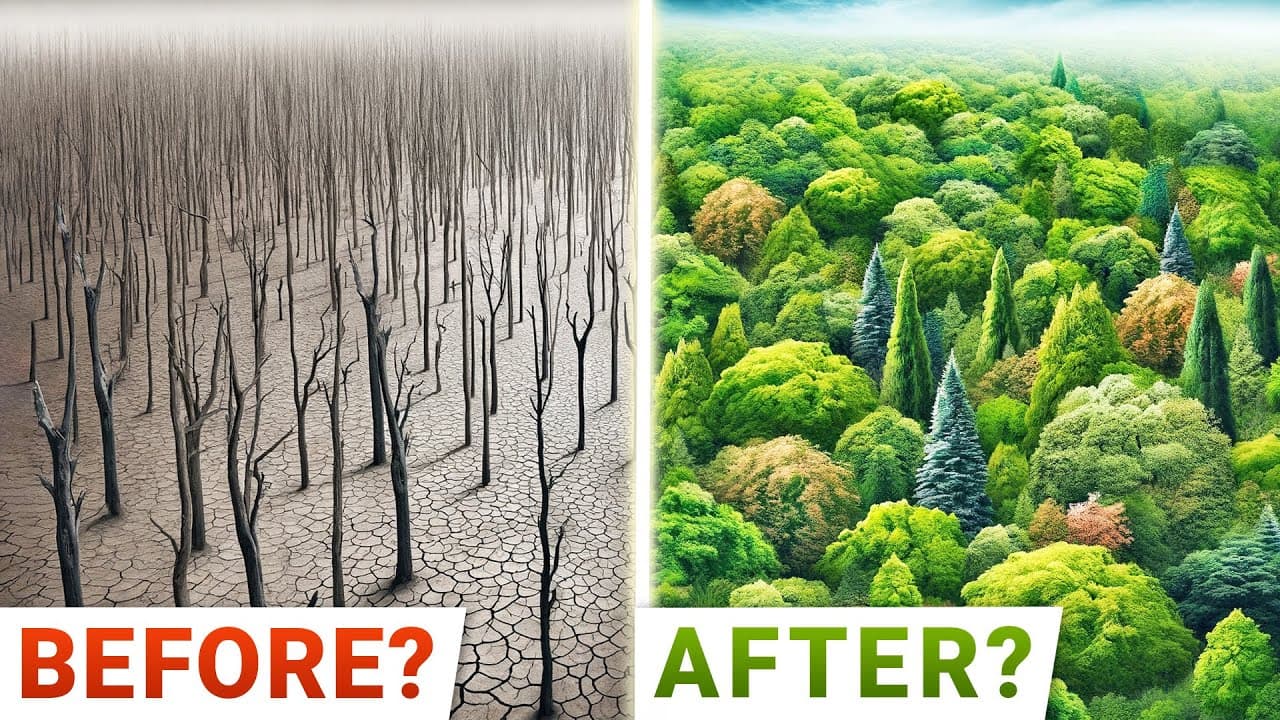
A 500-year ecosystem simulation reveals that deforestation disrupts the water cycle, leading to fewer clouds due to reduced transpiration. It also illustrates tipping points, showing that ecosystems can undergo irreversible changes when critical thresholds are crossed. The findings highlight the importance of conservation efforts in mitigating climate change effects.
Transcript
This work is able to simulate an ecosystem with up to 500,000 plants for 500 years. Buckle up Fellow Scholars, because we are going to see simulations with tipping points, deforestation, Yosemite valley, and the story of shrubs and pines. Yes we are in for a ride with this paper. This simulation goes down to the level of individual branches... Read More
Key Insights
- 😶🌫️ Deforestation disrupts the water cycle and leads to a decrease in cloud formation due to reduced transpiration.
- 😥 Tipping points in ecosystems can trigger irreversible and catastrophic changes, highlighting the need for proactive conservation measures.
- 😀 Different species exhibit varying levels of adaptability to changing environmental conditions, which can impact their survival in the face of stressors.
Install to Summarize YouTube Videos and Get Transcripts
Explore YouTube Video Summarizer or Get YouTube Transcript Extractor
Questions & Answers
Q: How does deforestation affect cloud formation in the simulated ecosystem?
Deforestation disrupts the water cycle in the ecosystem by reducing transpiration, resulting in a decrease in cloud formation. With fewer trees releasing water vapor, the atmosphere lacks the necessary moisture for condensation and cloud formation to occur.
Q: What are tipping points, and why are they important in ecosystem dynamics?
Tipping points are thresholds in an ecosystem where the effects of certain changes become unpredictable and often lead to catastrophic and irreversible consequences. They highlight the vulnerability of ecosystems to disturbances, such as climate change, and emphasize the need for proactive conservation measures to prevent ecosystem collapse.
Q: How do different species adapt to changing environmental conditions in the simulated ecosystem?
Different species exhibit varying levels of adaptability to changing environmental conditions. In the case of a slow drought, shrub land slowly recedes but adapts well to the new conditions. However, pine trees, which have less adaptability, disappear in clumps. Both species cooperate and compete when subjected to a combined stressor of drought, resulting in striped patterns that would not occur otherwise.
Q: How does the simulation compare to real-world observations?
The simulation shows remarkable agreement with theoretical results and real photographs of various ecosystems. It accurately replicates the patterns and dynamics observed in natural environments, demonstrating the reliability and validity of the simulation.
Summary & Key Takeaways
-
The paper introduces a comprehensive simulation that models an ecosystem with up to 500,000 plants for 500 years, providing insights into the effects of deforestation and transpiration on cloud formation.
-
The simulation shows that deforestation disrupts the water cycle, leading to a decrease in cloud formation, while reforestation restores the ecosystem and brings back the clouds.
-
The paper also explores the concept of tipping points, demonstrating how irreversible, catastrophic changes occur when certain thresholds are crossed, highlighting the vulnerability of ecosystems to climate change.
Read in Other Languages (beta)
Share This Summary 📚
Summarize YouTube Videos and Get Video Transcripts with 1-Click
Try YouTube Summary with ChatGPT & Claude or YouTube Transcript Generator
Explore More Summaries from Two Minute Papers 📚






Summarize YouTube Videos and Get Video Transcripts with 1-Click
Try YouTube Summary with ChatGPT & Claude or YouTube Transcript Generator