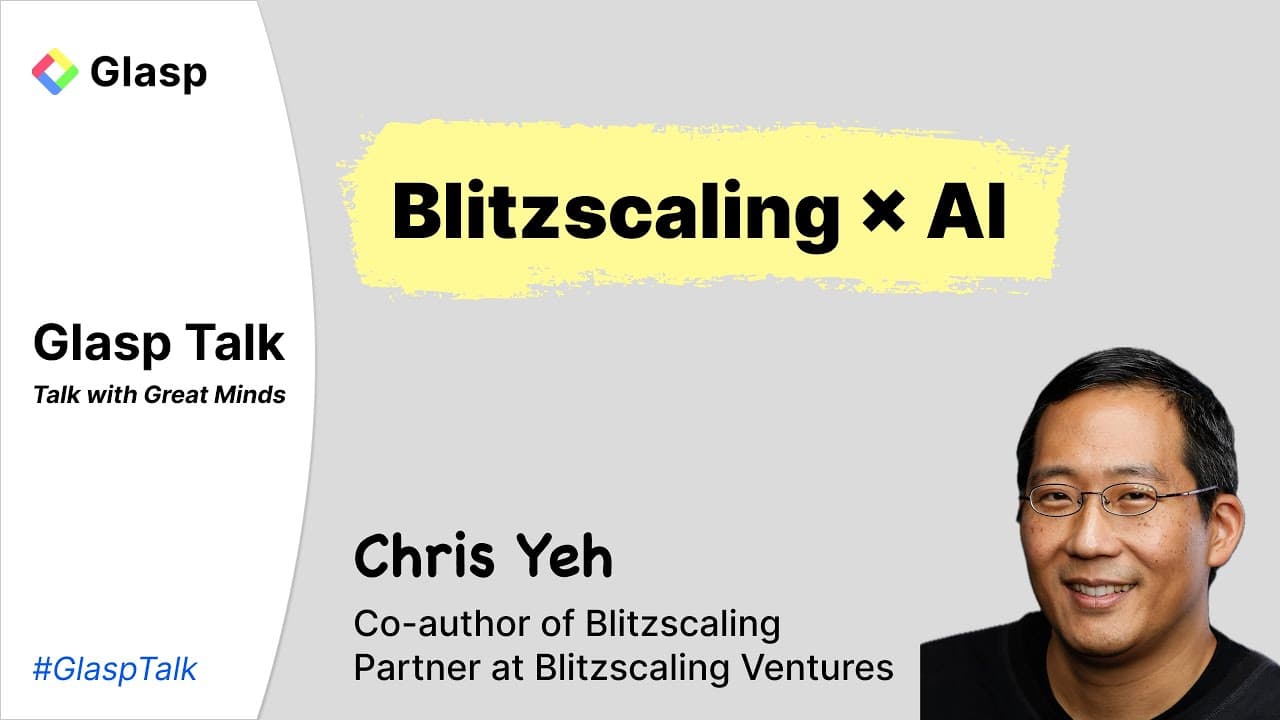
How Is AI Reshaping Blitzscaling and Startup Growth? Chris Yeh on Glasp Talk #63
TL;DR
AI is reshaping Blitzscaling by letting smaller teams accomplish more and grow further before raising money or hiring additional people. Chris Yeh calls AI the biggest technological wave of his lifetime because it affects almost every business and life, enabling activities that were previously impossible. He also explains why context, network effects, genuine adoption, and continuous learning matter, making the full discussion useful for founders navigating AI-driven growth.
Transcript
It's really the biggest wave that I've seen in my lifetime. And I think that's because of the way it has so much impact on almost every possible business and almost every possible life. The potential for AI to just dramatically change the way we do everything is enormous. And we're still at the very beginning of it. We barely even scratched the sur... Read More
Key Insights
- AI expands what is possible: Yeh distinguishes AI from the internet through capability rather than connectivity. The internet allowed existing activities to move online and connected people who previously depended on face-to-face communication. AI can make previously unavailable activities possible, from accelerating book production to controlling robots used in manufacturing. That broader effect on everyday action supports his view that AI may exceed earlier technology waves.
- The transformation has barely started: Despite the daily presence of tools such as ChatGPT and Gemini, Yeh believes society remains at the beginning of the AI wave. He says its impact can reach almost every possible business and almost every possible life. The significance lies not only in present applications, but in the enormous potential to change how people perform many kinds of work.
- Daily use can remain selective: Yeh uses AI every day without trying every available product. His regular tools include ChatGPT and Gemini, and he experiments with Perplexity and others. Because he does not develop software, he is not currently using Claude Code or Codex. His approach shows that daily AI use can center on relevant work rather than the number of tools adopted.
- Image iteration becomes continuous: While developing covers for self-published books, Yeh and his editor used AI to generate options, exchange feedback, and refine the work quickly. He also describes FlowState, although he notes uncertainty about whether it was associated with Canva. The tool continually generates images from one prompt, allowing users to review the stream until an appealing result appears.
- Technology creates new markets: Yeh connects AI to Blitzscaling first as a technological revolution. Such revolutions generate new markets and new market opportunities, creating conditions in which companies can pursue rapid growth. AI is therefore not merely another productivity feature within existing companies. It also provides the foundation for new businesses that can apply Blitzscaling principles in emerging categories.
- Individuals gain greater leverage: AI changes the operating capacity of each person, allowing individuals to do substantially more. Yeh observes that smaller teams are accomplishing more and reaching later stages before they need outside funding or additional employees. This leverage changes the relationship among progress, capital, and headcount, giving young companies more room to advance before expanding their organizations.
- Hiring limits rapid expansion: Organizational scalability can constrain Blitzscaling because companies cannot add effective employees instantly. They must find suitable people, bring them into the company, train them, and wait for them to become productive. Yeh presents AI agents as a way to reduce dependence on that sequence. When software performs more work, company growth can move faster than human hiring alone permits.
- Blitzscaling itself is changing: AI plays two roles in Yeh's framework. It generates the new opportunities that invite Blitzscaling, and it changes the process used to achieve rapid scale. The planned Blitzscaling and AI sequel will address both directions, along with the practical question of scaling future AI companies. This makes AI both the subject of growth and an instrument for growth.
- Context can outlast technology: The existing discussion warns that AI models and data can become outdated quickly, weakening purely technological defenses. A context moat instead depends on unique information, insights, and understanding that help a company deliver superior value. The point is not that technology is irrelevant. It is that technical access alone may not preserve differentiation when competitors can use similar AI capabilities.
- Networks strengthen defensibility: Network effects matter because greater participation can increase the value of a platform. The discussion identifies this dynamic as a meaningful competitive advantage when companies have access to similar AI agents. Investors accordingly look for AI-native businesses that can develop network effects and virality. These properties can support continued value beyond an initial model or product capability.
- Purchasing does not ensure adoption: An enterprise can acquire an AI product without changing how employees work. Successful adoption requires integration into workflows, observable usage, and improved processes or outcomes. Pilot Purgatory describes the condition in which purchased tools fail to become genuinely used products. That gap matters because weak utilization can lead customers to abandon the product rather than retain it.
- Learning requires model revision: Yeh's infinite learning mindset involves continually absorbing new information and noticing weak signals that challenge existing beliefs. People must be willing to update their understanding and release lessons from earlier successes when those lessons stop applying. This flexibility is especially important during a rapidly evolving AI wave. Human creativity and contextual understanding remain valuable when people connect ideas and contribute insights that generated content does not replace.
Install to Summarize YouTube Videos and Get Transcripts
Explore YouTube Video Summarizer or Get YouTube Transcript Extractor
Questions & Answers
Q: How has AI changed Blitzscaling and startup growth economics?
AI lets individual people accomplish more, so smaller teams can progress further before raising money or hiring additional employees. This reduces one constraint on Blitzscaling, the limited speed at which a company can expand its organization. Recruiting, onboarding, training, and bringing people up to speed all require time. AI agents can perform work without relying entirely on that hiring sequence, allowing growth to move faster. AI also creates new markets and opportunities in which companies can pursue rapid scale.
Q: How does AI compare with the internet and mobile technology waves?
Chris Yeh calls AI the biggest technological wave he has seen in his lifetime. The internet was transformative because it connected people and made it possible to conduct activities online. AI goes further by enabling people to do things they could not do before, including writing books more quickly and using AI to control manufacturing robots. Its possible reach extends across almost every business and almost every life. Yeh also stresses that this wave remains near its beginning.
Q: Which AI tools does Chris Yeh use in his daily work?
Yeh says he uses ChatGPT and Gemini and experiments with Perplexity and several other tools. He does not use as many developer-focused products because he does not write software. For that reason, he is not currently using Claude Code or Codex, although he follows their development. One practical use involved working with his editor to generate and refine covers for self-published books. The rapid back-and-forth made visual iteration possible in a way he considered remarkable.
Q: What is Blitzscaling and AI by Chris Yeh and Reid Hoffman?
Blitzscaling and AI is the planned sequel to Blitzscaling, the book Yeh co-authored with Reid Hoffman. The original book came out in 2018 and focuses on how companies grow quickly in competitive markets. The sequel will examine how AI has changed Blitzscaling and how Blitzscaling has enabled AI. It will also address how people can Blitzscale the AI companies of the future. Yeh says they are working on it during the current year and probably publishing it the next year.
Q: What becomes a startup's moat when competitors use similar AI agents?
The discussion identifies context and network effects as important defenses when technical advantages are fleeting. AI models and data can become outdated, so access to technology alone may not preserve a lead. A context moat comes from unique data, insights, and understanding that allow a startup to provide greater value. Network effects add protection when increased usage makes the platform more valuable. Together, these advantages can remain meaningful even when competitors obtain comparable AI agents.
Q: What is the difference between buying AI and adopting AI?
Buying AI means acquiring a tool, while adopting it means integrating that tool into real workflows. A purchased product creates little lasting value if employees do not use it or if existing processes remain unchanged. The discussion calls this failure state Pilot Purgatory, where AI products are purchased but not meaningfully utilized. Founders should observe user behavior and determine whether the product improves processes and outcomes. Genuine use supports engagement and retention, while weak use creates churn risk.
Q: What do investors seek in AI-native companies?
The existing discussion says investors look for AI-native companies with the potential for network effects and virality. Network effects matter because a platform can become more valuable as additional people use it. Founders also need to demonstrate engagement and retention, since initial access to AI does not prove durable customer value. Usage shows whether customers have integrated the product into their work. Retention then indicates whether the value lasts beyond a pilot or initial experiment.
Q: How can people develop an infinite learning mindset in the AI era?
An infinite learning mindset begins with continually taking in new information. People should pay attention to weak signals, especially when those signals challenge the models they already use to understand the world. They must then update their understanding instead of protecting earlier assumptions. Lessons associated with past success may need to be released when circumstances change. This willingness to revise beliefs supports adaptation during a rapidly evolving AI wave.
Summary & Key Takeaways
-
Comparing major technology waves: Chris Yeh describes AI as the biggest technological wave he has witnessed since becoming involved with startups in the mid-1990s. The internet transformed society by connecting people and making online activity possible. AI may prove even bigger because it changes daily activities and enables work that people could not do before. Examples include writing books more quickly and controlling manufacturing robots. Yeh emphasizes that this transformation remains at a very early stage, with its potential barely explored.
-
Using AI in daily work: Yeh uses ChatGPT and Gemini every day while also experimenting with Perplexity and other tools. He does not use as many development products because he does not write software, although he follows tools such as Claude Code and Codex. He describes collaborating with his editor on covers for self-published books. ChatGPT supported rapid generation and refinement, while a tool called FlowState continuously produced images from a prompt until they found a suitable option.
-
Extending the Blitzscaling framework: Blitzscaling, written by Chris Yeh and Reid Hoffman, was published in 2018 and examines how companies grow quickly in competitive markets. Yeh says they are working on a sequel called Blitzscaling and AI, probably for publication the following year. The planned book will examine three connected questions: how AI has changed Blitzscaling, how Blitzscaling has enabled AI, and how founders can Blitzscale future AI companies. The project updates their framework for a new technological revolution.
-
Scaling with smaller organizations: AI creates new markets and market opportunities, which Yeh says technological revolutions consistently do. It also changes how companies Blitzscale because individual people can accomplish much more. Smaller teams can progress further than before without immediately raising capital or expanding headcount. This helps address organizational scalability, a traditional constraint on rapid growth. Hiring, onboarding, training, and bringing people up to speed take time, while an army of AI agents can support even faster growth.
-
Defending value through adoption: The discussion presents technological advantages as potentially fleeting because AI models and data can become outdated. Context and network effects therefore become important sources of differentiation. For enterprise products, purchasing an AI tool is not the same as incorporating it into actual workflows. Companies can become trapped in Pilot Purgatory when tools are bought but remain unused, creating churn risk. Founders should examine user behavior, engagement, retention, and whether AI produces lasting improvements in processes and outcomes.
Read in Other Languages (beta)
Share This Summary 📚
Summarize YouTube Videos and Get Video Transcripts with 1-Click
Try YouTube Summary with ChatGPT & Claude or YouTube Transcript Generator
Explore More Summaries from Glasp 📚


Summarize YouTube Videos and Get Video Transcripts with 1-Click
Try YouTube Summary with ChatGPT & Claude or YouTube Transcript Generator