What Is Recursion in Programming and How Does It Work?
TL;DR
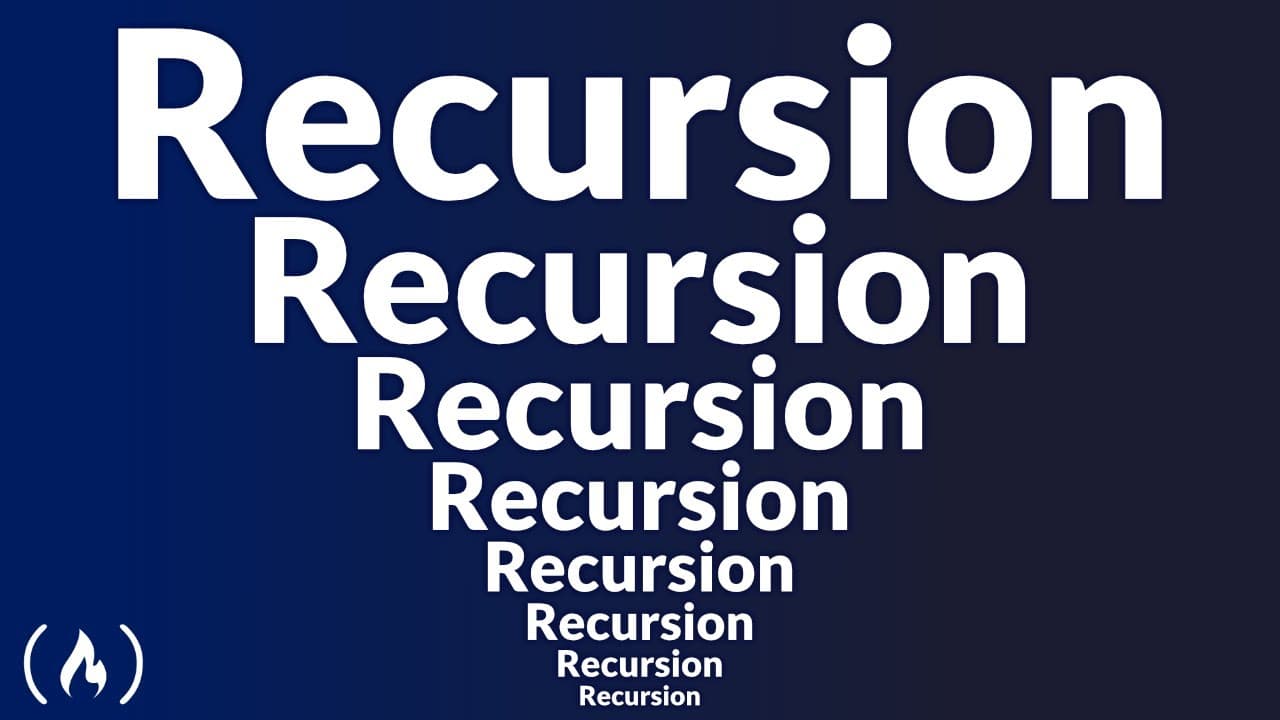
Recursion is a programming technique where a function calls itself to break down complex problems into simpler subproblems. It requires a base case to stop recursion and is particularly effective for tasks like string manipulation, checking palindromes, and applying sorting algorithms. While powerful, it can lead to memory overflow if not implemented carefully due to the stacking of function calls.
Transcript
When learning about recursion, it can seem like you're always going back to the beginning. In this course, the simple engineer will help you understand recursion using animations, thought processes, and more. Hey, guys, and welcome to another video brought to you by the simple engineer. In today's video, we are going to delve deep into th... Read More
Key Insights
- Recursion is a programming paradigm that involves a method calling itself and breaking down a problem into smaller subproblems.
- The base case is the stopping condition for recursion, and it helps avoid infinite loops.
- Recursion is a powerful tool for solving problems that involve complex data structures like trees and graphs.
- Recursion can reduce the need for complex loops and auxiliary data structures.
- Recursion can lead to memory overflow if not managed properly, as each method call adds a new stack frame.
- Recursion works well for recursively defined data structures like trees and graphs.
- Recursion can be used to solve various problems, like string reversal, palindrome checking, and binary search.
- Optimizations like memoization can be used to improve the efficiency of recursive algorithms.
Install to Summarize YouTube Videos and Get Transcripts
Explore YouTube Video Summarizer or Get YouTube Transcript Extractor
Questions & Answers
Q: How does recursion work in practice?
Recursion works by breaking down a problem into smaller subproblems and solving them using recursive calls. These recursive calls continue until a base case is reached, and the results are then combined to solve the original problem. Each recursive call has its own stack frame, allowing the program to keep track of the intermediate results and progress towards the base case.
Q: What are some common applications of recursion?
Recursion has various applications, including string reversal, palindrome check, converting decimal to binary, and sorting algorithms like merge sort and binary search. It is also useful for tree and graph traversals, solving mathematical problems (e.g., factorial and Fibonacci sequence), and optimizing certain algorithms (e.g., memoization).
Q: How does recursion help in problem-solving?
Recursion allows programmers to take complex problems and break them down into simpler subproblems, making them easier to solve. By dividing and conquering the problem space, recursion simplifies the logic and structure of the code. It also enables the use of indirect, self-referential solutions, where a function calls itself to solve smaller instances of the problem.
Q: Are there any downsides or limitations to using recursion?
Recursion can have downsides, such as increasing memory usage, especially if the recursion depth is large or if the function is not tail-recursive. Recursive solutions can also be less efficient than iterative solutions for some problems. Additionally, recursive code may be harder to understand and debug for some programmers, especially those less experienced with recursion.
Q: How can recursion be optimized?
Recursion can be optimized using techniques like memoization and tail recursion. Memoization involves storing the results of expensive function calls and reusing them when the same inputs occur again. Tail recursion eliminates the need for maintaining multiple stack frames by performing computations as part of the recursive call. Both techniques can help improve the performance and efficiency of recursive algorithms.
Q: What is the difference between recursion and iteration?
Recursion and iteration are both ways to solve problems, but they differ in their approach. Recursion involves breaking down a problem into smaller subproblems, solving them using recursive calls, and combining the results. Iteration, on the other hand, involves repeatedly executing a set of instructions in a loop until a certain condition is met. Recursion is often more concise and elegant for certain problems, while iteration is typically more efficient and easier to understand for others.
Q: Can recursion cause stack overflow errors?
Yes, recursion can lead to stack overflow errors if there are too many recursive calls without a proper base case or termination condition. This can happen when the recursion depth exceeds the limit of the program's call stack or available memory. To avoid stack overflow errors, it is important to design recursive functions with a proper base case and to optimize the code when necessary.
Summary & Key Takeaways
-
Recursion is a programming paradigm that solves problems by breaking them down into smaller subproblems and solving them using recursive calls.
-
Common applications of recursion include string reversal, palindrome check, converting decimal to binary, and sorting algorithms like merge sort and binary search.
-
Recursion follows a blueprint of dividing a problem, solving the smaller subproblems independently, and merging the results to solve the original problem.
Read in Other Languages (beta)
Share This Summary 📚
Summarize YouTube Videos and Get Video Transcripts with 1-Click
Try YouTube Summary with ChatGPT & Claude or YouTube Transcript Generator
Explore More Summaries from freeCodeCamp.org 📚




Summarize YouTube Videos and Get Video Transcripts with 1-Click
Try YouTube Summary with ChatGPT & Claude or YouTube Transcript Generator