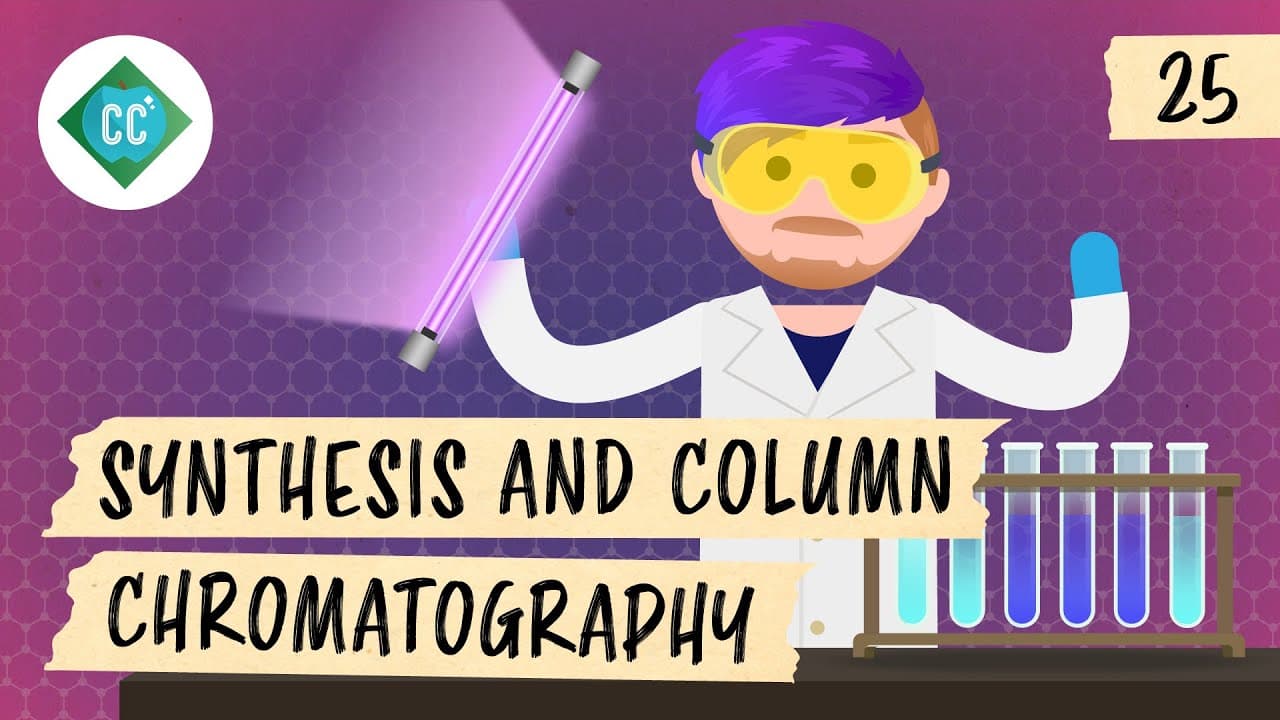
Synthesis and Column Chromatography: Crash Course Organic Chemistry #25
TL;DR
Chromatography is a technique used to separate and purify chemical compounds based on their polarity, and it plays a crucial role in organic chemistry.
Transcript
You can review content from Crash Course Organic Chemistry with the Crash Course App, available now for Android and iOS devices. Hi! I’m Deboki Chakravarti and welcome to Crash Course Organic Chemistry! When you get down to it, all life is kinda similar. From plants to fungi to humans, we share many of the same biological organic reactions tha... Read More
Key Insights
- ❓ Chromatography is an essential technique in organic chemistry for separating and purifying chemical compounds.
- 💁 Paper chromatography is a simple form of chromatography that can separate components based on their polarity.
- 🤔 Thin layer chromatography (TLC) is commonly used in organic chemistry labs to monitor reactions and separate mixtures.
- 🌥️ Flash chromatography is a larger-scale technique that can separate larger quantities of compounds.
- 📸 Both TLC and flash chromatography rely on the principles of polarity to separate components.
- 👻 Chromatography allows for the analysis and purification of compounds, ensuring their quality and facilitating further research.
- 🥳 Solvent systems with different ratios can alter the separation of compounds in chromatography.
Install to Summarize YouTube Videos and Get Transcripts
Explore YouTube Video Summarizer or Get YouTube Transcript Extractor
Questions & Answers
Q: What is chromatography and why is it important in organic chemistry?
Chromatography is a group of techniques used to separate and purify chemical compounds. It is important in organic chemistry because it allows scientists to isolate specific compounds from complex mixtures, ensuring purity and facilitating further analysis.
Q: How does paper chromatography work?
In paper chromatography, a piece of paper is used as the stationary phase and a solvent as the mobile phase. The sample is spotted at the origin, and capillary action causes the solvent to move up the paper, separating the components based on their polarity.
Q: What is TLC used for in organic chemistry labs?
Thin layer chromatography (TLC) is used to monitor reactions and separate mixtures in the lab. It involves a thin layer of silica gel or alumina as the stationary phase, and by altering the ratios of solvents in the mobile phase, different components can be separated.
Q: How is flash chromatography different from TLC?
Flash chromatography is a larger-scale technique used to separate larger quantities of compounds. It involves packing a column with silica gel as the stationary phase and using pressure to force the mobile phase through the column, collecting fractions of the desired compound.
Summary & Key Takeaways
-
Chromatography is a group of techniques that separate components of a mixture to identify or quantify them.
-
Paper chromatography, using a piece of paper as the stationary phase, can separate components in marker ink based on their polarity.
-
Thin layer chromatography (TLC) uses a thin layer of silica gel or alumina as the stationary phase and is commonly used in the lab to monitor reactions and separate mixtures.
Read in Other Languages (beta)
Share This Summary 📚
Summarize YouTube Videos and Get Video Transcripts with 1-Click
Try YouTube Summary with ChatGPT & Claude or YouTube Transcript Generator
Explore More Summaries from CrashCourse 📚

Summarize YouTube Videos and Get Video Transcripts with 1-Click
Try YouTube Summary with ChatGPT & Claude or YouTube Transcript Generator