How Can Companies Transition to AI-Native Organizations? | The New Era of Jobs: Organizational Singularity, EP #258
TL;DR
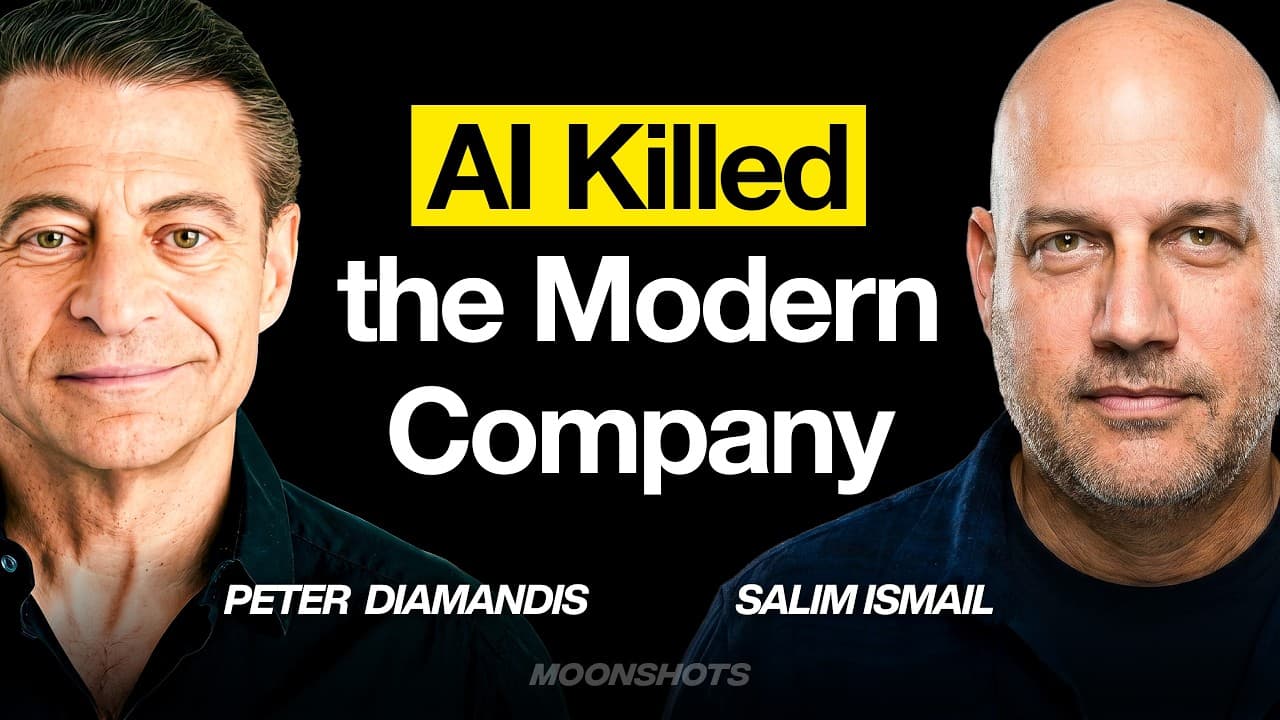
Companies can transition by replacing hierarchy-centered operations with AI-native, agentic workflows architected around intelligence. Salem Ismael argues that this shift will restructure companies and industries within one to two years, while digital twins, proprietary data, and rapid learning loops can help organizations improve without disrupting core operations. Read on for the proposed transition model, competitive stakes, and implications for management.
Transcript
Is there a line of your business, a high margin line of your business that two guys with open claw could replicate in 60 to 90 days? >> This is something across the board useful for everyone. >> When we wrote the exponential organizations book, we didn't realize how precient it would be. It turned out over 10 12 years we were dead on. Now that we s... Read More
Key Insights
- AI-native organizations focus on intelligence rather than hierarchy, necessitating a shift in business structure.
- Recursive self-improvement allows organizations to continuously enhance their processes and efficiency.
- Creating a digital twin at the edge helps companies transition without disrupting their core operations.
- Middle management roles will significantly decrease as AI takes over coordination tasks.
- Companies must reduce organizational drag to effectively implement AI-native processes.
- Proprietary data and rapid learning loops are critical competitive advantages in an AI-driven market.
- Firms can expect a 100x performance improvement by adopting AI-native models.
- Governments and non-profits can also benefit from transitioning to AI-native operations.
Install to Summarize YouTube Videos and Get Transcripts
Explore YouTube Video Summarizer or Get YouTube Transcript Extractor
Questions & Answers
Q: How can companies transition to AI-native organizations?
Companies should move from top-down, human-centric structures to digital, AI-centric operations built around agentic workflows. The proposed approach includes creating an AI-native digital twin at the organization’s edge so new processes can be tested and improved without disrupting core operations.
Q: What is the organizational singularity discussed in Moonshots EP #258?
Salem Ismael describes the organizational singularity as the breakdown of the traditional company model in the face of agentic AI. Organizations that were structured around hierarchy must instead be architected around intelligence.
Q: Why does Salem Ismael say traditional organizational structures must change?
Traditional companies were designed around the idea that transaction and coordination costs are cheaper inside a firm. The episode argues that agentic AI breaks that model by enabling a fundamentally different way to coordinate and execute work.
Q: How quickly could AI restructure companies and industries?
The episode predicts that agents, AI, AGI, and ASI will restructure how companies and industries operate within the next one to two years, rather than five or ten years. That compressed timeline makes organizational retooling an immediate concern.
Q: What is an AI-native digital twin?
An AI-native digital twin is a digital replica of an organization’s processes and workflows created at its edge. It gives a company a way to experiment with AI-native operations and improve them without disrupting the core business.
Q: What happens to middle management in an AI-native organization?
Middle management is expected to shrink as AI assumes more coordination work. The remaining role shifts toward oversight, exception handling, strategic judgment, and improving organizational efficiency.
Q: How can established companies defend against AI-driven competitors?
Companies can reduce organizational drag, develop proprietary data, and create rapid learning loops. The episode warns that failing to retool or restart an organization leaves it vulnerable to startups that can reproduce a high-margin business line in 60 to 90 days.
Q: Can AI-native models help governments and nonprofits?
Yes. The page explains that governments and nonprofits can use AI-native operating models to reduce friction and improve efficiency, including processes such as licenses or visas. The same shift from hierarchical coordination to intelligence-based workflows can apply beyond commercial companies.
Summary & Key Takeaways
-
AI-native organizations are redefining company structures by focusing on intelligence-driven models instead of traditional hierarchies. This shift requires businesses to create digital twins at the edge, enabling recursive self-improvement and reducing workforce needs. Companies that fail to adapt risk being outpaced by AI-driven startups.
-
The transition to AI-native operations involves significant changes, particularly in middle management, which will see a reduction as AI handles coordination tasks. Companies must reduce organizational drag and leverage proprietary data to maintain competitive advantages.
-
Governments and non-profits can also benefit from AI-native models, which offer improved efficiency and reduced friction in processes. The transition to AI-native structures is crucial for organizations to remain competitive and relevant in a rapidly evolving landscape.
Read in Other Languages (beta)
Share This Summary 📚
Summarize YouTube Videos and Get Video Transcripts with 1-Click
Try YouTube Summary with ChatGPT & Claude or YouTube Transcript Generator
Explore More Summaries from Peter H. Diamandis 📚


Summarize YouTube Videos and Get Video Transcripts with 1-Click
Try YouTube Summary with ChatGPT & Claude or YouTube Transcript Generator