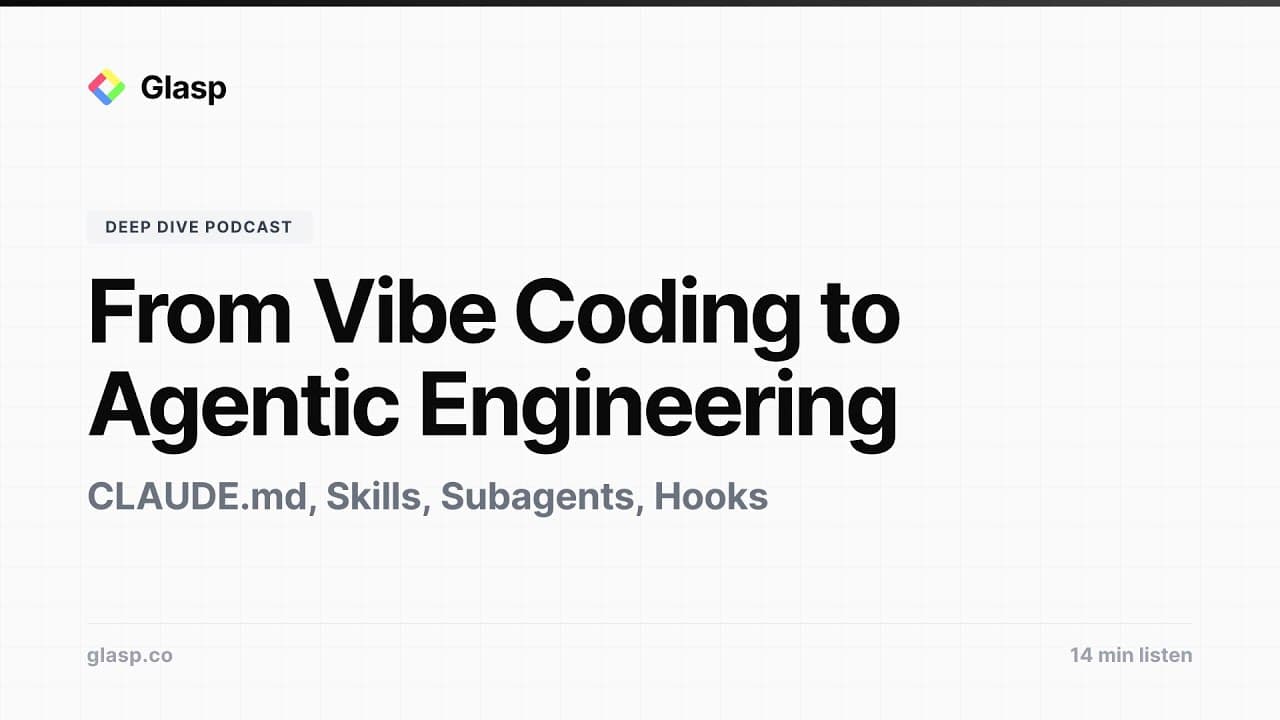
What Is Agentic Engineering in AI Coding?
TL;DR
Agentic engineering has replaced vibe coding by structuring AI coding workflows into four pillars: CLAUDE.md files, skills, subagents, and hooks. This approach enhances reliability and safety by providing context, isolating tasks, and enforcing non-negotiable rules, reducing the reliance on prompts and minimizing errors.
Transcript
Welcome back to Glasp Deep Dive, short takes on the long reads worth your attention. I'm Hope, and today: an AI coding workflow that felt like pure magic, and quietly stopped working after about a year. And I'm Adam. And almost nobody noticed the moment it broke. The magic just got a little less reliable each week, until one day you're cleaning up ... Read More
Key Insights
- Agentic engineering has replaced vibe coding, focusing on structured AI coding workflows.
- Vibe coding allowed AI models to handle tasks with minimal human intervention, but it led to errors and reliability issues.
- Agentic engineering involves four pillars: CLAUDE.md files, skills, subagents, and hooks.
- CLAUDE.md files provide essential context, loaded at the start of each session.
- Skills are specific tasks loaded only when needed, keeping the CLAUDE file streamlined.
- Subagents isolate tasks, preventing context pollution and ensuring focused processing.
- Hooks enforce non-negotiable rules, such as blocking destructive commands, ensuring safety.
- The shift emphasizes operational discipline, making AI coding predictable and constrained.
Install to Summarize YouTube Videos and Get Transcripts
Explore YouTube Video Summarizer or Get YouTube Transcript Extractor
Questions & Answers
Q: What is agentic engineering in AI coding?
Agentic engineering is a structured approach to AI coding that replaces vibe coding. It involves four pillars: CLAUDE.md files for essential context, skills for task-specific instructions, subagents for isolating tasks, and hooks for enforcing non-negotiable rules. This method enhances reliability and safety by reducing reliance on prompts and minimizing errors.
Q: How does agentic engineering improve AI coding reliability?
Agentic engineering improves AI coding reliability by providing a structured framework that includes CLAUDE.md files, skills, subagents, and hooks. These elements ensure that AI models have the necessary context, tasks are isolated to prevent context pollution, and non-negotiable rules are enforced. This reduces errors and enhances control over the coding process.
Q: What are the four pillars of agentic engineering?
The four pillars of agentic engineering are CLAUDE.md files, skills, subagents, and hooks. CLAUDE.md files provide essential context, skills offer task-specific instructions, subagents isolate tasks to prevent context pollution, and hooks enforce non-negotiable rules. Together, these pillars create a reliable and safe AI coding environment.
Q: Why did vibe coding lead to reliability issues?
Vibe coding led to reliability issues because it allowed AI models to handle tasks with minimal human intervention, resulting in errors and inconsistencies. The lack of structure meant that models could forget conventions, introduce unwanted patterns, and run destructive commands. This approach relied too heavily on prompts, which were not always reliable.
Q: What is the role of CLAUDE.md files in agentic engineering?
CLAUDE.md files play a crucial role in agentic engineering by providing essential context at the start of each session. They contain information that the AI model needs to understand the environment, such as stack, layout, safe commands, and domain terms. This ensures that the model has the necessary background to perform tasks accurately.
Q: How do subagents function in agentic engineering?
Subagents in agentic engineering function by isolating specific tasks, preventing context pollution, and ensuring focused processing. They handle individual tasks with their own prompt, context window, and tool permissions. This isolation is crucial for tasks that could introduce noise or require a fresh perspective, enhancing the overall reliability of the coding process.
Q: What are hooks in agentic engineering, and why are they important?
Hooks in agentic engineering are shell commands wired to tool events, running automatically without the model's input. They enforce non-negotiable rules, such as blocking destructive commands, ensuring safety in AI coding. Unlike prompts, which can fail probabilistically, hooks provide deterministic control, significantly reducing the risk of errors.
Q: How does agentic engineering enhance operational discipline in AI coding?
Agentic engineering enhances operational discipline in AI coding by treating the AI model like any other production system. It introduces conventions, guardrails, and isolation between concerns, making the coding process more predictable and constrained. This approach reduces reliance on magic and increases control, ensuring that AI coding is reliable and safe.
Summary & Key Takeaways
-
Agentic engineering replaces vibe coding by structuring AI workflows into four pillars: CLAUDE.md files, skills, subagents, and hooks. Each pillar addresses specific failure modes, enhancing reliability and safety. This approach reduces reliance on prompts and minimizes errors by providing context, isolating tasks, and enforcing non-negotiable rules.
-
Vibe coding allowed AI models to handle tasks with minimal human intervention, but it led to errors and reliability issues. Agentic engineering introduces a structured approach, focusing on context, task isolation, and rule enforcement. The four pillars ensure that AI coding is more predictable, constrained, and reviewable.
-
The shift from vibe coding to agentic engineering emphasizes operational discipline. By treating AI coding like any production system, with conventions and guardrails, the approach reduces magic and increases predictability. The four pillars provide a framework for reliable and safe AI coding, minimizing errors and enhancing control.
Read in Other Languages (beta)
Share This Summary 📚
Summarize YouTube Videos and Get Video Transcripts with 1-Click
Try YouTube Summary with ChatGPT & Claude or YouTube Transcript Generator
Explore More Summaries from Glasp 📚

Summarize YouTube Videos and Get Video Transcripts with 1-Click
Try YouTube Summary with ChatGPT & Claude or YouTube Transcript Generator