How to Build Integrated AI Systems with RAG and MCP
TL;DR
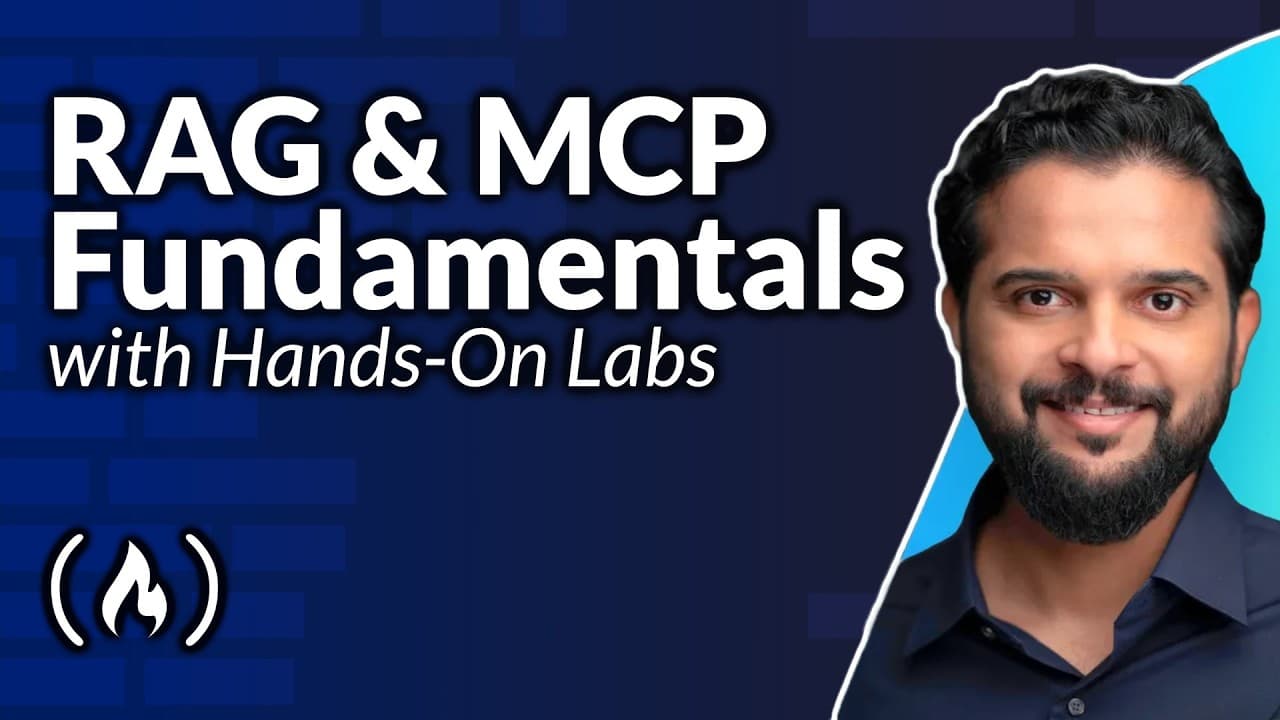
Learn to build integrated AI systems using Retrieval-Augmented Generation (RAG) for connecting models to your data and Model Context Protocol (MCP) for coordinating actions across software components. This course offers hands-on labs to practice building sophisticated applications without prior AI knowledge.
Transcript
This practical crash course teaches you to build integrated AI systems rather than standalone tools. You will first master retrieval augmented generation or RAG to connect models to your own data for accurate contextaware answers. Next, you will learn the model context protocol MCP to coordinate communication and actions across multiple software co... Read More
Key Insights
- RAG is a method to connect AI models to specific data sources, enabling context-aware responses.
- MCP is a protocol for coordinating communication and actions across software components.
- RAG systems involve retrieval, augmentation, and generation processes.
- Document chunking is crucial for precise information retrieval in large datasets.
- Semantic search using embeddings improves retrieval accuracy over keyword-based methods.
- Caching at multiple levels can significantly enhance RAG system performance.
- Vector databases like Chroma and Pinecone efficiently handle large-scale semantic searches.
- MCP servers expose tools, resources, and prompts to facilitate AI interaction with third-party systems.
Install to Summarize YouTube Videos and Get Transcripts
Explore YouTube Video Summarizer or Get YouTube Transcript Extractor
Questions & Answers
Q: How to connect AI models to specific data sources for context-aware responses?
Retrieval-Augmented Generation (RAG) connects AI models to specific data sources, enabling them to provide context-aware responses. RAG involves retrieval of relevant data, augmenting the AI model's input with this data, and generating contextually accurate answers. This process allows AI systems to deliver more precise and relevant information based on the user's query.
Q: What is the role of Model Context Protocol (MCP) in AI systems?
Model Context Protocol (MCP) coordinates communication and actions across multiple software components in AI systems. MCP servers expose tools, resources, and prompts, allowing AI agents to interact with third-party systems seamlessly. This protocol standardizes how AI applications communicate, facilitating integration and enhancing the functionality of AI-driven solutions.
Q: Why is document chunking essential in RAG systems?
Document chunking is essential in RAG systems to ensure precise information retrieval from large datasets. By breaking documents into smaller, focused chunks, AI models can retrieve and process only the relevant sections needed for a query. This improves the accuracy and efficiency of the retrieval process, providing users with more relevant and concise answers.
Q: How does semantic search improve retrieval accuracy?
Semantic search improves retrieval accuracy by understanding the meaning of words and phrases rather than relying solely on keyword matches. It uses embeddings to convert text into mathematical vectors, allowing the system to find semantically similar content even when the exact words do not match. This approach leads to more accurate and contextually relevant search results.
Q: What are the benefits of using vector databases in AI systems?
Vector databases, like Chroma and Pinecone, efficiently handle large-scale semantic searches by organizing data into high-dimensional vector spaces. They use indexing algorithms to quickly retrieve relevant information, making them ideal for applications requiring fast and accurate semantic search capabilities. These databases support scalable and resource-efficient data retrieval in AI systems.
Q: How can caching enhance RAG system performance?
Caching enhances RAG system performance by storing the results of expensive operations and reusing them for repeated or similar queries. It can be implemented at multiple levels, such as query, embedding, and response caching. This reduces the computational load and response time, significantly improving the system's efficiency and user experience.
Q: What are the key components of an MCP server?
An MCP server consists of three key components: tools, resources, and prompts. Tools define the actions the server can perform, resources provide data or information needed for decision-making, and prompts guide AI agents in formulating queries. These components enable AI systems to interact effectively with third-party platforms, enhancing their capabilities and integration.
Q: How do AI agents use MCP to interact with third-party systems?
AI agents use MCP to interact with third-party systems by accessing the tools, resources, and prompts exposed by MCP servers. The protocol standardizes communication, allowing agents to perform actions, retrieve data, and generate responses. This facilitates seamless integration with external systems, enabling AI agents to execute complex tasks and provide comprehensive solutions.
Summary & Key Takeaways
-
Learn to build AI systems using Retrieval-Augmented Generation (RAG) for connecting models to data and Model Context Protocol (MCP) for coordinating actions. The course covers RAG's retrieval, augmentation, and generation processes, and MCP's role in communication across software components. Hands-on labs are included for practical learning.
-
RAG enables AI models to provide context-aware answers by connecting to specific data sources. MCP allows for seamless coordination of actions across multiple software components. The course offers a practical approach to understanding and implementing these technologies through hands-on labs.
-
The course teaches document chunking for precise information retrieval, semantic search using embeddings, and efficient use of vector databases. It also covers caching strategies to enhance system performance and provides insights into building and using MCP servers for AI interaction with external systems.
Read in Other Languages (beta)
Share This Summary 📚
Summarize YouTube Videos and Get Video Transcripts with 1-Click
Try YouTube Summary with ChatGPT & Claude or YouTube Transcript Generator
Explore More Summaries from freeCodeCamp.org 📚

![How to turn Open Source into a Job with Nick Taylor [Podcast #181] thumbnail](/_next/image?url=https%3A%2F%2Fi.ytimg.com%2Fvi%2Fm7nkioXNiik%2Fhqdefault.jpg&w=750&q=75)

![When NOT to use AI in your hackathon project with MLH winners Cindy Cui and Alison Co [Podcast #198] thumbnail](/_next/image?url=https%3A%2F%2Fi.ytimg.com%2Fvi%2FGpxFF82I8Nk%2Fhqdefault.jpg&w=750&q=75)
Summarize YouTube Videos and Get Video Transcripts with 1-Click
Try YouTube Summary with ChatGPT & Claude or YouTube Transcript Generator