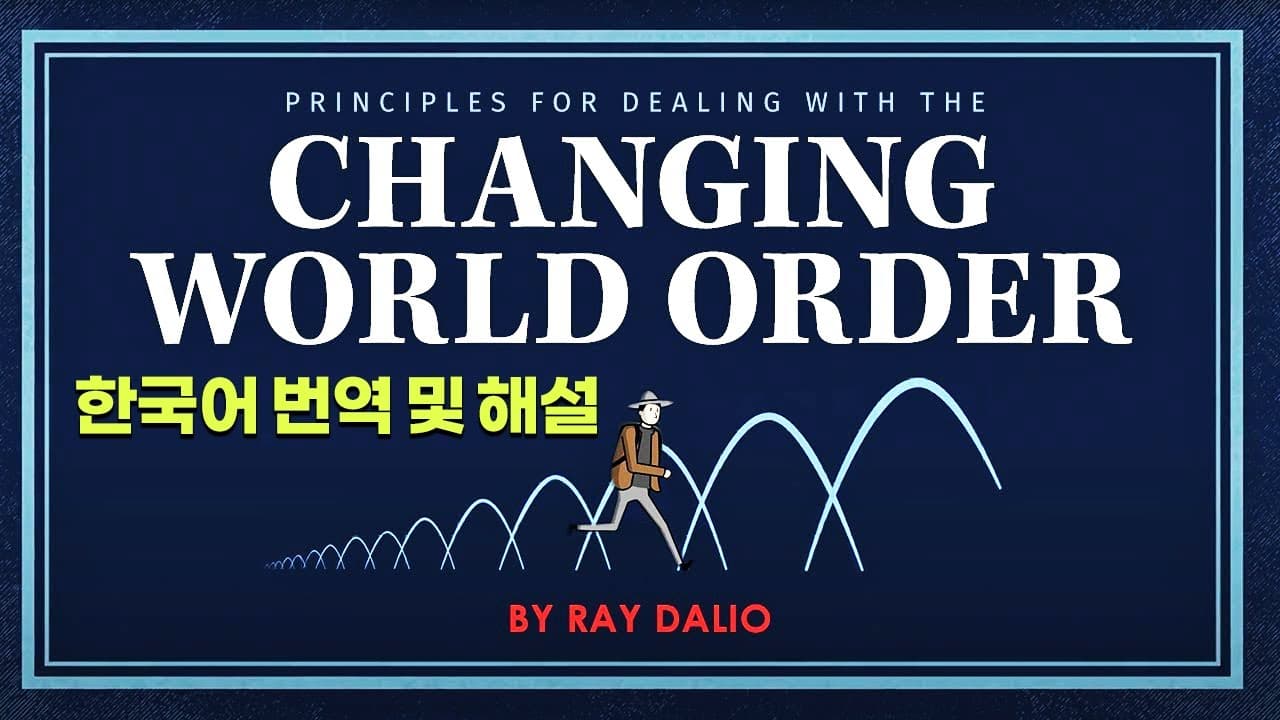
How Does Ray Dalio Explain the Changing World Order? | Korean Translation and Commentary
TL;DR
Ray Dalio explains that world orders change when unsustainable debt, internal division, and rivalry between rising and dominant powers converge. Drawing on roughly 500 years of Dutch, British, and U.S. history, he connects these shifts with money printing, currency decline, war, and changes in reserve-currency power. Read on to understand the recurring signals and principles he uses to anticipate major economic and geopolitical transitions.
Transcript
the changing world order the times ahead will be radically different from those that we've experienced in our lifetimes though similar to many times before how do i know that because they always have been over my roughly 50 years of global macroeconomic investing i've learned the hard way that the most important events that surprised me did so beca... Read More
Key Insights
- Historical comparison is essential because the most consequential surprises may involve events that never occurred during an individual's lifetime. Dalio responded to painful investment surprises by studying approximately 500 years of history for comparable economic, political, and geopolitical situations.
- The 1971 suspension of dollar convertibility into gold allowed the United States to keep spending beyond its earnings by issuing more paper dollars. Dalio says the resulting increase in money without corresponding national wealth reduced each dollar's value and helped raise asset and commodity prices.
- Large-scale money printing is a recurring government response when spending exceeds tax revenue and economic conditions deteriorate. According to Dalio's principle, monetary expansion during crises tends to weaken paper currency while raising the prices of stocks, gold, commodities, and other scarce assets.
- The three major pressures preceding order changes are unsustainable debt, widening internal divisions, and conflict between rising and dominant powers. Dalio identifies zero interest rates and money printing, political polarization over wealth, and United States-China rivalry as contemporary examples of these pressures.
- An order is a governing system that structures how people or countries deal with one another. Internal orders are commonly established through constitutions, while world orders are commonly established through treaties, and both have historically changed after civil or international wars.
- The American world order emerged after the Allied victory in World War II, when the United States became the dominant global power. The 1944 Bretton Woods agreement established a new monetary system and positioned the dollar as the world's leading reserve currency.
- A reserve currency is widely accepted around the world and is a major source of national power. Dalio connects reserve-currency status with the ability of an empire to become exceptionally wealthy and influential within the governing and monetary structure of a world order.
- National power can be assessed through eight measures: education, innovation and technology, global competitiveness, economic output, world trade, military strength, financial-center power, and reserve-currency strength. Dalio argues that education typically improves first, while later gains and declines unfold in a reinforcing sequence.
Install to Summarize YouTube Videos and Get Transcripts
Explore YouTube Video Summarizer or Get YouTube Transcript Extractor
Questions & Answers
Q: How does Ray Dalio explain the changing world order?
Dalio describes world-order change as a recurring historical process involving the rise and decline of major powers. He highlights three pressures that can appear together: unsustainable debt, widening internal conflict, and rivalry between a rising power and the established leader.
Q: Why does Ray Dalio study history to anticipate future crises?
Dalio says his most painful investment surprises involved events that had never occurred during his lifetime but had happened many times before. He therefore studied roughly 500 years of history to identify comparable economic, political, and geopolitical situations and develop principles for handling them.
Q: What happened when the United States suspended dollar-gold convertibility in 1971?
On August 15, President Nixon announced the temporary suspension of the dollar's convertibility into gold or other reserve assets. Dalio expected stocks to plunge, but the market rose sharply and continued upward by nearly 25 percent.
Q: Why can large-scale money printing raise stocks, gold, and commodity prices?
Dalio explains that printing money increases the number of dollars without a corresponding increase in national wealth or productivity, reducing each dollar's value. As the new dollars enter markets to buy stocks, gold, and commodities, their prices rise in currency terms while paper money weakens.
Q: What recurring conditions can signal a changing world order?
Dalio identifies governments struggling to service debt after interest rates reach zero, political conflict driven by wealth and value gaps, and competition between rising and dominant powers. He points to money printing, domestic polarization, and rivalry between China and the United States as examples of these pressures.
Q: What is the difference between an internal order and a world order?
An internal order governs relationships among people within a country and is commonly established through a constitution. A world order governs relationships among countries and is commonly established through treaties; historically, civil and international wars have reshaped these systems.
Q: How does Ray Dalio measure the power of an empire?
Dalio compares empires using eight measures: education, innovation and technology, competitiveness, economic output, world trade, military strength, financial-center power, and reserve-currency strength. He says education typically improves first, followed by reinforcing gains or declines across the other measures.
Q: How long do major empire cycles and transitions last?
Dalio's framework presents the rise and decline of major powers as overlapping cycles lasting roughly 250 years. Transitions between leading powers last about 10–20 years and tend to be conflict-prone because dominant powers resist decline.
Summary & Key Takeaways
-
Dalio began studying long historical cycles after the United States ended dollar convertibility into gold in 1971. Contrary to his expectation of a market collapse, stocks rose sharply. Historical comparison with 1933 showed him that currency devaluation and monetary expansion can increase the prices of stocks, gold, and commodities while weakening paper money.
-
Three developments motivated Dalio's broader study: governments lacked enough money to service debts even after interest rates reached zero, wealth and value gaps intensified political conflict, and China increasingly challenged the United States. He found that these conditions had appeared together before, particularly during the period from 1930 through 1945.
-
Dalio describes orders as systems governing relationships within countries or between them. He compares major empires through education, innovation, competitiveness, economic output, trade, military strength, financial centers, and reserve currencies. His historical framework presents imperial change as overlapping cycles lasting roughly 250 years, with conflict-prone transitions lasting about 10–20 years.
Read in Other Languages (beta)
Share This Summary 📚
Summarize YouTube Videos and Get Video Transcripts with 1-Click
Try YouTube Summary with ChatGPT & Claude or YouTube Transcript Generator
Explore More Summaries from 내일은 투자왕 - 김단테 📚





Summarize YouTube Videos and Get Video Transcripts with 1-Click
Try YouTube Summary with ChatGPT & Claude or YouTube Transcript Generator