How Could Congress End the Government Shutdown?
TL;DR
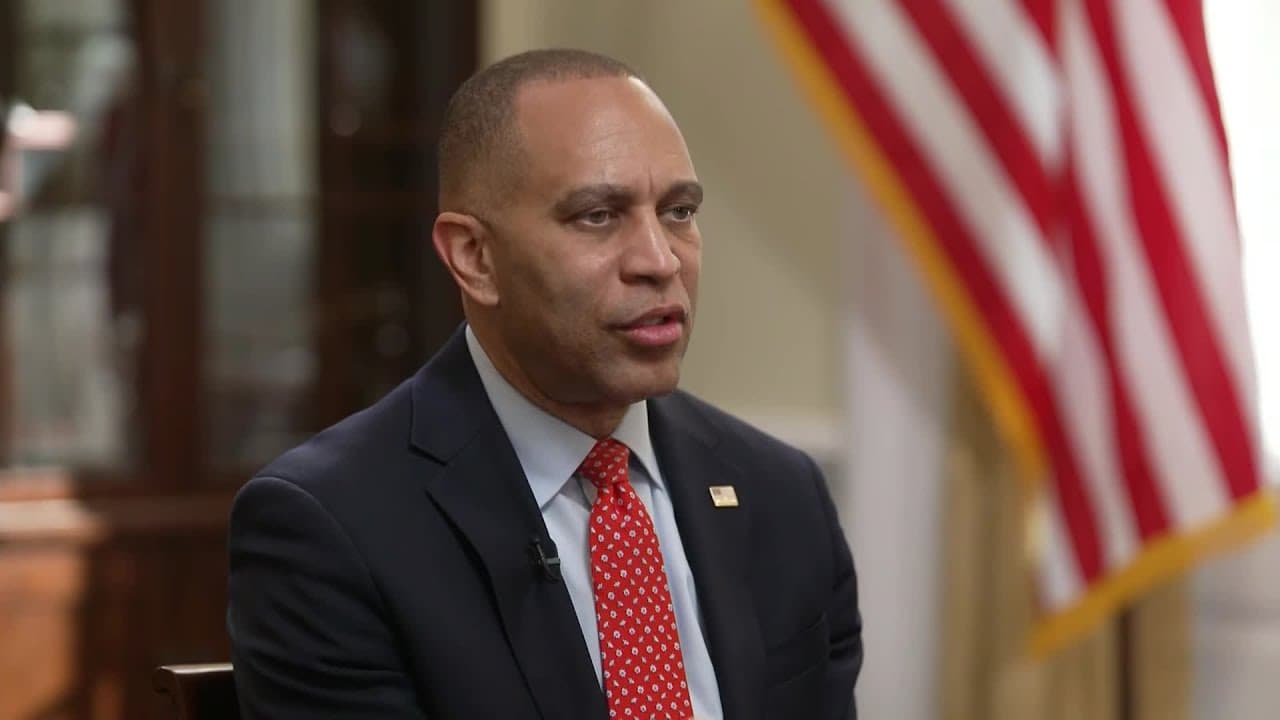
Reopening the government requires bipartisan spending negotiations that also address expiring Affordable Care Act tax credits, according to Hakeem Jeffries. He argues that President Donald Trump must authorize Republican leaders to negotiate, while Congress must protect federal workers, respond to rising health insurance costs, and reach an agreement supporting health, public safety, and economic well-being.
Transcript
It's day 23. And I'm curious sort of what has changed between day one, the start of this shutdown and today in terms of the conversation and how you're feeling about where things are? Well, as Democrats, we continue to make clear to our Republican colleagues that we will sit down with them any time, any place in order to reopen the government, to n... Read More
Key Insights
- Democrats are willing to negotiate a bipartisan agreement to reopen the government, but Jeffries says the agreement must also address the health care crisis, especially the urgent extension of Affordable Care Act tax credits that help working-class Americans afford insurance.
- Negotiations are extremely limited because Donald Trump has not authorized House or Senate Republican leaders to negotiate, according to Jeffries. He argues that meaningful progress depends on the president engaging directly with Democratic leaders and becoming serious about reopening the government.
- Affordable Care Act tax credits support people with relatively modest incomes, with Jeffries stating that more than 90% of recipients earn about $63,000 or less. He warns that failing to extend the credits could sharply increase premiums for tens of millions of Americans.
- A 14-month continuing resolution is unacceptable to Democrats because it would continue government funding without resolving their health care demands. Jeffries says Democrats will not support a partisan Republican spending bill that they believe continues to weaken health care access and affordability.
- Republican health care proposals include nearly $1 trillion in Medicaid reductions, a possible $536 billion Medicare reduction, and proposed appropriations cuts of $1.7 billion for the CDC and roughly $500 million for the NIH, according to the figures presented by Jeffries.
- The November 1 open enrollment period is a major pressure point because Americans will see the practical effects of higher insurance costs. Jeffries says notices were already reaching tens of millions of people who need certainty when planning their household finances and medical care.
- Federal employees are legally entitled to back pay under a 2017 law signed by Donald Trump, according to Jeffries. He nevertheless recognizes workers' concerns because Trump suggested that furloughed employees might not receive compensation despite the statutory requirement.
- Zohran Mamdani said he would retain New York City Police Commissioner Jessica Tisch if elected mayor, a decision Jeffries praised according to the description. Jeffries also said he would endorse a candidate in the mayoral race before early voting begins on Saturday.
Install to Summarize YouTube Videos and Get Transcripts
Explore YouTube Video Summarizer or Get YouTube Transcript Extractor
Questions & Answers
Q: How does Hakeem Jeffries say the government shutdown can end?
Hakeem Jeffries says the government can reopen through direct bipartisan negotiations involving Democrats, congressional Republicans, and the White House. Democrats are prepared to meet anywhere and at any time, but they want a spending agreement that also addresses Affordable Care Act tax credits. Jeffries argues that Donald Trump must authorize Republican leaders to negotiate and personally engage in finding a path forward.
Q: Why are Affordable Care Act tax credits central to the shutdown dispute?
Affordable Care Act tax credits are central because Jeffries says their expiration would make health insurance substantially less affordable for tens of millions of Americans. More than 90% of recipients earn about $63,000 or less, according to his remarks. He warns that some households could face premium increases of $1,000 or $2,000 per month as the November 1 open enrollment period approaches.
Q: Why does Jeffries reject a 14-month continuing resolution?
Jeffries rejects a 14-month continuing resolution because it would extend government funding without addressing the health care issues Democrats consider urgent. He says Democrats will not vote for a partisan Republican spending bill that continues existing health care reductions or leaves Affordable Care Act tax credits unresolved. For Jeffries, reopening the government must accompany a bipartisan agreement that improves health, public safety, and economic well-being.
Q: What health care reductions does Jeffries criticize?
Jeffries criticizes what he describes as nearly $1 trillion in Medicaid reductions, a possible $536 billion Medicare reduction at the end of the year, and the failure to extend Affordable Care Act tax credits. He also cites proposed appropriations reductions of $1.7 billion for the Centers for Disease Control and roughly $500 million for the National Institutes of Health.
Q: Why is November 1 important in the shutdown negotiations?
November 1 marks the beginning of open enrollment for health insurance, making the effects of unresolved Affordable Care Act tax credits more visible. Jeffries says notices were already being sent to tens of millions of Americans who need certainty about premiums and coverage. He predicts that approaching enrollment will increase pressure on Congress because higher premiums, co-pays, and deductibles will become concrete household concerns.
Q: Will furloughed federal workers receive back pay after the shutdown?
Jeffries says a law passed in 2017 and signed by Donald Trump requires furloughed federal workers and other federal employees to receive back pay. He therefore describes the legal requirement as clear. However, he acknowledges that workers are reasonably worried because Trump suggested that compensation might be withheld, which Jeffries characterizes as contrary to the law governing shutdown back pay.
Q: Why does Jeffries blame Donald Trump for limited negotiations?
Jeffries says Donald Trump has not given House or Senate Republican leaders permission to negotiate, leaving conversations between the parties extremely limited. He also notes that Trump met Democratic congressional leaders only two days before the shutdown, after initially agreeing to a meeting and then canceling it. Although that discussion lasted about an hour, Jeffries says the administration provided no subsequent follow-up.
Q: What did Jeffries say about the New York City mayoral race?
According to the description, Jeffries praised Democratic nominee Zohran Mamdani for saying that he would keep Police Commissioner Jessica Tisch in her position if he won the New York City mayoral race. Jeffries had not yet publicly selected a candidate in the material provided, but he said he would make his endorsement before early voting began on Saturday.
Summary & Key Takeaways
-
Hakeem Jeffries says Democrats are willing to negotiate anywhere and at any time to reopen the government. Their conditions include a bipartisan spending agreement and decisive action on health care, particularly extending Affordable Care Act tax credits before open enrollment exposes millions of Americans to potentially severe premium, co-pay, and deductible increases.
-
Jeffries attributes the limited negotiations to Donald Trump, arguing that Republican congressional leaders lack permission to negotiate. He says Democratic leaders requested another White House meeting before Trump's Asia trip. According to Jeffries, an earlier meeting occurred only two days before the shutdown and produced no follow-up from the administration.
-
Jeffries rejects a proposed 14-month continuing resolution because it would not resolve Democrats' health care concerns. He also criticizes proposed Medicaid, Medicare, CDC, and NIH reductions, emphasizes legally required back pay for furloughed workers, and says he will endorse a New York City mayoral candidate before early voting begins on Saturday.
Read in Other Languages (beta)
Share This Summary 📚
Summarize YouTube Videos and Get Video Transcripts with 1-Click
Try YouTube Summary with ChatGPT & Claude or YouTube Transcript Generator
Explore More Summaries from Bloomberg Television 📚





Summarize YouTube Videos and Get Video Transcripts with 1-Click
Try YouTube Summary with ChatGPT & Claude or YouTube Transcript Generator