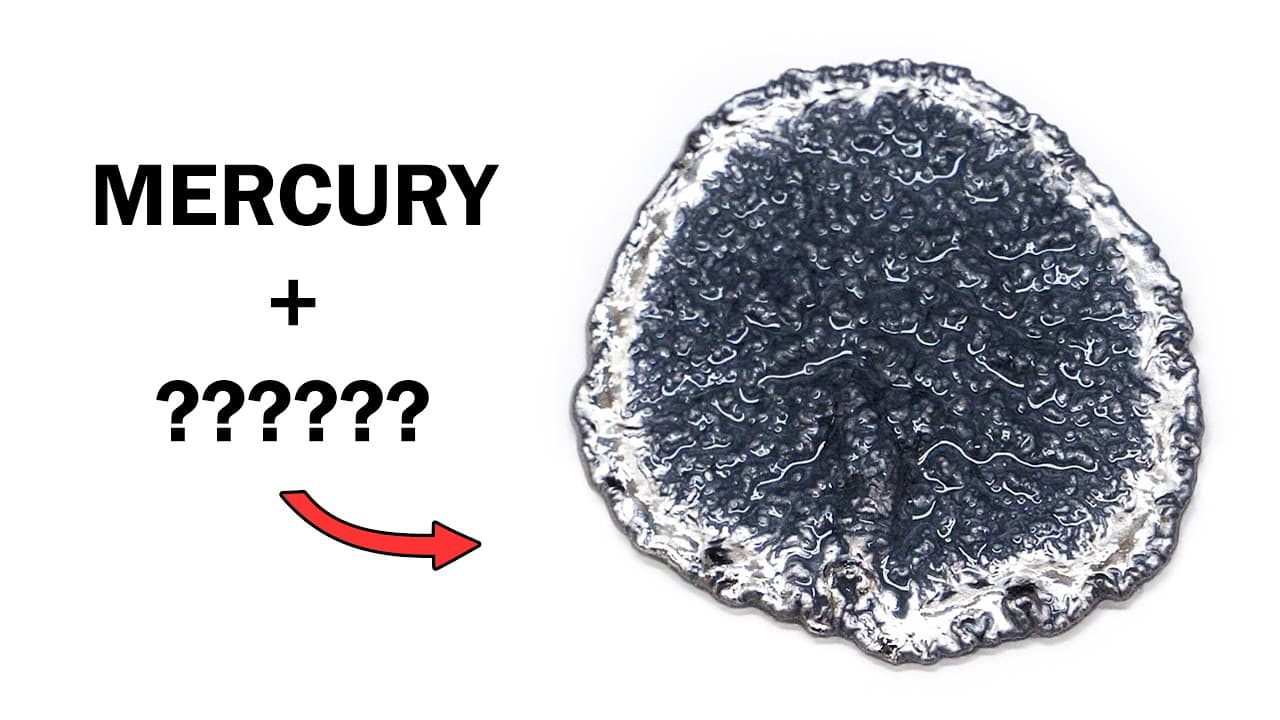
Turning mercury into a weird sponge
TL;DR
Sodium metal reacts with mercury to form a sodium amalgam, which can then be used to create an ammonium amalgam, despite ammonium not being a metal. The process involves a redox reaction and the resulting amalgam is unstable at room temperature.
Transcript
almost every medal has a unique reaction with mercury and a couple of months ago I decided to make a series about it for the first video I started with sodium metal and I combined it with the mercury by just dropping pieces in and then squishing it down the reaction that occurred was extremely fast and it also generated a lot of heat this caused th... Read More
Key Insights
- 🛟 Sodium amalgam serves as a precursor to create other amalgams, including the ammonium amalgam.
- 💁 The reaction between sodium amalgam and ammonium ions involves a redox reaction, resulting in the formation of ammonium amalgam.
- ❓ The solidification of the ammonium amalgam in contact with mercury is not fully understood and can be attributed to the alteration of sodium distribution or the solidifying properties of the ammonium radical.
- 🐢 Keeping the ammonium amalgam at a lower temperature slows down its degradation process.
- 😑 The stability of the ammonium amalgam can be influenced by the concentration of ammonium ions and the presence of other substances, such as ammonium chloride or ammonium nitrate.
- 🥵 Heating the amalgam above 100°C can cause it to decompose rapidly.
- 💁 The formation and behavior of the ammonium amalgam are still a topic of debate and require further research for confirmation.
Install to Summarize YouTube Videos and Get Transcripts
Explore YouTube Video Summarizer or Get YouTube Transcript Extractor
Questions & Answers
Q: What is the purpose of creating a sodium amalgam before attempting to make an ammonium amalgam?
The sodium amalgam serves as a precursor for creating other amalgams, including the ammonium amalgam. The process acts as a gateway to forming amalgams that are typically difficult to create.
Q: How is the ammonium amalgam formed from the sodium amalgam and ammonium ions?
The sodium metal in the amalgam reacts with the ammonium ions, accepting an electron and causing the ammonium ions to become neutral. The resulting neutral ammonium radical dissolves into the mercury, while sodium ions combine with chloride anions in solution to form sodium chloride.
Q: Why does the ammonium amalgam solidify when in contact with mercury?
The solidification of the amalgam in contact with mercury is not fully understood. One theory suggests that a small amount of the ammonium radical might be able to solidify mercury. Another possibility is that the distribution of sodium in the mercury is altered by the reaction and bubbles produced, resulting in increased concentration and solidification.
Q: How does the temperature affect the formation and stability of the ammonium amalgam?
Lowering the temperature slows down the reaction and degradation process of the ammonium amalgam. Keeping it cold helps to slow down the degradation, while room temperature reactions result in faster expansion.
Summary & Key Takeaways
-
The content explores the process of creating an ammonium amalgam through a series of chemical reactions involving sodium amalgam and ammonium ions.
-
Sodium metal reacts with mercury to form a sodium amalgam, which is then combined with an ammonium solution to create the ammonium amalgam.
-
The reaction involves a redox reaction between sodium and ammonium ions, resulting in the formation of ammonium amalgam.
Read in Other Languages (beta)
Share This Summary 📚
Summarize YouTube Videos and Get Video Transcripts with 1-Click
Try YouTube Summary with ChatGPT & Claude or YouTube Transcript Generator
Explore More Summaries from NileRed 📚

Summarize YouTube Videos and Get Video Transcripts with 1-Click
Try YouTube Summary with ChatGPT & Claude or YouTube Transcript Generator