How to Turn LinkedIn Reach Into Qualified Leads
TL;DR
Build a LinkedIn audience around qualified demand, then move interested readers onto an email list with a relevant tool or lead magnet. Combine specific customer pain signals, monthly voice-memo reflections, newsletters, repost calls to action, and readable value-dense images so content remains human, earns distribution, and supports a business pipeline instead of producing empty reach.
Transcript
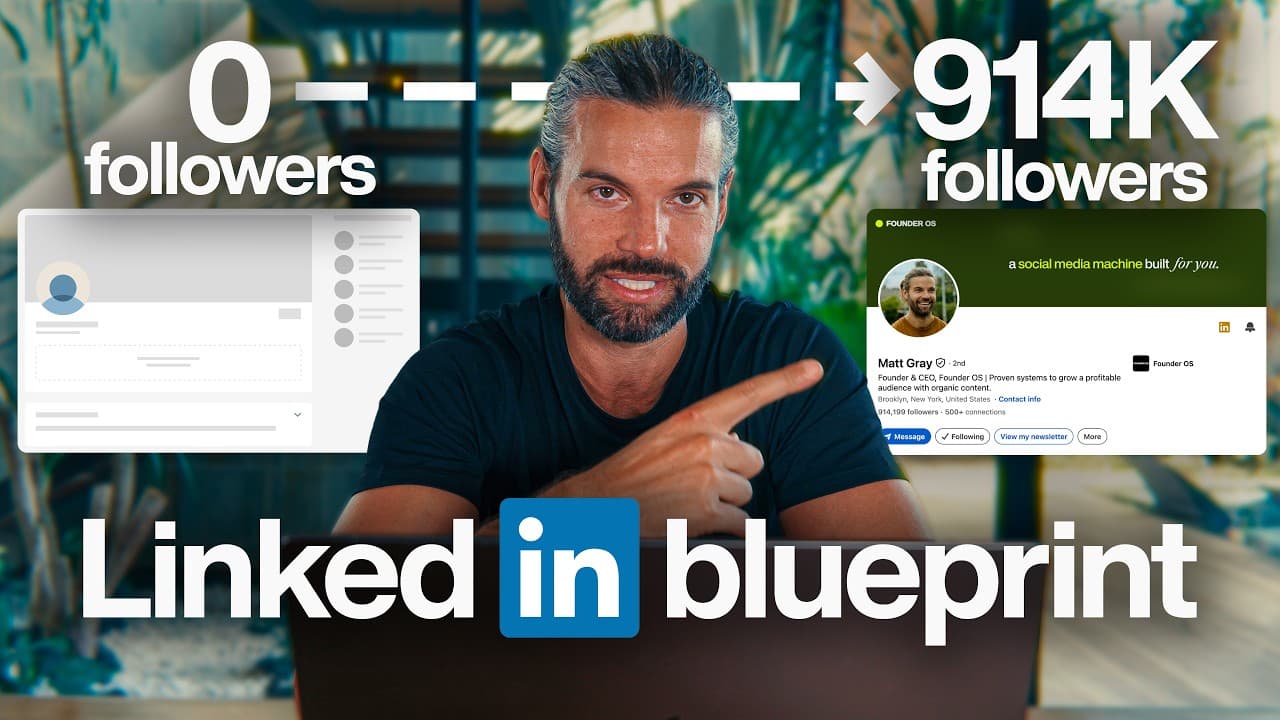
Here are the five steps I use to beat the new LinkedIn algorithm. The same system that grew my account past 913,000 [music] followers and 59 million views a month with zero ad spend. I'll run all five live on my own account. How I turn attention into email subscribers. How my newsletters become my post. The surface signals that make the right perso... Read More
Key Insights
- Reach is not the primary business objective because a large follower count can still produce an empty pipeline. LinkedIn posts should target a defined customer, solve recognizable problems, and create a clear path from platform attention to an owned email list.
- Relevant lead magnets turn readers into identifiable prospects by extending the value of a post. The featured CEO hourly-rate calculator helps founders assess tasks and delegation needs, then requests contact information such as an email address, Instagram handle, and LinkedIn URL.
- Reposts are presented as an important LinkedIn distribution signal. The creator explicitly asks readers to repost useful content, alongside a follow request and lead-magnet link, so each post can pursue platform reach, audience growth, and email acquisition at the same time.
- A monthly content ritual creates authentic material from spoken reflection. The creator records a voice memo during a roughly 45-minute walk, answers questions about current interests and ideas, and converts the recording into a document that preserves his language and perspective.
- An authenticity pack is the source document for a content waterfall. Transcribed reflections supply hooks, post bodies, newsletters, LinkedIn content, and YouTube concepts, allowing one thoughtful recording session to support several formats without beginning each piece from a blank page.
- Resonant copy begins with specific pain and dream signals from a clearly defined market. Concrete experiences, such as being unable to unplug or not knowing what a busy team is doing, are more compelling than broad statements about business being difficult.
- Value-dense images work best when they remain clean and easy to read. The image should communicate useful ideas quickly, stop the scroll, and reward closer attention without becoming overloaded with information or simply repeating the accompanying post word for word.
- Strong LinkedIn headlines can borrow structural patterns from successful titles on other platforms. The creator studies bookmarked titles and subtitles, especially effective YouTube titles and X posts, then adapts their copywriting patterns to LinkedIn while keeping the underlying message relevant to his audience.
Install to Summarize YouTube Videos and Get Transcripts
Explore YouTube Video Summarizer or Get YouTube Transcript Extractor
Questions & Answers
Q: How do you turn LinkedIn followers into email subscribers?
Publish posts that address a specific problem your target customer already recognizes, then offer a closely related tool or guide at the end. The example uses a CEO hourly-rate calculator that helps founders evaluate their work and delegation needs. To receive the result, a reader provides contact information, including an email address, which moves the relationship from LinkedIn into an owned email channel.
Q: Why should LinkedIn creators stop optimizing only for reach?
Reach alone does not guarantee a useful business pipeline. A large account can attract broad attention while producing few qualified prospects if its posts are disconnected from the creator's market and offers. The recommended approach is to create content for a defined customer, solve relevant operational problems, and include a path to an email list where that audience can be nurtured and monetized.
Q: What calls to action should a LinkedIn post include?
The example combines three calls to action with different purposes. Readers are asked to follow the account, repost the content, and access a practical resource. Following supports audience growth, reposting helps distribution within LinkedIn, and the resource link captures contact information. Together, these actions help the post earn more exposure while also creating an audience relationship that does not depend entirely on the platform.
Q: How can a monthly voice memo become LinkedIn content?
Schedule roughly 45 minutes for a walk and record answers to reflective prompts about current obsessions, memorable conversations, recurring ideas, quotes, or contrarian beliefs. Transcribe the recording into an authenticity pack, then extract hooks and longer passages. Those materials can feed a newsletter bank, and the newsletters can become LinkedIn posts while also inspiring content for other channels.
Q: How do you write LinkedIn copy that resonates with a target audience?
Define the market first, then document 10–20 pain signals and 10–20 dream signals in language that reflects what those people feel, see, and experience. Specific details are essential. For an operator founder, examples include being unable to unplug, feeling more stressed despite collecting substantial monthly revenue, or not knowing what a busy team is actually working on.
Q: Why is specific copy more effective than generic business advice?
Specific copy makes the intended reader feel recognized because it describes concrete situations rather than universal frustrations. Statements about vacations feeling expensive because the business may falter, or a content team repeatedly asking what will be published, reveal detailed knowledge of the customer. Generic phrases such as being busy or finding business difficult do not demonstrate the same depth of understanding.
Q: How should value-dense images be designed for LinkedIn?
Keep the image clean, readable, and focused on the core message. It should contain enough useful information to reward attention without becoming crowded. The image copy should also differ from the post text, much like a YouTube thumbnail complements its title. This gives readers two connected but distinct reasons to pause, read, and spend more time with the content.
Q: How can creators find stronger headline ideas for LinkedIn posts?
Review headlines and subtitles that have already captured your attention, including saved examples from recent months. The creator specifically studies patterns from effective YouTube titles and X posts because he considers their copywriting stronger than much of what appears on LinkedIn. The goal is to adapt useful structures and patterns, then connect them to original, audience-specific ideas rather than copying the source material.
Summary & Key Takeaways
-
The system prioritizes business relevance over raw reach. Posts address founders who need better delegation and operating systems, then direct those readers to practical resources. A CEO hourly-rate calculator collects contact details and brings interested prospects onto an email list, reducing dependence on LinkedIn for continued access to the audience.
-
A monthly content ritual supplies authentic source material. During a roughly 45-minute walk, the creator records answers to reflective questions about current ideas, conversations, quotes, and contrarian beliefs. The recording is transcribed into an authenticity pack, which feeds a newsletter bank, LinkedIn posts, and concepts for YouTube videos.
-
Resonant copy and readable images improve relevance and attention. Detailed pain and dream signals help posts reflect the audience's actual experiences instead of generic business problems. Handwritten graphics summarize key ideas with copy that complements rather than duplicates the post, while strong headline patterns and clean layouts encourage readers to stop and engage.
Read in Other Languages (beta)
Share This Summary 📚
Summarize YouTube Videos and Get Video Transcripts with 1-Click
Try YouTube Summary with ChatGPT & Claude or YouTube Transcript Generator
Explore More Summaries from Matt Gray 📚
Summarize YouTube Videos and Get Video Transcripts with 1-Click
Try YouTube Summary with ChatGPT & Claude or YouTube Transcript Generator