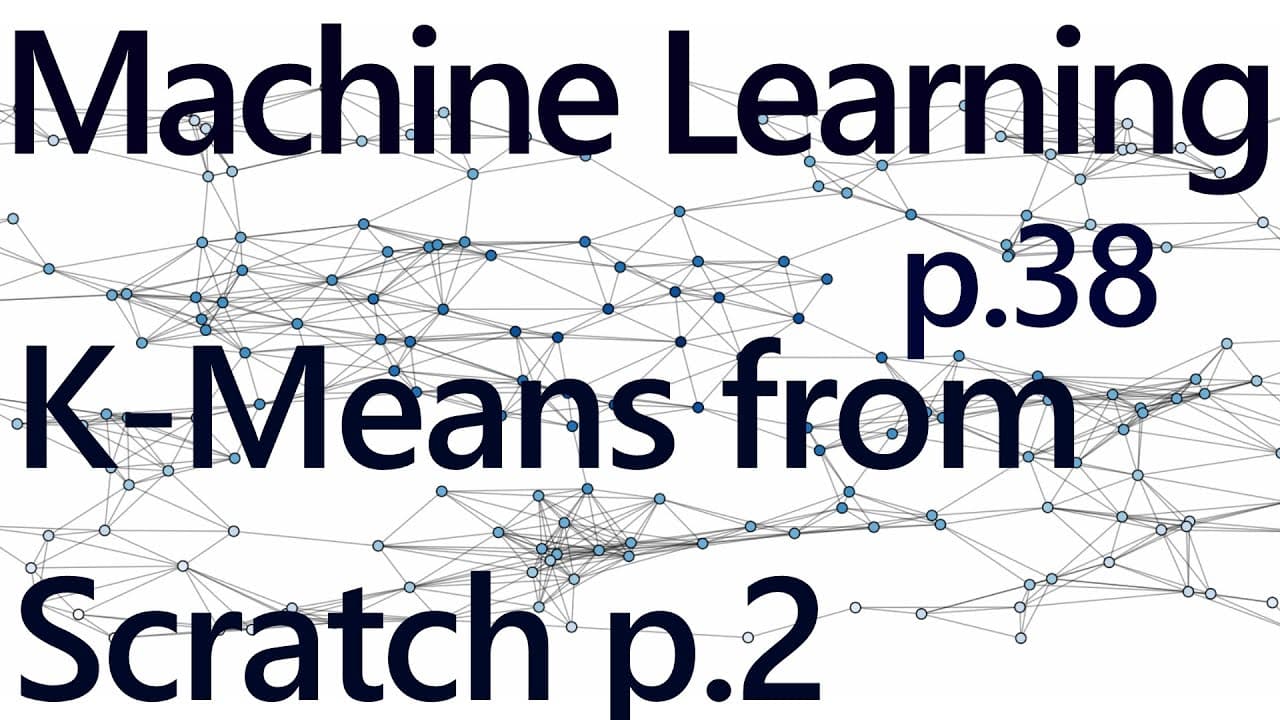
How to Develop a Custom K-Means Clustering Algorithm
TL;DR
To develop a custom k-means algorithm, create functions for centroid initialization, distance calculations, and iterative optimization until convergence is reached. The algorithm effectively classifies data points by continually updating centroids based on cluster memberships and can predict classifications for new data points based on the established clusters.
Transcript
what's going on everybody welcome to part 38 of our machine learning tutorial series I'm hoping to cover a lot so let's go ahead and get started we've been working on our own custom k-means algorithm and we're going to continue picking that up so at this point we have at least classified all of the feature sets and in this part here passing for now... Read More
Key Insights
- 👈 The custom k-means algorithm accurately classifies data points into clusters.
- ❓ Optimization is crucial for determining the convergence of the algorithm.
- 😥 The algorithm can effectively predict the cluster for new data points.
Install to Summarize YouTube Videos and Get Transcripts
Explore YouTube Video Summarizer or Get YouTube Transcript Extractor
Questions & Answers
Q: What is the purpose of the custom k-means algorithm developed in the tutorial?
The purpose is to classify data points into clusters based on their features, using the k-means algorithm.
Q: How is the optimization of the algorithm implemented?
Optimization is done by comparing the movement of centroids after each iteration and checking if it exceeds the tolerance value.
Q: How is the prediction of new data points performed?
The algorithm calculates the distances between the new data points and all centroids, and assigns them to the cluster with the minimum distance.
Q: What happens when new data points are added to the dataset?
The algorithm adjusts the centroids based on the new data points, potentially changing the cluster assignment for existing data points.
Summary & Key Takeaways
-
The tutorial covers the development of a custom k-means algorithm, starting with classification and centroid redefinition.
-
The algorithm uses optimization to determine if the centroids have moved significantly, and continues iterations until convergence.
-
The code is implemented and tested on a dataset, showing accurate clustering and the ability to predict new data points.
Read in Other Languages (beta)
Share This Summary 📚
Summarize YouTube Videos and Get Video Transcripts with 1-Click
Try YouTube Summary with ChatGPT & Claude or YouTube Transcript Generator
Explore More Summaries from sentdex 📚
Summarize YouTube Videos and Get Video Transcripts with 1-Click
Try YouTube Summary with ChatGPT & Claude or YouTube Transcript Generator