How to Launch a Profitable AI Startup in 30 Days
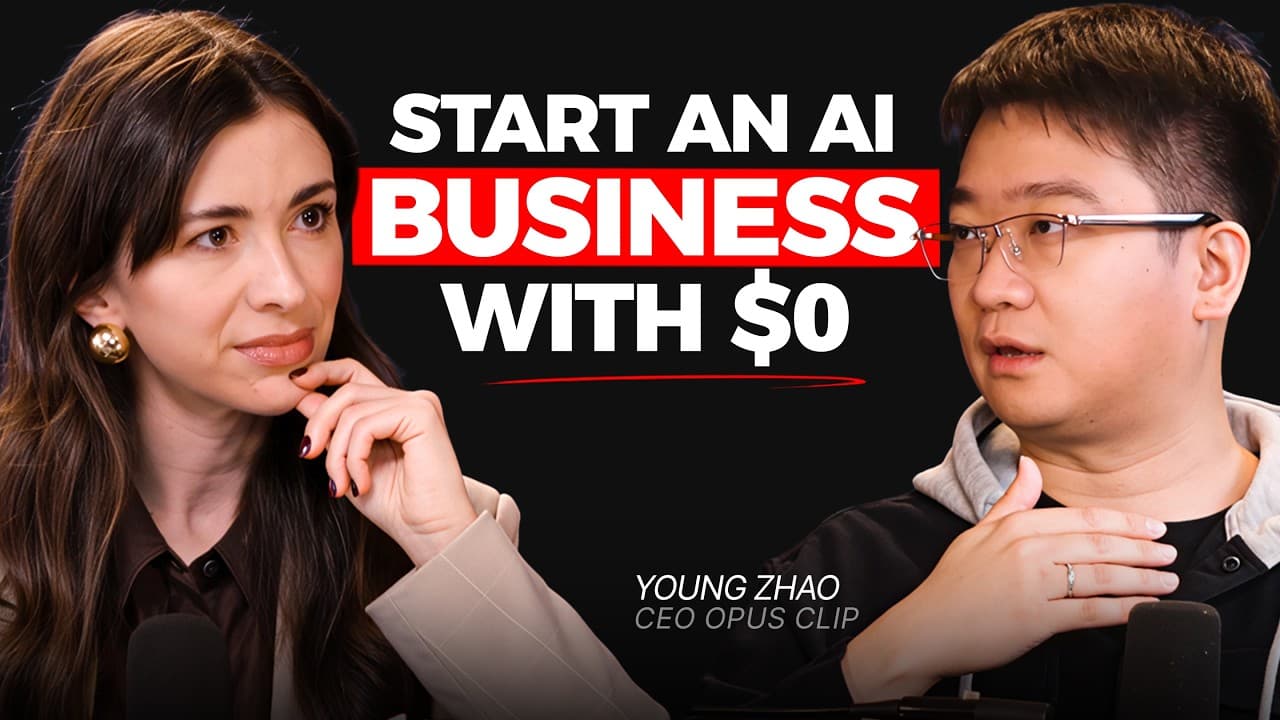
TL;DR
To build a successful AI startup, focus on identifying a real, unsolved problem and create a product that addresses it effectively. Validate your idea through early user feedback and iterate quickly. Avoid building mere features for existing platforms, and ensure you have a unique distribution channel. Passion for problem-solving and disciplined execution are crucial for long-term success.
Transcript
So let's imagine you have to start a company again. Walk me through the first 30 days. What will you do >> if I have to start a company again? I think the first thing is >> this is Young, co-founder and CEO of Opus Clip, an AI tool that turns long videos into viral short clips. In just 2 and 1/2 years, he built it into one of the fastest growing AI... Read More
Key Insights
- Young Zhao built Opus Clip, an AI tool, into a $215M company by focusing on solving real problems.
- Passion for problem-solving and building is crucial for startup founders, not just passion for the specific product.
- Identifying and solving a real, painful job to be done is the first step in building a successful startup.
- Early validation through user feedback is essential; focus on delivering value before building a full product.
- Avoid building features that large incumbents can easily replicate within their existing workflows.
- Pricing should be based on value creation, unit economics, and customer willingness to pay.
- Using AI as a thinking partner can enhance decision-making and provide valuable insights.
- Discipline in execution and time management is crucial for long-term success as a founder.
Install to Summarize YouTube Videos and Get Transcripts
Explore YouTube Video Summarizer or Get YouTube Transcript Extractor
Questions & Answers
Q: How to build a successful AI startup?
To build a successful AI startup, identify a real, unsolved problem and create a product that addresses it effectively. Validate your idea through early user feedback and iterate quickly. Avoid building mere features for existing platforms, and ensure you have a unique distribution channel. Passion for problem-solving and disciplined execution are crucial for long-term success.
Q: What is the key to finding product-market fit?
The key to finding product-market fit is to focus on solving a real, painful job to be done. This involves deeply understanding the market, users, and existing workflows. Early validation through user feedback is essential; focus on delivering value before building a full product. Iterate based on feedback to refine the product and achieve a strong market fit.
Q: Why is passion important for startup founders?
Passion is important for startup founders because it drives them to continuously solve problems and build valuable products. However, it's not just about passion for the specific product; it's about a broader passion for problem-solving, building, and making an impact. This passion helps founders persist through challenges and stay focused on their long-term goals.
Q: What should AI founders avoid when building a product?
AI founders should avoid building features that large incumbents can easily replicate within their existing workflows. These features are often not sustainable as standalone products. Instead, founders should focus on solving unique, vertical business problems and owning the workflow end-to-end, ensuring their solution offers distinct value that cannot be easily replicated.
Q: How should AI startups approach pricing?
AI startups should approach pricing by considering the value creation of their product and benchmarking against existing solutions. They should also consider their unit economics, including costs like storage and inference. Conducting experiments and customer interviews can help refine pricing strategies, ensuring they align with customer perceptions of value and willingness to pay.
Q: What is the role of AI as a thinking partner?
AI can serve as a valuable thinking partner by providing insights and enhancing decision-making processes. Founders can use AI to run through ideas, ask for feedback, and explore different scenarios. This involves engaging in detailed conversations with AI, treating it as a senior thought partner, and leveraging its capabilities to gain new perspectives and solutions.
Q: Why is discipline important for founders?
Discipline is important for founders because it enables them to manage their time, resources, and focus effectively. It involves setting clear goals, maintaining a structured routine, and consistently working towards objectives. Discipline helps founders stay aligned with their mission, push through challenges, and make informed decisions that contribute to long-term success.
Q: How can founders validate their startup ideas?
Founders can validate their startup ideas by engaging with potential users early and gathering feedback on the product's value and usability. This involves creating a minimal viable product (MVP), conducting customer interviews, and running experiments to test assumptions. Validation helps identify product-market fit and refine the product based on real-world insights and user needs.
Summary & Key Takeaways
-
Young Zhao emphasizes the importance of solving real problems and iterating based on user feedback. He advises against building mere features for existing platforms, as incumbents can easily replicate them. Founders should focus on unique distribution channels and ensure their product addresses a genuine pain point.
-
Zhao highlights that passion for problem-solving and disciplined execution are crucial for startup success. He stresses the importance of understanding the market and users deeply to create a product that offers real value and stands out in a competitive landscape.
-
Pricing strategies should reflect the value created and be informed by customer feedback. Founders should use AI as a thinking partner to enhance decision-making and maintain discipline in managing their time and resources effectively.
Read in Other Languages (beta)
Share This Summary 📚
Summarize YouTube Videos and Get Video Transcripts with 1-Click
Try YouTube Summary with ChatGPT & Claude or YouTube Transcript Generator
Explore More Summaries from Silicon Valley Girl 📚






Summarize YouTube Videos and Get Video Transcripts with 1-Click
Try YouTube Summary with ChatGPT & Claude or YouTube Transcript Generator