Best hidden feature of Python | Chaining comparison operators
TL;DR
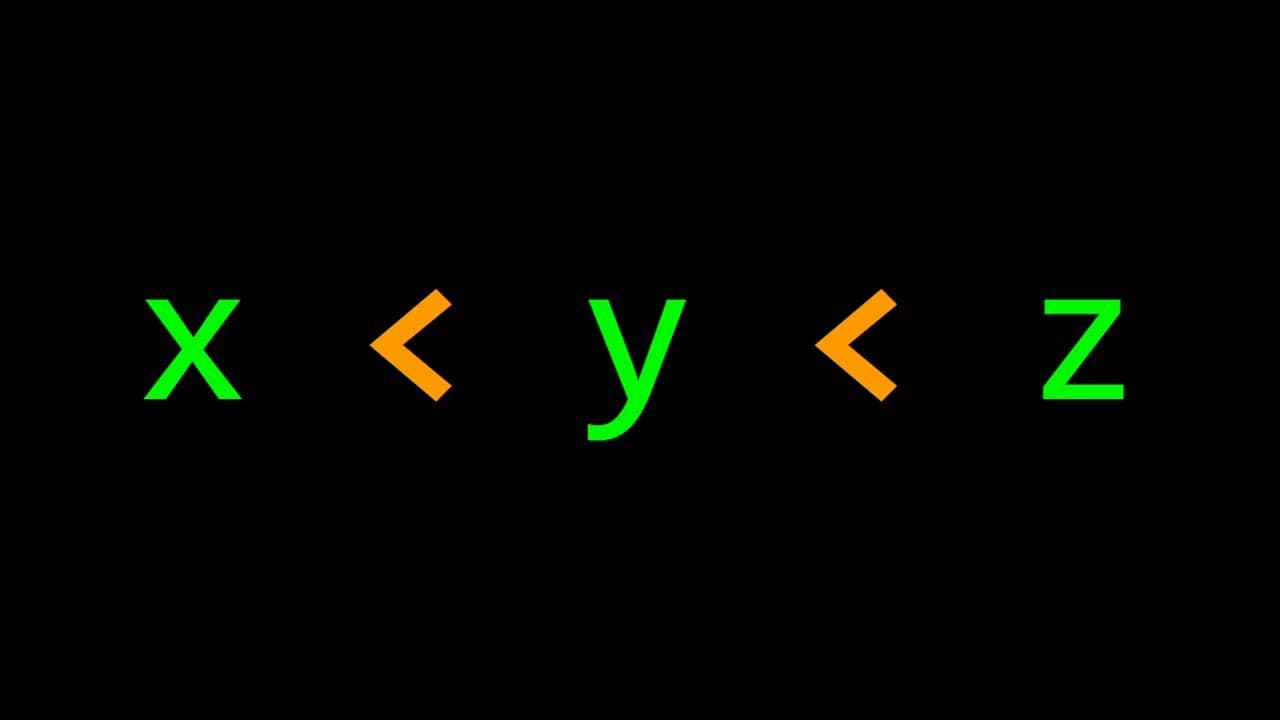
Python’s hidden comparison-chaining feature lets you express several comparisons in one intuitive statement, such as 1 < x < y < 4. With x equal to 2 and y equal to 3, Python evaluates each binary comparison and returns true only when the entire chain is true. Operators can also be mixed in an arbitrarily long chain, making this a concise feature worth exploring through the examples below.
Transcript
this is a hidden feature of python that i recently came across the chaining of comparison operators that is not available in almost any mainstream programming language i think it's elegant and intuitive and doesn't make any sense to me why it's not available in most languages so what is it say we assign the values 2 and 3 to x and y and then look a... Read More
Key Insights
- 🔍 Python's chaining of comparison operators is an elegant and intuitive feature that is not commonly found in mainstream programming languages. It allows for the chaining of multiple comparison operators in a single statement, evaluating the statement as a chain of binary comparison operators.
- 🔄 This feature allows for the use of various comparison operators, such as less than, greater than, less than or equal to, and greater than or equal to, which can be mixed and matched in a single chain.
- ❌ Changing the order or the operator in the chain can alter the evaluation of the statement. For example, switching the order of 4 and y in the statement can change its truth value.
- 🌐 This chaining feature is available in a few other languages like Pearl, Reiku, Julia, Scheme, Common Lisp, and Closure, but the constraint of using only the same operator in the chain may apply in some cases. =⃣ Chaining the equality comparison operator in Lisp can be used to evaluate lists of numbers, returning true if all values are equal and false otherwise. Similarly, the less than operator can be used to check if a sequence is in strictly increasing order.
- 💡 Despite being easy to implement and mathematically intuitive, this feature is not commonly included in mainstream languages due to factors like laziness, low importance compared to other features, and potential backward compatibility issues.
- ⚙️ Backward compatibility concerns arise if chaining operators were allowed previously but didn't exhibit the intuitive behavior, leading to potential breaking changes.
- 🌐 If you're interested in further exploration of this topic, the Software Engineering Stack Exchange contains insightful discussions on the reasons behind the absence of this feature in mainstream languages.
Install to Summarize YouTube Videos and Get Transcripts
Explore YouTube Video Summarizer or Get YouTube Transcript Extractor
Questions & Answers
Q: How does Python evaluate chained comparison operators?
Python treats a chained statement as a series of binary comparisons joined by logical conditions. For example, 1 < x < y < 4 means that 1 is less than x, x is less than y, and y is less than 4; the whole chain is true only when every comparison is true.
Q: What is an example of comparison operator chaining in Python?
Assigning 2 to x and 3 to y makes 1 < x < y < 4 evaluate to true. Each individual comparison—1 less than x, x less than y, and y less than 4—is true.
Q: Can Python mix different operators in one comparison chain?
Yes. Less than, greater than, less than or equal to, and greater than or equal to operators can be mixed within a single chain. The chain can also be arbitrarily long.
Q: When does a chained comparison return false in Python?
The entire expression returns false when any individual comparison is false. With y equal to 3, changing the last part of the example so that it requires y to be greater than 4 makes the chain false.
Q: Does the order of values matter in a chained comparison?
Yes, changing the order can change the result. With x equal to 2 and y equal to 3, the chain becomes true when its comparisons state that 1 is less than x, x is less than 4, and 4 is greater than y.
Q: Which other languages support chained comparison operators?
The transcript identifies Perl 6, Reiku, and Julia as languages with this feature. It also describes chaining as a first-class feature in Scheme, Common Lisp, and Closure, though those functional-language examples require the same operator throughout the chain.
Q: How are comparison chains used in Lisp?
The equality operator can be applied across a list, returning true when all values are equal and false when one differs. Similarly, the less-than operator can test whether an entire sequence is in strictly increasing order.
Q: Why do many mainstream languages lack comparison chaining?
The discussion summarized in the transcript says the feature is easy to implement, mathematically intuitive, and elegant, but relatively low in importance compared with other features. Adding it can also cause painful backward-compatibility problems when similar syntax was previously accepted with different behavior.
Summary
In this video, the speaker discusses a hidden feature in Python - the chaining of comparison operators. This feature allows for the combination of multiple comparison operators in a single statement, making it intuitive and elegant. The speaker demonstrates how this feature works and explains its availability in other programming languages as well. The video also touches upon the reasons why this feature is not commonly implemented in mainstream languages.
Questions & Answers
Q: What is the chaining of comparison operators in Python?
The chaining of comparison operators in Python refers to the ability to combine multiple comparison operators in a single statement. This allows for a more concise and intuitive representation of complex conditions. For example, the statement 1 < x < y < 4 evaluates to true if 1 is less than x, x is less than y, and y is less than 4.
Q: Why is the chaining of comparison operators not available in most programming languages?
The chaining of comparison operators is a feature that is not commonly available in mainstream programming languages. There could be several reasons for this. Firstly, it might not have been considered as a high-priority feature during the development of these languages. Secondly, implementing this feature might require additional effort and could potentially break backward compatibility. Lastly, the importance of this feature might be perceived as relatively low compared to other language features.
Q: Which programming languages besides Python support the chaining of comparison operators?
While the chaining of comparison operators is not prevalent in most programming languages, there are a few languages that do support this feature. Some examples include Perl 6, Raku, Julia, Scheme, Common Lisp, and Clojure. However, it's worth noting that in some functional languages like Scheme, Common Lisp, and Clojure, the chaining of operators is limited to using only the same operator.
Q: How does the chaining of comparison operators work in languages like Scheme, Common Lisp, and Clojure?
In languages like Scheme, Common Lisp, and Clojure, the chaining of comparison operators is limited to using only the same operator. For example, applying the equality operator to a list of numbers will return true if all elements in the list are equal and false otherwise. Similarly, applying the less than operator to a list will return true if the elements are in strictly increasing order and false otherwise.
Q: What are some advantages of using the chaining of comparison operators in Python?
The chaining of comparison operators in Python offers several advantages. Firstly, it allows for more concise and readable code by eliminating the need for multiple separate comparison statements. It also aligns with mathematical and intuitive reasoning, making it easier to express complex conditions in a natural way. Additionally, the feature is relatively easy to implement and adds elegance to the language.
Q: Are there any drawbacks or limitations to using the chaining of comparison operators?
While the chaining of comparison operators offers benefits, there are also some limitations to be aware of. One limitation is that the chaining can only be done with the same operator, which means you cannot mix and match different comparison operators in a single chain. Furthermore, there is a potential risk of breaking backward compatibility if this feature was allowed previously but did not behave intuitively. However, overall, the drawbacks seem minimal compared to the advantages this feature provides.
Q: What is the significance of list comprehensions in Python?
The speaker briefly mentions list comprehensions in relation to the hidden feature of chaining comparison operators. List comprehensions are a powerful feature in Python that allows for concise creation and manipulation of lists. Although not directly related, the speaker sees list comprehensions as another significant feature in Python that adds to its overall appeal.
Q: Why is the chaining of comparison operators considered a hidden or lesser-known feature of Python?
The chaining of comparison operators might be considered a hidden or lesser-known feature of Python due to its limited availability in mainstream programming languages. Additionally, it may not be heavily documented or prominently mentioned in Python learning resources, making it less well-known among beginner and intermediate Python developers.
Q: Can you provide a resource to learn more about the chaining of comparison operators and its significance?
The speaker mentions a link in the video description that leads to the Software Engineering Stack Exchange page. This page discusses the chaining of comparison operators from a semi-philosophical perspective and provides insights into why most mainstream languages do not include this feature. Exploring the answers on that page can provide further understanding and appreciation for this hidden feature.
Q: What is the speaker's opinion on the chaining of comparison operators in Python?
The speaker expresses enthusiasm and appreciation for the chaining of comparison operators in Python. They consider it one of the best hidden features of Python and praise its elegance and intuitiveness. While acknowledging that this feature might not have been a top priority during language development, the speaker believes it adds value to the language and encourages others to explore and embrace it.
Takeaways
In summary, the video highlights the hidden feature of chaining comparison operators in Python. This feature allows for the combination of multiple comparison operators in a single statement, making code more concise, intuitive, and elegant. Although not commonly available in mainstream programming languages, a few languages such as Perl 6, Raku, Julia, Scheme, Common Lisp, and Clojure do support this feature. The speaker recommends exploring the provided resources to understand why this feature is not widely implemented. Despite its lesser-known status, the chaining of comparison operators is considered one of the best hidden features in Python, alongside other notable features like list comprehensions.
Summary & Key Takeaways
-
Python allows chaining of comparison operators, where multiple operators can be combined in a single statement.
-
Chained operators in Python evaluate the statement as a chain of binary comparisons, yielding a boolean result.
-
Chained operators are available in some other languages like Perl, Reiku, Julia, and functional languages like Scheme, Common Lisp, and Closure.
Read in Other Languages (beta)
Share This Summary 📚
Summarize YouTube Videos and Get Video Transcripts with 1-Click
Try YouTube Summary with ChatGPT & Claude or YouTube Transcript Generator
Explore More Summaries from Lex Fridman 📚





Summarize YouTube Videos and Get Video Transcripts with 1-Click
Try YouTube Summary with ChatGPT & Claude or YouTube Transcript Generator