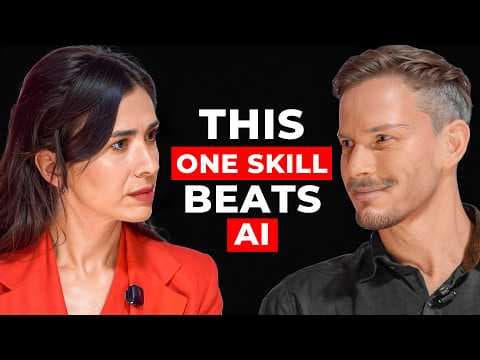
How to stay relevant as AI disrupts jobs in 2 years

TL;DR
AI will disrupt many jobs and change how work gets done. Stay relevant by adopting open AI tools, learning to integrate AI into everyday tasks, and preparing for rapid shifts in technology and access models. Expect breakthroughs in biotech, software, and new operating paradigms that require proactive adaptation.
Transcript
What kind of reality we will see in the future mostly depend on whether big tech companies will have control on who has access to artificial intelligence. >> These are David and Daniel Lieberman, investors and founders who sold their company to Snap. Now they're building Gonka, a decentralized AI network designed to make AI more open and affordable... Read More
Key Insights
- AI access determines who benefits and who controls the technology, with control often concentrated among a few big players.
- Open access versus gatekeeping will shape the pace and reach of AI adoption, influencing pricing, availability, and who can participate in AI-driven innovation.
- The industry can shift from purely software to AI-enhanced hardware and services, accelerating disruption across trades and manufacturing.
- Every profession is expected to face disruption, but timing varies by task complexity and physical requirements.
- Public and private stakeholders may create trust mechanisms and governance to balance innovation with safety and fairness.
- There is potential for AI to dramatically improve problem solving in everyday tasks, illustrating a future where AI augments rather than replaces human labor.
- Localized, real-world problems (like plumbing) can leverage AI to provide immediate, low-friction improvements in efficiency and outcomes.
- The conversation around ownership in AI companies highlights how founder values can be diluted by corporate control, affecting long-term direction and accountability.
Install to Summarize YouTube Videos and Get Transcripts
Explore YouTube Video Summarizer or Get YouTube Transcript Extractor
Questions & Answers
Q: How to stay relevant as AI disrupts jobs in the next few years
Staying relevant requires actively integrating AI into everyday work, developing a mindset of continuous learning, and selecting roles that leverage AI as a tool rather than viewing it as a threat. Seek cross-functional projects where AI can improve efficiency, accuracy, and decision making, and build skills in prompt design, data interpretation, and human–AI collaboration. This approach reduces risk by creating value that machines cannot easily replicate and keeps you adaptable as new tools emerge.
Q: What is the potential timeline for AI to cause widespread disruption
Disruption is expected to occur in waves across different professions, with some tasks disrupted in the near term and others taking longer due to physical constraints or complex expertise. The conversation emphasizes that breakthroughs in biotech, chemistry, and software could create tipping points within a few years, after which adapting becomes essential for many careers.
Q: Who controls access to AI according to the discussion
The discussion centers on whether access to AI will be freely available to everyone or restricted by big tech gatekeepers. It highlights the tension between market-driven access and policy or governance that could either democratize AI or concentrate power in a few players who control data, models, and infrastructure.
Q: What example shows AI aiding real world jobs like plumbing
An illustrative example describes using AI via camera input to diagnose piping issues remotely, enabling a plumber to fix problems more quickly. This demonstrates AI not replacing hands-on labor entirely but enhancing problem solving and decision making in field work, reducing downtime and costs for the customer.
Q: Why is the 1.5% share of a founder mentioned
The 1.5% figure is used to reveal how founders and key contributors may no longer have majority control in open, traded AI companies. It underscores the risk that those who built the technology can lose decision-making influence as ownership becomes dispersed among shareholders and institutions.
Q: What role might governments play in AI access
Governments could step in to regulate access, ensure safety, and prevent harmful concentration of power in AI ecosystems. This could involve creating standards, promoting interoperability, and encouraging open models or public options to balance innovation with consumer protection and equitable opportunity.
Q: How might AI change operating systems and coding languages
The hosts anticipate that AI could lead to substantial rewrites of operating systems and coding languages, driven by new paradigms enabled by AI. This would require developers to learn new tooling, refactor existing systems, and adapt to more AI-assisted programming workflows that broaden productivity and capability.
Q: What is the concept of a decentralized AI network
A decentralized AI network aims to distribute access and governance of AI tools, making it harder for a single entity to gate or monopolize capabilities. Such a model aspires to lower costs, increase openness, and empower a wider range of users and developers to contribute and benefit from AI innovations.
Summary & Key Takeaways
-
AI disruption will touch every profession, with accelerations expected in the next few years and a need for early adoption of AI-enabled workflows. Individuals should build adaptable skills and seek opportunities where AI augments human work rather than replaces it. Collaboration with AI and learning to guide its use will be essential.
-
Markets and access to AI will be shaped by who controls the technology and how governance evolves, including discussions around open models versus proprietary gatekeeping. The outcome will influence pricing, availability, and individual ability to benefit from AI advances.
-
Practical shifts will occur in everyday tasks and services, such as AI assisting tradespeople like plumbers, reducing repetitive labor and enabling faster problem solving. This evolution will require new safety, trust, and standards as AI becomes more embedded in consumer workflows.
Read in Other Languages (beta)
Share This Summary 📚
Summarize YouTube Videos and Get Video Transcripts with 1-Click
Try YouTube Summary with ChatGPT & Claude or YouTube Transcript Generator
Explore More Summaries from Silicon Valley Girl 📚





Summarize YouTube Videos and Get Video Transcripts with 1-Click
Try YouTube Summary with ChatGPT & Claude or YouTube Transcript Generator