Karpathy Joins Anthropic: What Recursive AI Means
TL;DR
Andrej Karpathy, at 39 years old, is joining Anthropic to lead a new pre-training team focused on recursive self-improvement, meaning Claude helping improve itself. Anthropic was EBIT positive in its most recent quarter per the Wall Street Journal, and LLM makers are approaching roughly $100 billion in ARR at about 80% gross margins on inference. The two remaining frontiers are recursive self-improvement and continual learning.
Transcript
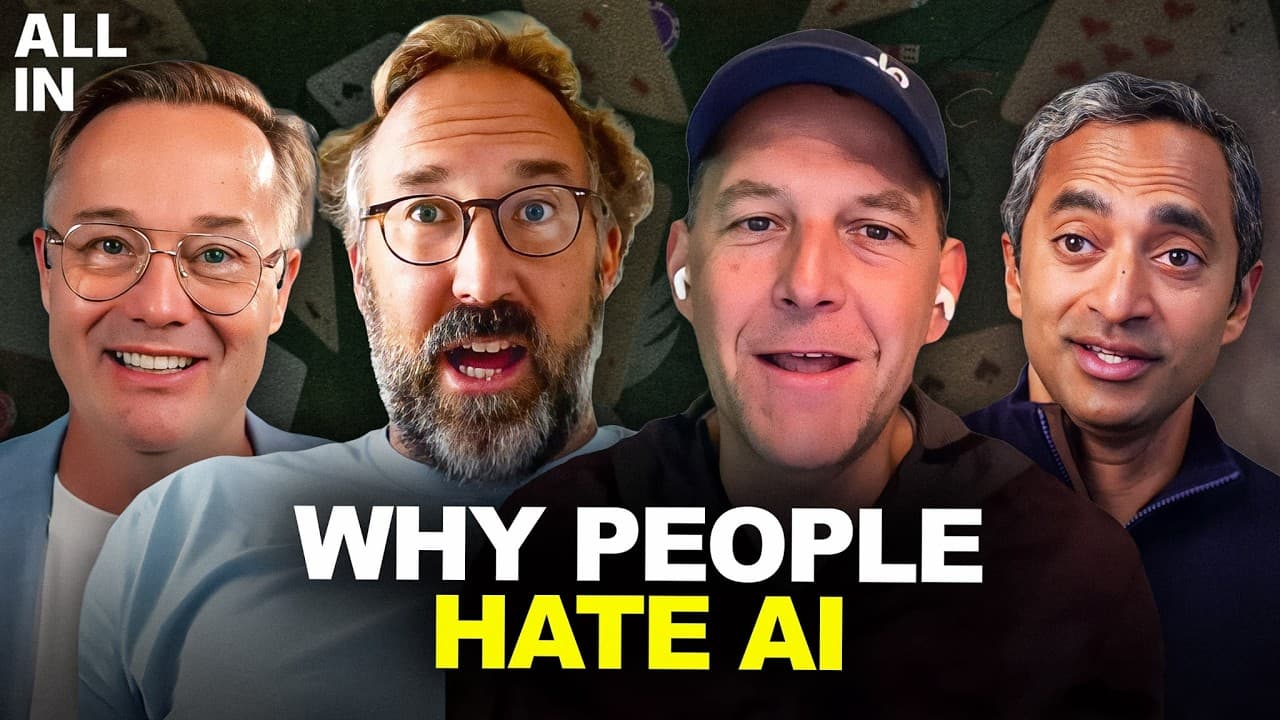
All right, everybody. Welcome back to the number one podcast in the world. It's the Allin podcast, episode 274. Sachs is out today, but we're very lucky to have Gavin Baker from Treaties Management joining us. The spicy takes must flow. Welcome back to the program. Besty Gavin, >> thanks for having me. Always love it. >> It's been a huge week in te... Read More
Key Insights
- Andrej Karpathy is joining Anthropic to lead a new pre-training team whose focus is recursive self-improvement, the idea of having Claude improve itself. He is 39 years old, was a founding member of OpenAI, and previously led the self-driving team at Tesla.
- Recursive self-improvement means a model has input into its own training while it is training, either during a forward pass or through another model influencing that training. Combined with continual learning, it is described as one of the two final frontiers for AI.
- Continual learning, where a model learns from experience the way humans do, has not been unlocked yet. Pairing it with recursive self-improvement is described on the show as the holy grail that could pull the future forward in a very real way.
- Anthropic was EBIT positive in the most recent quarter according to the Wall Street Journal. That single fact is presented as important for the whole AI narrative because it answers circular funding and ROI criticism with actual returns rather than projections.
- OpenAI and Anthropic together are estimated at roughly $100 billion of ARR with about 80% gross margins on inference. Adding Gemini, Cursor, XAI and open source, the panel sees $200 billion to $400 billion of ARR possible by the end of this year.
- Google's culture historically singled out individual technical talents by naming them Google fellows, including Amit Singhal, Sridhar Ramaswamy and Jeff Dean. The comparison is that such people sit at the foot of wave after wave of technical change.
- Karpathy hand-labeled Tesla video data himself, reportedly spending around a quarter of his time on it in the 2016 to 2017 era. He was also among the first to commercialize Richard Sutton's bitter lesson essay, which centers on brute force computation.
- Networks of smaller models working together may produce a lower cost and energy per token than one single large model. A minor architectural breakthrough that halves cost per token is described as a large efficiency gain that early research papers suggest is reachable.
Install to Summarize YouTube Videos and Get Transcripts
Explore YouTube Video Summarizer or Get YouTube Transcript Extractor
Questions & Answers
Q: Why is Andrej Karpathy joining Anthropic?
Karpathy is taking charge of a new pre-training team at Anthropic, with recursive self-improvement as the stated focus, in other words having Claude improve itself. Anthropic had already been talking publicly about AI improving AI. The panel frames him as a rare curious technologist who can be sent off to invent new things, comparing the role to the Google fellow tradition where singular technical talents were singled out and repeatedly sat at the front of each new technical wave.
Q: What is recursive self-improvement in AI models?
Recursive self-improvement is the idea that a model has input into its own training while that training is happening, for instance during a forward pass, or that another model has input into the training. On the show it is called one of the two final frontiers for AI alongside continual learning. If it works, the panel argues model quality could improve by an order of magnitude on a yearly basis, described as a new form of Moore's law where quality goes parabolic.
Q: How profitable are the AI model companies right now?
Anthropic was EBIT positive in the most recent quarter according to the Wall Street Journal, which is presented as an important data point for the entire AI narrative. OpenAI and Anthropic combined are estimated at roughly $100 billion of ARR with about 80% gross margins on inference. That combination of scale, margin and fast growth is used to argue the returns on AI spend are actually showing up rather than being purely circular funding.
Q: How large could total AI model revenue get this year?
Adding Gemini, Cursor, XAI and open source to the roughly $100 billion of ARR at OpenAI and Anthropic, the estimate on the show is that $200 billion, $300 billion or $400 billion of ARR by the end of this year is not hard to see, at high margin. Notably, that figure deliberately excludes other economically important GPU use cases such as better recommender systems and better ad targeting and measurement at Facebook, Google and Amazon.
Q: What is continual learning and why does it matter?
Continual learning is described as the holy grail: the model learns from experiences the way humans do, rather than being frozen after training. It has not been unlocked yet. The argument on the show is that continual learning combined with recursive self-improvement would pull the future forward in a very real way, and that under those conditions even a claim of models improving 10x every year might turn out to be conservative.
Q: Are smaller AI models the future instead of one giant model?
One path discussed is building much smaller models and then creating networks of those smaller models that work together, so the aggregate produces less energy cost and less cost per token than a single large model. Verticalized small language models are also called out as a direction, with one company mentioned doing this for corporations. Early research, including an MIT paper referenced on the show, suggests there is significant room to run in rearchitecting models and how they are deployed.
Q: What did Google put inside the Chrome browser?
About two weeks before the episode, Google included the Gemini Nano model in the Chrome browser without announcing it. It is roughly 4 gigabytes on your computer and handles tasks like proofreading, spelling and autocomplete. One host called this covert installation on everybody's operating system, while another pushed back on the word covert and argued Google is not in the business of doing shady things.
Q: Why do the hosts say breathless AI model coverage is a problem?
The argument is that talking breathlessly about every model improvement has no ROI and wastes time, and that framing AI as a mysterious thing being done to people fuels an us versus them reaction, part of why AI now reads to many as a four-letter word. The suggested focus instead is end user achievements that were previously impossible, such as OpenAI helping solve a math problem outstanding for decades, and shelved drug candidates now heading into clinical trials and INDs.
Summary & Key Takeaways
-
Andrej Karpathy is joining Anthropic to run a new pre-training team, with recursive self-improvement as the focus. He was a founding member of OpenAI and led the self-driving team at Tesla, where he was among the first to commercialize Richard Sutton's bitter lesson essay through brute force computation. He also coined the term vibe coding.
-
Anthropic's commercial success is described as undeniable, with the company reported EBIT positive in the most recent quarter per the Wall Street Journal. Combined private LLM ARR is around $100 billion with roughly 80% gross margins on inference, and adding Gemini, Cursor, XAI and open source could push the total toward $200 billion to $400 billion by year end.
-
Beyond larger single models, the panel argues the bigger opportunity is rearchitecting how models work together: smaller models networked to cut cost and energy per token, plus verticalized small language models. Google quietly shipped the 4 gigabyte Gemini Nano model inside Chrome for proofreading, spelling and autocomplete, and one bestie urges shifting the conversation from model benchmarks to real end user results.
Read in Other Languages (beta)
Share This Summary 📚
Summarize YouTube Videos and Get Video Transcripts with 1-Click
Try YouTube Summary with ChatGPT & Claude or YouTube Transcript Generator
Explore More Summaries from All-In Podcast 📚





Summarize YouTube Videos and Get Video Transcripts with 1-Click
Try YouTube Summary with ChatGPT & Claude or YouTube Transcript Generator