How to Land a Spaceship on the Moon Using Q-Learning
TL;DR
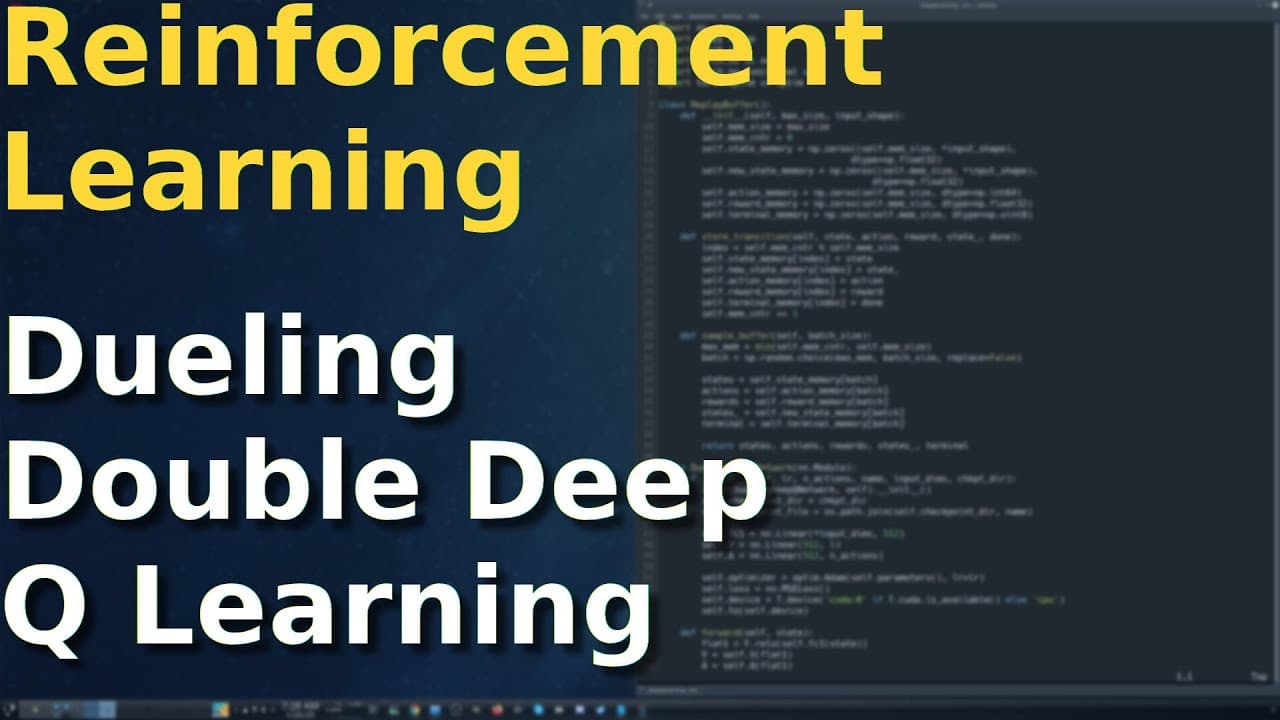
To land a spaceship on the moon using dueling double-deep Q-learning, build a replay buffer to store memories and create a dueling DQ network for estimating state values and action advantages. Your agent will utilize these components to select actions, learn from experiences, and optimize performance through hyperparameter tuning.
Transcript
in this tutorial you will learn how to land a spaceship on the moon using dueling double-deep q-learning you don't need any prior exposure to reinforcement learning you don't need any prior exposure to deep you learning or double deep cue learning you just need to follow along let's get started before we get allow me to address my relatively long h... Read More
Key Insights
- 🌓 The tutorial focuses on using dueling double-deep Q-learning to land spaceships on the moon.
- 🏛️ The replay buffer class is crucial for storing and sampling memories during learning.
- 🪈 The dueling DQ network separates the estimation of state value and action advantage in order to generate accurate Q values.
- 🍵 The agent class handles action selection, memory storage, model testing, and learning from experiences.
- 👻 The main loop executes multiple games, allowing the agent to interact with the environment, learn from experiences, and improve its performance over time.
- ☠️ Hyperparameters such as gamma, epsilon, learning rate, and replace interval can be adjusted to optimize the agent's learning process.
- ☠️ The training may require tuning, such as adjusting the learning rate or the replace interval, to stabilize training and improve performance.
Install to Summarize YouTube Videos and Get Transcripts
Explore YouTube Video Summarizer or Get YouTube Transcript Extractor
Questions & Answers
Q: What is the purpose of the replay buffer class?
The replay buffer class stores memories of states, actions, rewards, new states, and terminal flags to facilitate learning from past experiences. It also allows for the uniform sampling of memories during learning.
Q: How are actions selected in the Epsilon-Greedy strategy?
Actions are selected randomly with a probability of epsilon, or greedily (choosing the best action given the current state) with a probability of 1-epsilon. Epsilon decreases over time to gradually shift towards more greedy actions.
Q: What is the purpose of the dueling DQ network's value and advantage streams?
The value stream estimates the value of the current state, while the advantage stream measures the relative advantage of each action in the given state. Combining these two streams produces the Q function, which guides action selection.
Q: How does discounting of future rewards influence learning?
The gamma parameter determines the extent to which the agent discounts future rewards. A value closer to 1 makes the agent more farsighted and values future rewards higher, while a value closer to 0 makes the agent more myopic and focuses on immediate rewards.
Summary & Key Takeaways
-
This tutorial teaches how to land a spaceship on the moon using dueling double-deep Q-learning, without needing prior knowledge in reinforcement or deep learning.
-
The tutorial covers the construction of a replay buffer class to store memories and facilitate sampling, as well as the creation of a dueling DQ network to handle observations and actions.
-
The agent class handles memory storage, action selection, learning, and model testing. The main loop executes multiple games, choosing actions, storing transitions, learning from memories, and tracking scores.
Read in Other Languages (beta)
Share This Summary 📚
Summarize YouTube Videos and Get Video Transcripts with 1-Click
Try YouTube Summary with ChatGPT & Claude or YouTube Transcript Generator
Explore More Summaries from Machine Learning with Phil 📚


Summarize YouTube Videos and Get Video Transcripts with 1-Click
Try YouTube Summary with ChatGPT & Claude or YouTube Transcript Generator