Why Is Bondi Compared to Nixon's Attorney General?
TL;DR
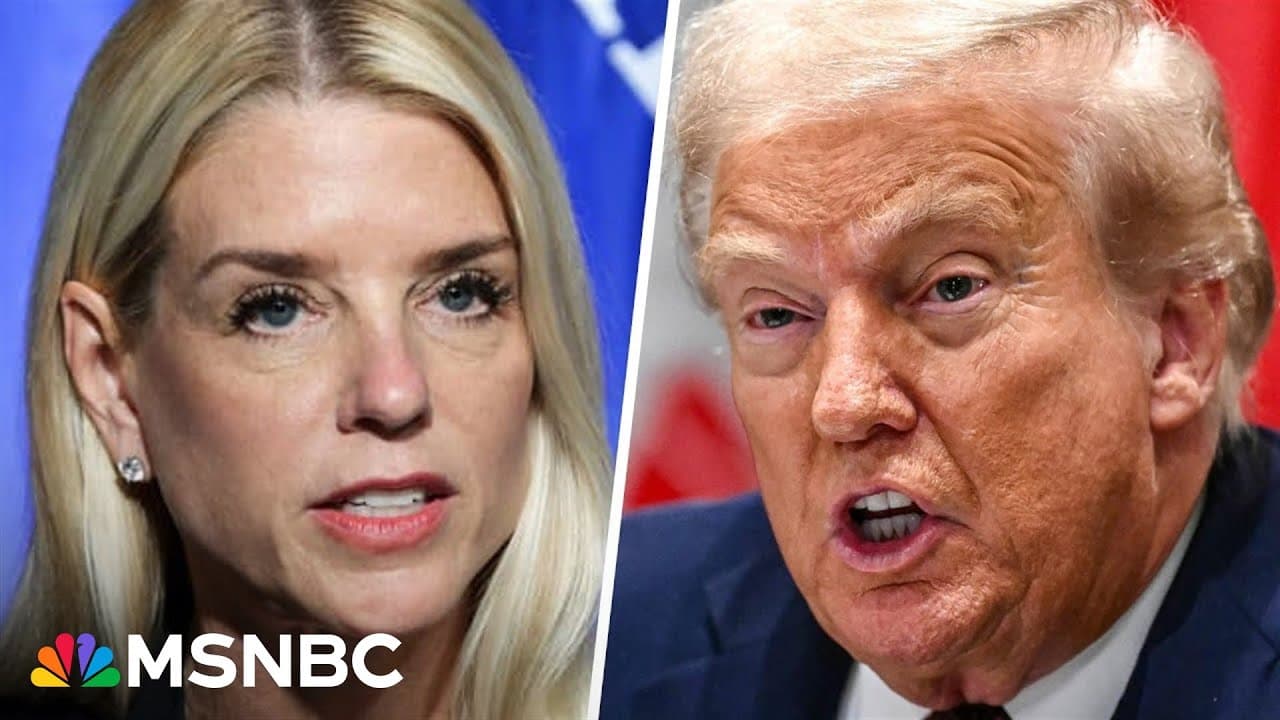
Pam Bondi is criticized for allegedly allowing the White House to influence who the Justice Department prosecutes and protects. The panel argues that the Letitia James bank-fraud case appears unusually small, difficult to prove, and politically charged, while contrasting it with the abandoned investigation into Tom Homan’s alleged acceptance of $50,000 in cash.
Transcript
WITH THE MUSTACHE RIGHT THERE WAS DONALD TRUMP'S FORMER WHITE HOUSE ATTORNEY, TY COBB. JOINING US NOW, MSNBC JUSTICE AND INTELLIGENCE CORRESPONDENT KEN DILANIAN, FORMER ASSISTANT ATTORNEY GENERAL WHO LED THE JUSTICE DEPARTMENT'S CRIMINAL DIVISION. LESLIE CALDWELL, FORMER ADVISER TO GEORGE W BUSH AND JOHN MCCAIN AND CREATOR OF THE CIRCUS. MARK MCKIN... Read More
Key Insights
- Pam Bondi is accused by the panel of breaking with the Justice Department tradition of keeping prosecutorial decisions separate from White House political interests. Tom Dupree characterizes her reliance on presidential directives and rejection of career prosecutors’ judgment as highly unusual, if not unique, in national history.
- The panel’s comparison with Watergate rests on institutional distance, not merely the seriousness of individual allegations. Ken Dilanian says Nixon-era prosecutors indicted administration figures while Nixon remained president, whereas he believes the current White House directly influences who is prosecuted and who is protected.
- The Letitia James case alleges bank fraud and false statements connected to a loan. Leslie Caldwell says the alleged benefit was slightly more than $18,000 across the loan’s entire life, nobody apparently lost money, and such a small matter would not normally justify committing limited prosecutorial resources.
- Prosecutorial charging decisions require both sufficient evidence and sound discretion. Caldwell explains that prosecutors must assess whether they can prove guilt beyond a reasonable doubt and whether bringing the case is worthwhile, even when conduct might technically support an allegation.
- Criminal intent is an essential challenge in the case against Letitia James. Prosecutors would need to prove that she knowingly made a false statement to obtain a lower mortgage rate, while documents and communications reportedly showing that she disclosed the property’s intended use could undermine that theory.
- Political context complicates the legitimacy of the Letitia James indictment. The panel acknowledges criticism that James campaigned on pursuing Trump and brought a real-estate fraud case against him, but argues that perceived political motivation in an earlier case does not justify repeating the same conduct against her.
- The Tom Homan investigation raises unanswered questions about selective enforcement. Dilanian says investigators examined an alleged acceptance of $50,000 in cash, but the case was closed without charges, and Bondi refused to explain what happened to the taxpayer money or release records that might clarify the decision.
- Selective prosecution can operate by both action and inaction. Dupree says the principal concern is that the Justice Department may punish political enemies while rewarding friends, bringing charges against figures such as James while declining potentially warranted cases involving people associated with the administration.
Install to Summarize YouTube Videos and Get Transcripts
Explore YouTube Video Summarizer or Get YouTube Transcript Extractor
Questions & Answers
Q: Why is Pam Bondi being compared with Nixon’s attorney general?
Pam Bondi is compared unfavorably with Nixon-era Justice Department leadership because the panel believes she has allowed presidential political interests to shape prosecutorial decisions. Ken Dilanian notes that administration figures were indicted while Richard Nixon remained president. By contrast, he argues that the current White House is deciding who is prosecuted and who is not, with Bondi publicly defending the president.
Q: Why does the panel consider the current Justice Department situation worse than Watergate?
The panel considers the situation potentially worse because Dilanian says there was still some institutional distance between Nixon, the FBI, and the Justice Department during Watergate. He argues that no comparable distance exists now and that the White House is calling the shots. The concern is that decisions about prosecution and non-prosecution reflect presidential loyalty rather than independent legal judgment.
Q: What charges were brought against Letitia James?
Letitia James was charged with bank fraud and making false statements in connection with loan documents. The discussion says the alleged conduct enabled her to avoid paying slightly more than $18,000 over the entire life of the loan. Caldwell emphasizes that the prosecution must still prove that James knowingly made a false statement with the intent to receive a financial benefit.
Q: Why does Leslie Caldwell believe the Letitia James case should not have been brought?
Leslie Caldwell says she would not have brought the case because the alleged fraud is extremely small and apparently caused no meaningful financial loss. Prosecutors have limited time and resources, so focusing on a case involving slightly more than $18,000 can prevent work on cases involving far larger alleged frauds. She also identifies evidence and intent issues that could make conviction difficult.
Q: What evidence could create problems for the case against Letitia James?
The panel says James’s paperwork, emails, and other documents may show that she clearly identified the property as something other than her primary residence. It also says she informed the mortgage originator that her niece would live there and did not claim she was renting it to a stranger. Caldwell considers those disclosures a major potential problem for proving a knowing false statement.
Q: What must prosecutors prove to establish criminal intent against Letitia James?
Prosecutors must prove that James knew her statement was false, made it to obtain a benefit such as a lower mortgage rate, and intended to accomplish that result. Caldwell says cases involving this type of intent are always difficult. The reported documents concerning the residence and its intended occupant, combined with the prosecution’s political context, could make that burden especially challenging.
Q: What happened to the investigation involving Tom Homan and $50,000?
Dilanian says an FBI investigation examined evidence that Tom Homan allegedly accepted $50,000 in cash, but the investigation was later closed without charges. He says the matter apparently never went before a grand jury. Questions remain about whether Homan retained the cash, whether it was returned, and whether it was treated as income, because Bondi declined to provide answers or records.
Q: How does the panel define weaponization of the Justice Department?
The panel describes weaponization as using prosecutorial power to punish political enemies while protecting or rewarding political allies. Dupree says the concern arises when officials decide that evidence warrants charges against Letitia James but decline charges in other potentially prosecutable matters. Under this view, both bringing a politically advantageous case and abandoning an inconvenient investigation can demonstrate selective enforcement.
Summary & Key Takeaways
-
The panel argues that Pam Bondi has departed from Justice Department traditions separating prosecutorial decisions from White House political interests. Ken Dilanian and Tom Dupree contend that the current department appears willing to pursue presidential opponents while declining to investigate or charge officials aligned with the administration, creating concerns about selective enforcement.
-
Leslie Caldwell says the Letitia James indictment involves an allegedly insignificant bank fraud that reportedly saved her slightly more than $18,000 over the loan’s life. She argues that prosecutors with limited resources ordinarily prioritize much larger cases and that documents indicating James disclosed the property’s intended use could create substantial evidentiary problems.
-
The discussion contrasts the James prosecution with the closed investigation into Tom Homan’s alleged acceptance of $50,000 in cash. Dilanian says Bondi declined to answer Senate questions or release relevant records, leaving unresolved what happened to the taxpayer money. The panel frames both matters as tests of consistent and politically independent enforcement.
Read in Other Languages (beta)
Share This Summary 📚
Summarize YouTube Videos and Get Video Transcripts with 1-Click
Try YouTube Summary with ChatGPT & Claude or YouTube Transcript Generator
Explore More Summaries from MS NOW 📚

Summarize YouTube Videos and Get Video Transcripts with 1-Click
Try YouTube Summary with ChatGPT & Claude or YouTube Transcript Generator