How to Create a Custom K-Means Clustering Algorithm in Python
TL;DR
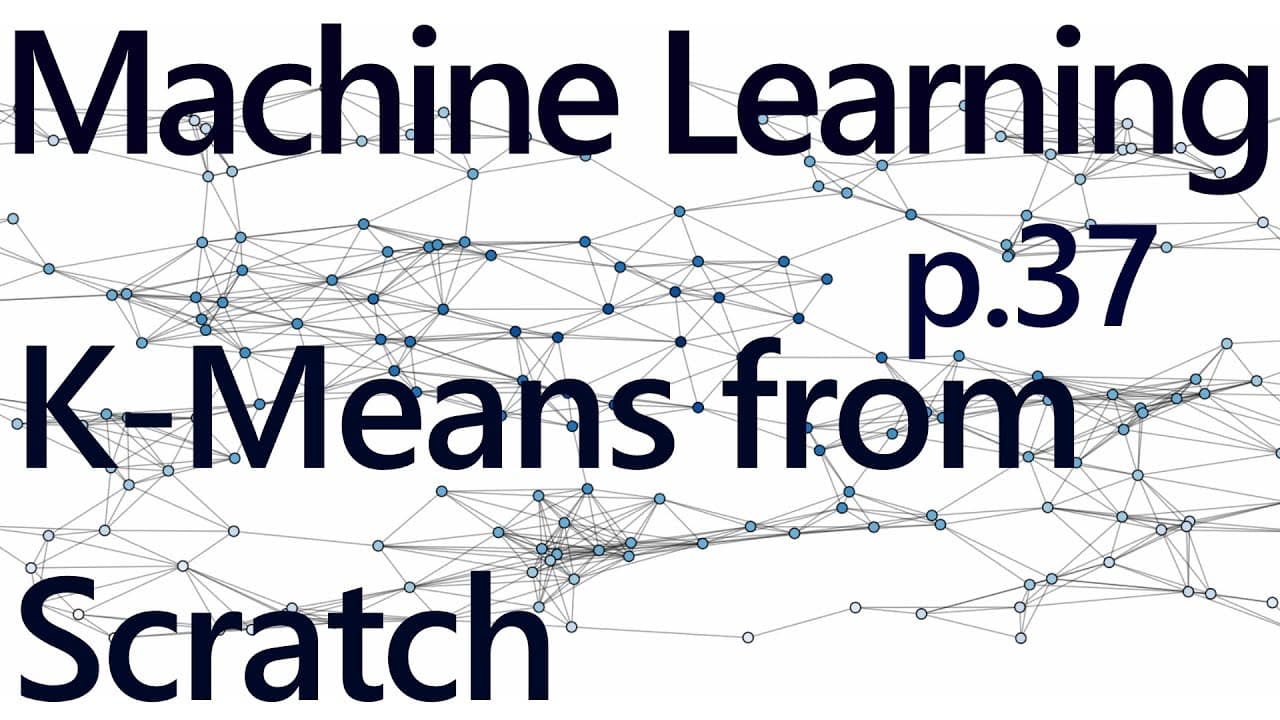
To create a custom K-means clustering algorithm in Python, start by defining the number of clusters (K) and initializing centroids. Iterate through the dataset by classifying data points based on the nearest centroid, updating centroids with the mean of their assigned points, and repeat until convergence, controlled by tolerance and maximum iterations.
Transcript
what's going on everybody and welcome to part 37 of our machine learning tutorial series leading up to this we've been talking about a whole bunch of machine learning classifiers but specifically clustering even more specifically flat clustering even more specifically k-means clustering so with flat clustering k-means the idea is that you the scien... Read More
Key Insights
- 😉 K-means clustering is a popular algorithm for data grouping based on their similarities.
- 👌 The K-means algorithm starts by randomly selecting K centroids.
- 😥 Iteratively, data points are assigned to the nearest centroid, and the centroids are updated based on the mean of their respective class.
- 🎮 Tolerance and maximum iterations play a role in controlling the convergence of the algorithm.
- 😥 The algorithm aims to minimize the sum of squared distances between data points and their respective centroids.
- 🎃 Custom implementations of K-means clustering allow for a deeper understanding of the algorithm and customization based on specific requirements.
- 😉 K-means clustering can be used in various domains, such as customer segmentation, image compression, and anomaly detection.
Install to Summarize YouTube Videos and Get Transcripts
Explore YouTube Video Summarizer or Get YouTube Transcript Extractor
Questions & Answers
Q: What is K-means clustering?
K-means clustering is an unsupervised machine learning algorithm that separates a given data set into K distinct groups based on their similarities.
Q: How do you select the initial centroids in K-means clustering?
The initial centroids are selected randomly or by using other strategies, such as the k-means++ initialization method, which aims to choose centroids that are far apart.
Q: How does the K-means algorithm classify data points?
The algorithm calculates the distances between each data point and the centroids, assigning each point to the nearest centroid based on the minimum distance.
Q: What is the significance of tolerance and maximum iterations in K-means clustering?
Tolerance determines the threshold for centroid movement. If the centroids' movement is below the tolerance value, the algorithm stops iterating. Maximum iterations limit the number of times the algorithm reassigns and updates centroids.
Summary & Key Takeaways
-
The tutorial introduces K-means clustering, which involves separating a data set into K number of groups.
-
The content creator explains the steps of the K-means algorithm, including selecting initial centroids, classifying data points, and updating centroids iteratively.
-
The tutorial provides code examples and discusses the importance of tolerance and maximum iterations in the algorithm.
Read in Other Languages (beta)
Share This Summary 📚
Summarize YouTube Videos and Get Video Transcripts with 1-Click
Try YouTube Summary with ChatGPT & Claude or YouTube Transcript Generator
Explore More Summaries from sentdex 📚
Summarize YouTube Videos and Get Video Transcripts with 1-Click
Try YouTube Summary with ChatGPT & Claude or YouTube Transcript Generator