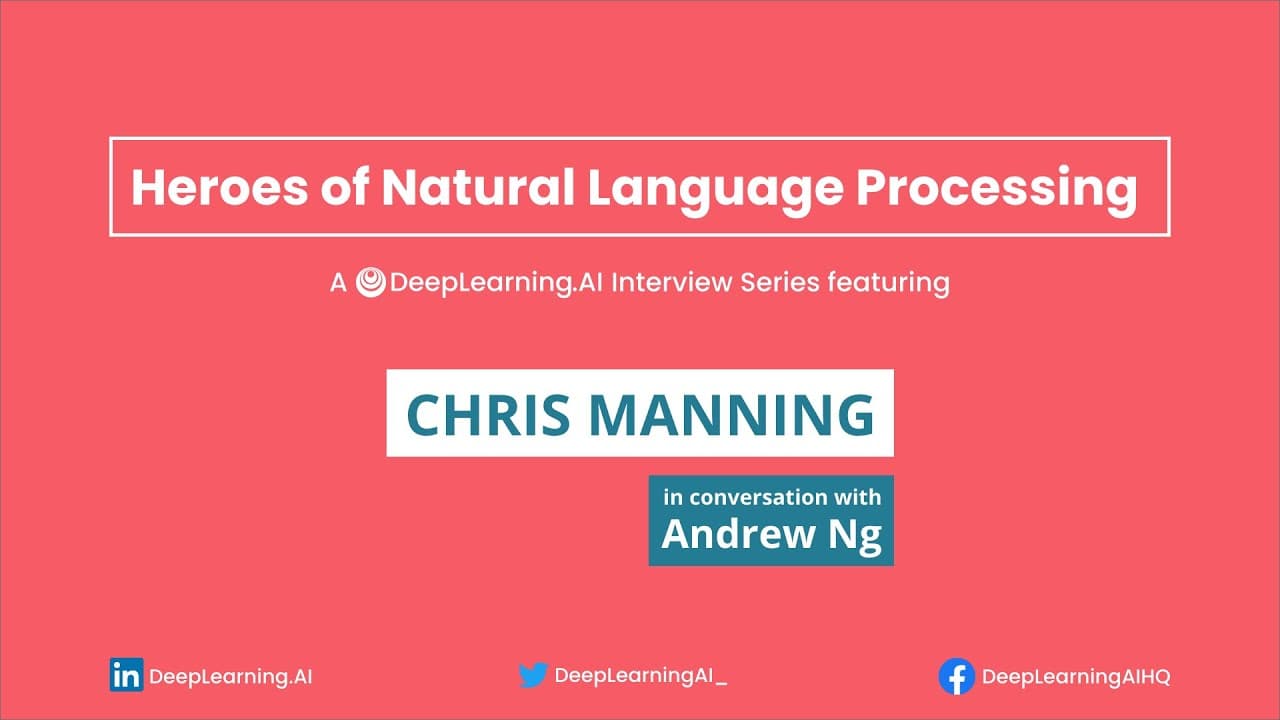
Chris Manning's Journey: How Did He Become an NLP Pioneer?
TL;DR
Chris Manning, a leading NLP researcher, transitioned from linguistics to artificial intelligence by exploring how machine learning can mimic human language learning. His significant contributions, including tree recursive neural networks and the GloVe algorithm, illustrate the transformative impact of deep learning and attention mechanisms in natural language processing. Despite advances like GPT-3, he believes genuine AGI remains a distant goal.
Transcript
- Welcome to this interview series, to kick it off, I'm delighted to have with us today Chris Manning. Chris is I believe the most highly cited NLP researcher in the world. He is a Professor of Computer Science and Linguistics at Stanford University. He's also the Director of the Stanford AI lab, which is where I had previously held as well. Chris ... Read More
Key Insights
- 🥺 Chris Manning's background in linguistics shaped his interest in language learning and led him to explore AI and machine learning.
- 😮 The dominant approach in NLP and AI before the rise of machine learning was knowledge-based systems, where subject matter experts encoded their knowledge.
- 👨🔬 Transformer architectures have revolutionized NLP research by utilizing attention to capture the structure of language.
- 🛀 The development of large-scale models, such as GPT-3, has shown impressive generality but does not represent a path towards AGI.
Install to Summarize YouTube Videos and Get Transcripts
Explore YouTube Video Summarizer or Get YouTube Transcript Extractor
Questions & Answers
Q: How did Chris Manning transition from linguistics to AI?
Chris Manning's interest in language learning led him to explore machine learning as a means to understand human language. He started delving into neural networks in the late 1980s and continued his research journey from there.
Q: What was the dominant approach in NLP and AI before machine learning became popular?
Before the rise of machine learning, the dominant approach in NLP and AI was knowledge-based systems. These systems relied on subject matter experts to encode their knowledge into knowledge representation systems, which limited their flexibility.
Q: How did the development of transformer architectures impact NLP research?
Transformer architectures, which are built around the concept of attention, have revolutionized NLP research. Attention allows for the creation of a soft tree structure, which enables the models to learn various aspects of language structure. This has led to significant advancements in language understanding.
Q: How does the scaling of NLP models affect the field?
The scaling of NLP models, such as GPT-3, has resulted in impressive performance in various tasks. However, the increasing size and computational demands of these models are not a sustainable path towards artificial general intelligence (AGI). Furthermore, the future of NLP research lies in considering other factors, such as meta-learning, to achieve more intelligent systems.
Summary & Key Takeaways
-
Chris Manning initially had a background in linguistics and became fascinated with how humans learn language.
-
He explored machine learning as a way to understand language learning and started working with neural networks in the late 1980s.
-
Chris Manning's research contributions include tree recursive neural networks, sentiment analysis, neural network dependency parsing, and the GloVe algorithm.
Read in Other Languages (beta)
Share This Summary 📚
Summarize YouTube Videos and Get Video Transcripts with 1-Click
Try YouTube Summary with ChatGPT & Claude or YouTube Transcript Generator
Explore More Summaries from DeepLearningAI 📚



Summarize YouTube Videos and Get Video Transcripts with 1-Click
Try YouTube Summary with ChatGPT & Claude or YouTube Transcript Generator