How to Spend Your Finite Time Without Regret
TL;DR
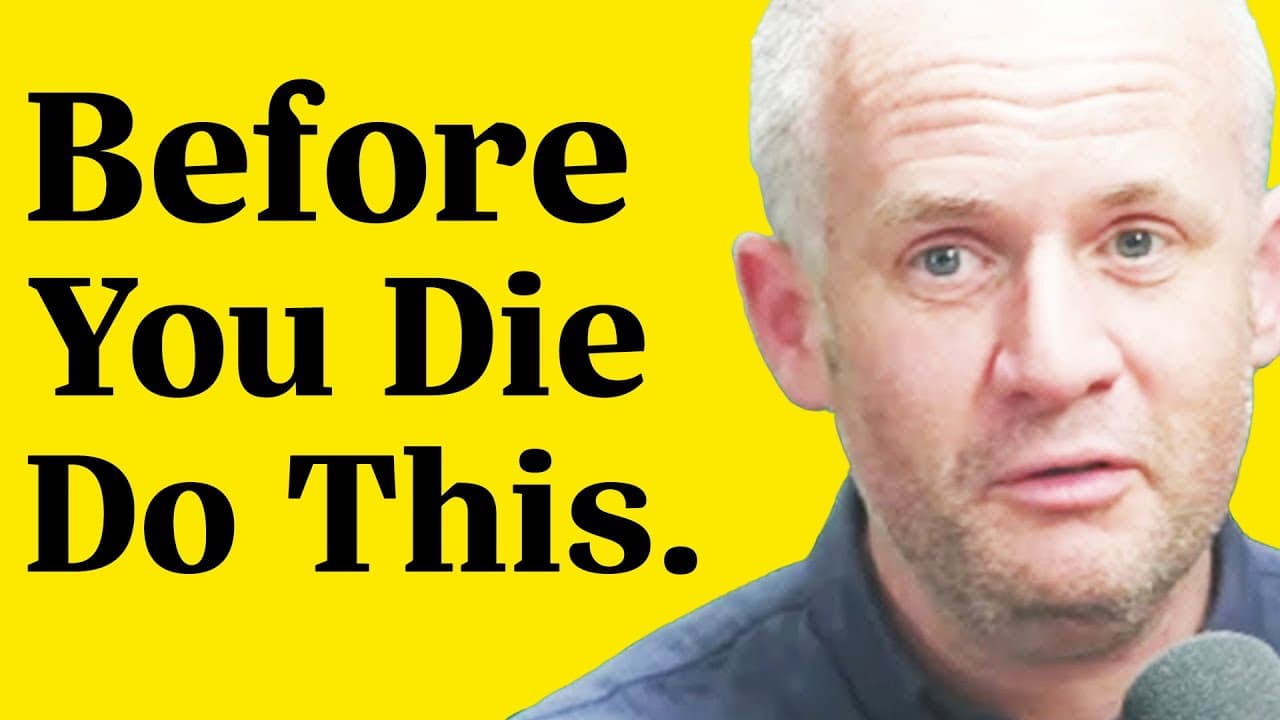
Accept that your time is finite, then choose a few meaningful commitments instead of trying to fit every worthwhile possibility into one life. Real freedom comes from saying no even to attractive opportunities, making time for what matters now, and directing attention toward relationships, work, and local actions where you can have a meaningful effect.
Transcript
if you don't commit to relationships or projects or to a career or to a place where you live it feels like you're holding all the potential inside yourself there's a terrible danger in telling yourself real life hasn't begun yet yeah the point is you already are making a choice that time is still gone and you've decided to use those years that we w... Read More
Key Insights
- Human time is finite rather than limitless, although nobody knows how many weeks they will receive. The figure of 4,000 weeks is illustrative, but it highlights the unavoidable fact that every chosen activity uses time that cannot later be recovered.
- Accepting finitude is liberating because it ends the impossible demand to complete every ambition and obligation. There will always be too much to do, so a meaningful life depends on choosing something worthwhile and possible instead of maximizing every available moment.
- Saying no is necessary even when an opportunity is genuinely valuable. Removing only tedious or unwanted activities cannot make every meaningful possibility fit, because worthwhile projects, destinations, causes, relationships, and responsibilities will still exceed the time available.
- Avoiding commitment is itself a choice about how to spend time. Keeping every career, relationship, project, or place theoretically possible may feel protective, but the years used while waiting are still gone and cannot be held in reserve for a later real life.
- The only worthwhile time-management principle presented is to make time now. Telling yourself that real life has not begun postpones engagement with the life already happening and risks sacrificing irreplaceable years while waiting for ideal circumstances or complete certainty.
- Social media intensifies dissatisfaction by exposing people continuously to attractive alternatives. Algorithms can present the destinations, experiences, and causes most likely to capture attention, making a good choice feel inadequate simply because another appealing possibility remains available elsewhere.
- Global awareness can focus attention on problems where an individual has limited direct influence. Ethical living and giving money may help, but caring for a relative or improving a neighborhood can also represent meaningful uses of time with tangible local effects.
- Finite people face effectively unlimited inputs, including emails, work requests, ambitions, opportunities, and accounts of suffering. Because personal capacity has a clear upper limit, peace depends on acknowledging the mismatch rather than trying to overcome it through greater efficiency alone.
Install to Summarize YouTube Videos and Get Transcripts
Explore YouTube Video Summarizer or Get YouTube Transcript Extractor
Questions & Answers
Q: How can accepting limited time reduce regret?
Accepting limited time reduces regret by making choice unavoidable and meaningful. Instead of assuming every worthwhile ambition can eventually be completed, a person can select a few relationships, projects, responsibilities, or places and give them attention now. Some valuable alternatives must remain unexplored, but acknowledging that fact prevents endless postponement and the mistaken belief that real life will begin later.
Q: Why must people say no to worthwhile opportunities?
People must say no to worthwhile opportunities because the number of meaningful possibilities exceeds the time available. Eliminating chores and unwanted commitments does not create enough room for every appealing journey, cause, relationship, or project. A workable life therefore requires choosing some things that matter and relinquishing others that also matter, without treating every unchosen option as evidence of failure.
Q: Why is avoiding commitment still a choice?
Avoiding commitment still consumes time, even when it feels like preserving freedom. A person who delays choosing a career, relationship, project, or place to live is using irreplaceable years in that state of hesitation. Potential is not stored untouched while decisions are postponed. The elapsed time reflects one way of living rather than an escape from choosing altogether.
Q: How does social media make ordinary life feel inadequate?
Social media displays a continual stream of destinations, experiences, causes, and problems that a person could pursue. Algorithms can emphasize the possibilities most likely to attract that individual, so even a satisfying holiday or meaningful activity may be compared with another appealing option. This exposure makes unavoidable limits more painful and can cause a good life to seem unnecessarily mundane.
Q: What is the most useful time-management principle?
The central time-management principle is to make time now for what matters. Waiting for an ideal future can support the dangerous belief that real life has not started, even though present years are already being spent. Because time cannot be recovered, meaningful relationships, projects, and responsibilities need current commitment rather than indefinite placement on a future list.
Q: How should people respond to overwhelming global problems?
People can acknowledge the importance of global problems while recognizing the limits of individual influence. Giving money and living more ethically are possible responses, but meaningful action also includes caring for an elderly relative, helping a neighborhood, doing good work, and being present with family. Local contributions should not be devalued simply because they operate on a smaller scale.
Q: Why does trying to maximize every day create stress?
Trying to maximize every day preserves the belief that enough effort could extract everything desirable from a finite life. That goal is impossible because ambitions, obligations, work, and opportunities have no matching upper limit, while personal capacity does. Relief begins when the aim changes from fitting everything in to choosing something meaningful, possible, and worthy of present attention.
Q: How can people manage unlimited work and obligations?
People can manage unlimited work and obligations by first accepting that the total volume may never be completed. Emails, requests from a boss, personal ambitions, and family or social expectations can keep expanding, while available time remains clearly limited. The practical task is therefore to select important commitments and tolerate unfinished possibilities, rather than expecting efficiency to eliminate the mismatch.
Summary & Key Takeaways
-
Human life is finite, and the figure of 4,000 weeks is intended as an illustration rather than a guaranteed lifespan. Fully accepting this limit can replace the exhausting effort to maximize every day with a calmer goal: choose something meaningful and possible, knowing that no one can fulfill every ambition or obligation.
-
Meaningful living requires rejecting some genuinely desirable possibilities, not merely removing tedious tasks. The world contains more worthwhile projects, destinations, causes, relationships, and ambitions than anyone can pursue. Commitment therefore means choosing certain paths, accepting their alternatives will remain unexplored, and recognizing that postponing commitment is itself a use of irreplaceable time.
-
The internet and social media continually expose people to attractive possibilities, suffering, and global problems, intensifying the sense that ordinary life is inadequate. A healthier response is to acknowledge limited influence and value tangible contributions, such as caring for relatives, improving a neighborhood, working well, and remaining present in close relationships.
Read in Other Languages (beta)
Share This Summary 📚
Summarize YouTube Videos and Get Video Transcripts with 1-Click
Try YouTube Summary with ChatGPT & Claude or YouTube Transcript Generator
Explore More Summaries from Dr Rangan Chatterjee 📚


Summarize YouTube Videos and Get Video Transcripts with 1-Click
Try YouTube Summary with ChatGPT & Claude or YouTube Transcript Generator